This page explains the concepts of the reciprocal lattice and reciprocal lattice vectors.
Lattice Parameters and Crystal Geometry
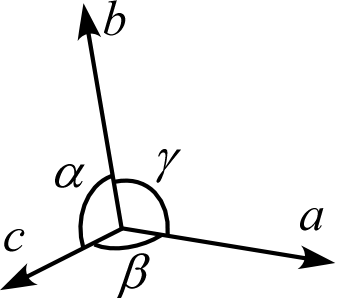
A brief review. As already described on the “1.3. Lattice Parameters, Crystal Systems, and Bravais Lattices” page, the crystal lattice of a three-dimensional crystal is described by the lengths \(a,b,c\) of lattice vectors \(\textbf{a}, \textbf{b}, \textbf{c}\) in three directions, and the angles \(\alpha,\beta,\gamma\) between them. These six parameters \(a,b,c,\alpha,\beta,\gamma\) are called the (real) lattice parameters1. Using the lattice parameters, one can calculate various geometric quantities such as the following.
| Unit cell volume \(V\) | $$V^2= a^2 b^2 c^2 (1-\cos^2{\alpha}-\cos^2\beta – \cos^2\gamma + 2 \cos\alpha \cos\beta \cos\gamma)$$ |
| Interplanar spacing \(d\) of \((hkl)\) | $$\frac{V^2}{d^2} =h^2 \sigma_{11} + k^2 \sigma_{22} + l^2 \sigma_{33} + 2 k l \sigma_{23} + 2 l h \sigma_{31} + 2 h k \sigma_{12} $$where \( \sigma_{11}= b^2 c^2 \sin^2\alpha, \quad \sigma_{22}= c^2 a^2 \sin^2\beta, \) \(\sigma_{33}= a^2 b^2 \sin^2\gamma, \quad \sigma_{23}= a^2 b c (\cos\beta \cos\gamma -\cos\alpha ),\) \( \sigma_{31}= a b^2 c (\cos\gamma \cos\alpha -\cos\beta ), \quad \sigma_{12}= a b c^2 (\cos\alpha \cos\beta -\cos\gamma) \) |
| Angle \(\theta\) between \((h_1k_1l_1)\) and \((h_2k_2l_2)\) | $$\begin{array}{l} \Large{\frac{V^2 \cos\theta}{d_1 d_2}} \normalsize{=h_1 h_2 σ_{11}+ k_1 k_2 σ_{22} + l_1 l_2 σ_{33}}\\ \qquad+ (k_1 l_2 + k_2 l_1) σ_{23} + (l_1 h_2 + l_2 h_1 ) σ_{31}+ (h_1 k_2 + h_2 k_1 ) σ_{12} \end{array}$$where \(d_1, d_2\) are the interplanar spacings of \((h_1k_1l_1)\) and \((h_2k_2l_2)\), respectively |
| Length \(r\) of \([uvw]\) | $$r^2 = u^2 a^2 + v^2 b^2 + w^2 c^2 + 2 v w b c \cos\alpha+ 2 w u c a \cos\beta + 2 u v a b \cos\gamma$$ |
| Angle \(\psi\) between \([u_1v_1w_1]\) and \([u_2v_2w_2]\) | $$\begin{array}{l} r_1 r_2 \cos\psi = u_1 u_2 a^2 + v_1 v_2 b^2 + w_1 w_2 c^2 + (v_1 w_2 + v_2 w_1) b c \cos\alpha \\ \qquad + (w_1 u_2 + w_2 u_1) c a \cos\beta +(u_1 v_2 + u_2 v_1) a b \cos\gamma\end{array}$$where \(r_1, r_2\) are the lengths of \([u_1v_1w_1]\) and \([u_2v_2w_2]\), respectively |
| Angle \(\phi\) between the \((hkl)\) plane normal and \([uvw]\) | $$r\cos\phi =d (h u + k v + l w) $$where \(r\) is the length of \([uvw]\) and \(d\) is the interplanar spacing of \((hkl)\) |
Although several complex formulas have been presented, in the modern era — unlike the days when only scientific calculators were available — there is little merit in computing geometric quantities in this way. It is far more useful to employ the concept of the reciprocal lattice described below and perform calculations in an environment2 capable of matrix and vector operations.
What Is the Reciprocal Lattice?
Inverse Matrix and the Definition of the Reciprocal Lattice
The reciprocal lattice vectors \(\mathbf{a^*}, \mathbf{b^*}, \mathbf{c^*}\) are defined with respect to the real lattice vectors \(\textbf{a}, \textbf{b}, \textbf{c}\) as follows (note that \(\mathbf{^*}\) is a superscript, not multiplication):$$
\mathbf{a^*}=\frac{\textbf{b}\times\textbf{c}}{V},\ \ \mathbf{b^*}=\frac{\textbf{c}\times\textbf{a}}{V},\ \ \mathbf{c^*}=\frac{\textbf{a}\times\textbf{b}}{V}
$$where \(V\) is the volume of the (real) unit cell, and \(\times\) denotes the vector cross product.
This relationship can also be defined using matrix notation. First, express the real lattice vectors \(\textbf{a}, \textbf{b}, \textbf{c}\) in Cartesian coordinates as \((a_x, a_y, a_z)、(b_x, b_y, b_z)、(c_x, c_y, c_z) \). Using these as row components, construct the following 3×3 matrix \(R\), and then compute its inverse matrix \(R^{-1}\)3.
$$R =\begin{pmatrix}a_x & a_y & a_z \\b_x & b_y & b_z \\c_x & c_y & c_z\end{pmatrix}
\ \ \Longrightarrow \ \ \
R^{-1} =\begin{pmatrix}a^*_x & b^*_x & c^*_x \\ a^*_y & b^*_y & c^*_y \\ a^*_z & b^*_z & c^*_z \end{pmatrix}
$$The column components of \(R^{-1}\) correspond to the reciprocal lattice vectors.
$$\textbf{a}^*=(a^*_x,a^*_y,a^*_z),\ \ \textbf{b}^*=(b^*_x,b^*_y,b^*_z),\ \ \textbf{c}^*=(c^*_x,c^*_y,c^*_z)
$$ The real lattice vectors and reciprocal lattice vectors satisfy the following relationships (which can also be taken as their definition):
$$ \mathbf{a} \mathbf{a^*} = \mathbf{b} \mathbf{b^*} = \mathbf{c} \mathbf{c^*} = 1,\quad
\mathbf{a} \mathbf{b^*} = \mathbf{a} \mathbf{c^*} = \mathbf{b} \mathbf{c^*} = \mathbf{b} \mathbf{a^*}= \mathbf{c} \mathbf{a^*}= \mathbf{c} \mathbf{b^*} =0$$
Properties of the Reciprocal Lattice Vector
Once the reciprocal unit lattice vectors have been obtained, the interplanar spacing and interplanar angles for any \((hkl)\) plane can be easily computed using vector operations. This is because the following reciprocal lattice vector corresponding to the \((hkl)\) plane:$$
\textbf{g} = h \textbf{a}^* + k \textbf{b}^* + l \textbf{c}^*
$$has a magnitude equal to the reciprocal of the interplanar spacing \(d\), and its direction corresponds to the plane normal. For example, the interplanar spacing \(d\) of the \((hkl)\) plane is:$$
d = 1/|\textbf{g}|,\ \ \ where\ \ \ \textbf{g}= h \textbf{a}^* + k \textbf{b}^* + l \textbf{c}^*
$$and the interplanar angle \(\theta\) between \((h_1k_1l_1)\) and \((h_2k_2l_2)\) is:$$
\cos\theta = \frac{\mathbf{g_1 g_2}}{|\mathbf{g_1}| |\mathbf{g_2}|},\ \ \ where\ \ \ \mathbf{g_1}= h_1 \textbf{a}^* + k_1 \textbf{b}^* + l_1 \textbf{c}^*\ \ \ \&\ \ \ \mathbf{g_2} = h_2 \textbf{a}^* + k_2 \textbf{b}^* + l_2 \textbf{c}^*$$ which can be easily calculated. There is no need to use complex trigonometric functions.
Conversion from Lattice Parameters to Vectors
Above, it was casually stated that “the real lattice vectors are expressed in Cartesian coordinates,” but how exactly should this calculation be performed? Since the three real lattice vectors \(\mathbf{a}, \mathbf{b}, \mathbf{c}\) are not necessarily orthogonal, it is generally impossible to align each of them with the \(X, Y, Z\) axes of a Cartesian coordinate system. Some may prefer to align \(\mathbf{a}\) with the \(X\)-axis, while others may prefer to align \(\mathbf{c}\) with the \(Z\)-axis. Even after choosing one axis direction, degrees of freedom remain. Naturally, there is no single universally accepted answer. Here, we will explain how to express the (real) lattice parameters \(a,b,c,\alpha,\beta,\gamma\) in a Cartesian coordinate system using the following convention4:
- Align \(\mathbf{c}\) with the \(Z\)-axis
- Align \(\mathbf{b}\) within the \(YZ\) plane
Following this convention, \(\mathbf{c}\) can be simply defined as \( \mathbf{c} = (0,0,c)\). Next, for \(\mathbf{b}\), considering that the angle with \(\mathbf{c}\) is \(\alpha\) and that it lies in the \(YZ\) plane (i.e., \(X=0\)), it can also be simply defined as \( \mathbf{b} = (0,b \sin\alpha,b \cos\alpha)\). For \(\mathbf{a}\), it becomes somewhat more complex, but taking into account the relationships with the already determined \(\mathbf{b, c}\):
$$ \mathbf{a} = \left(a \sqrt{1-\cos^2\beta-\left(\frac{\cos\gamma-\cos\alpha \cos\beta}{\sin\alpha}\right)^2},\ \ a \frac{\cos\gamma-\cos\alpha \cos\beta}{\sin\alpha},\ \ a\cos\beta \right)
$$5. By computing \(\mathbf{a}, \mathbf{b}, \mathbf{c}\) in this way, the reciprocal lattice vectors can then be obtained through simple vector and matrix operations, and these can in turn be used to easily calculate interplanar spacings, interplanar angles, and other geometric quantities.
Relationship Between Real and Reciprocal Lattice Parameters
This is supplementary information. When the real-space lattice parameters are given as (not vectors but) \(a, b, c, \alpha, \beta, \gamma\), the reciprocal-space lattice parameters \(a^*, b^*, c^*, \alpha^*, \beta^*, \gamma^*\) can be converted as follows:
$$
a^* = (b c \sin\alpha)/v, \quad
b^* = (c a \sin\beta)/v, \quad
c^* = (a b \sin\gamma)/v \\
\begin{array}{rcl}
\cos\alpha^* & = &(\cos\beta \cos\gamma -\cos\alpha)/(\sin\beta \sin\gamma)\\
\cos\beta^* &=& (\cos\gamma \cos\alpha -\cos\beta)/(\sin\gamma \sin\alpha)\\
\cos\gamma^* &=& (\cos\alpha \cos\beta -\cos\gamma)/(\sin\alpha \sin\beta)
\end{array}$$
The volume of the reciprocal-space lattice \( v^*\) can be calculated as:
$${v^*}^2={a^*}^2 {b^*}^2 {c^*}^2 (1-\cos^2\alpha^*-\cos^2\beta^*-\cos^2\gamma^* +2 \cos\alpha^* \cos\beta^* \cos\gamma^*)
$$The relationship \(v^*=1/v\) holds between \(v^*\) and the real-space lattice volume \( v\). There are many other related formulas6, but with the advancement of computers, using the reciprocal lattice vector concept described above provides a simpler solution in most cases.
Footnotes
- On this page, the concept of “reciprocal lattice parameters” also appears, so “real lattice parameters” is used deliberately for clarity. In ordinary contexts, simply saying “lattice parameters” is fine. ↩︎
- Matrix and vector operations can be done in Excel, and are also highly compatible with symbolic computation software like Mathematica and programming languages like Python, making them widely applicable. ↩︎
- Incidentally, the inverse of a 3×3 matrix can be computed using the formula
$$R^{-1} =
(-a_z b_y c_x + a_y b_z c_x + a_z b_x c_y – a_x b_z c_y – a_y b_x c_z + a_x b_y c_z)^{-1}
\\begin{pmatrix}
-b_z c_y + b_y c_z & +a_z c_y – a_y c_z & -a_z b_y + a_y b_z \\\\
+b_z c_x – b_x c_z & -a_z c_x + a_x c_z & +a_z b_x – a_x bz \\\\
-b_y c_x + b_x c_y & +a_y c_x – a_x c_y & -a_y b_x + a_x b_y
\\end{pmatrix}
$$ ↩︎ - This convention is widely used in the crystallography community and can be considered a de facto standard. ↩︎
- Be careful about the distinction between right-handed and left-handed coordinate systems. Here, the calculation is performed so that the result is right-handed. Reversing \(\mathbf{a}\) converts it to a left-handed system. ↩︎
- By combining the reciprocal lattice parameters, we define \(A,B,C,U,V,W\) as follows:
\( A={a^*}^2,\ \ B={b^*}^2,\ \ C={c^*}^2,\ \ U=2b^*c^*\\cos\\alpha^*,\ \ V=2c^*a^*\\cos\\beta^*,\ \ W=2a^*b^*\\cos\\gamma^*\)
The volume of the reciprocal unit cell \({v^*}\) can be expressed as:
\({v^*}^2= (4ABC-AU^2-BV^2-CW^2+UVW)/4\)
The interplanar spacing \( d\) of a crystal plane \((h k l)\) can be expressed as:
\(\\frac{1}{d^2} = h^2 A + k^2 B + l^2 C + kl U + lh V + hk W \)
The following are supplementary relations that are rarely used in practice.
\(a^* = \\sqrt{A}, \ b^* = \\sqrt{B}, \ c^* = \\sqrt{C}\)
\( \\alpha^* =\\arccos \\frac{U}{2 \\sqrt{BC}}, \ \\beta^* = \\arccos \\frac{V}{2 \\sqrt{CA}}, \ \\gamma^* =\\arccos \\frac{W}{2 \\sqrt{AB}} \)
\( a = \\frac{b^* c^* \\sin{\\alpha^*}}{v^*} = \\left(\\frac{4BC-U^2 }{4ABC-AU^2-BV^2-CW^2+UVW}\\right)^{1/2} = \\left(A-\\frac{BV^2+CW^2-UVW}{4BC- U^2}\\right)^{-1/2} \)
\( b = \\frac{c^* a^* \\sin{\\beta^*}}{v^*} = \\left(\\frac{4CA-V^2 }{4ABC-AU^2-BV^2-CW^2+UVW}\\right)^{1/2} = \\left(B-\\frac{CW^2+AU^2-UVW}{4CA- V^2}\\right)^{-1/2} \)
\( c = \\frac{a^* b^* \\sin{\\gamma^*}}{v^*} = \\left(\\frac{4AB-W^2 }{4ABC-AU^2-BV^2-CW^2+UVW}\\right)^{1/2} = \\left(C-\\frac{AU^2+BV^2-UVW}{4AB- W^2}\\right)^{-1/2} \)
\(\\sin\\alpha = {\\frac{a^*}{bc v^*}} = \\left( \\frac{4A(4ABC-AU^2-BV^2-CW^2+UVW)}{(4CA-V^2)(4AB-W^2)}\\right)^{1/2} =\\left( 1- \\frac{(VW-2AU)^2}{(4CA-V^2)(4AB-W^2)} \\right)^{1/2} \)
\(\\sin\\beta = {\\frac{b^*}{ca v^*}} = \\left( \\frac{4B(4ABC-AU^2-BV^2-CW^2+UVW)}{(4AB-W^2)(4BC-U^2)}\\right)^{1/2} =\\left( 1- \\frac{(WU-2BV)^2}{(4AB-W^2)(4BC-U^2)} \\right)^{1/2} \)
\(\\sin\\gamma = {\\frac{c^*}{ab v^*}} = \\left( \\frac{4C(4ABC-AU^2-BV^2-CW^2+UVW)}{(4BC-U^2)(4CA-V^2)}\\right)^{1/2} =\\left( 1- \\frac{(UV-2CW)^2}{(4BC-U^2)(4CA-V^2)} \\right)^{1/2} \)
\(\\cos\\alpha = \\frac{\\cos\\beta^* \\cos\\gamma^* -\\cos\\alpha^* }{\\sin\\beta^* \\sin\\gamma^* } = \\frac{VW-2AU}{\\sqrt{(4CA-V^2)(4AB-W^2)} } \)
\(\\cos\\beta = \\frac{\\cos\\gamma^* \\cos\\alpha^* -\\cos\\beta^* }{\\sin\\gamma^* \\sin\\alpha^* } = \\frac{WU-2BV}{\\sqrt{(4AB-W^2)(4BC-U^2)} } \)
\(\\cos\\gamma = \\frac{\\cos\\alpha^* \\cos\\beta^* -\\cos\\gamma^* }{\\sin\\alpha^* \\sin\\beta^* } = \\frac{UV-2CW}{\\sqrt{(4BC-U^2)(4CA-V^2)} }\) ↩︎