Policy for Origin Choice
When constructing crystal structures using space groups, there is a concept called origin choice. This is a concept that requires attention in certain space groups where there are two ways to choose the origin coordinates.
A crystal lattice is defined by three independent lattice translation vectors, and the parallelepiped formed by these vectors is the unit cell. No matter where we choose the origin (starting point) of the lattice translation vectors, the properties of the crystal do not change at all. However, if different individuals choose the origin differently, unnecessary confusion may arise. For the case where the only symmetry operation is lattice translation (= space group \(P1\)), there is no choice but to pick arbitrarily. However, the remaining 229 space groups also possess other symmetry operations (rotation, rotoinversion, screw, glide), which exist discretely in space. The great crystallographers of the past realized that linking the spatial arrangement of such (non-translational) symmetry operations to the origin position of the translation vectors would likely reduce confusion. The currently widespread international standard (= established by IUCr [International Union of Crystallography]) for choosing the origin of crystal lattice vectors can be summarized by the following three policies.
- Policy 1: For space groups possessing \(\bar{1}\) (center of symmetry), choose the position of \(\bar{1}\) as the origin.
- Policy 2: Choose the position with the highest site symmetry of the space group as the origin. However, if there is no site symmetry higher than \(1\), choose a point on a screw axis, a glide plane, or on their line or point of intersection as the origin.
- Policy 3 (special case): Space group \(P2_12_12_1\) (orthorhombic) and its supergroups \(I2_12_12_1\) (orthorhombic) and \(P2_13\) , \(I2_13\) , \(F4_132\) , \(P4_332\) , \(P4_132\) , \(I4_132\) (cubic) all lack a center of symmetry, but as a special exception they do not follow Policy 2. Instead, the origin is chosen at a point equidistant (in fractional coordinate space) from three non-intersecting \(2_1\) screw axes.
Site symmetry indicates what kind of point symmetry exists when looking around from a given point in the crystal (for details, see the “3.3. Site Symmetry and Wyckoff Positions” page). For most space groups (206 out of 230 types), the origin can be uniquely determined by the above three policies. However, there are some space groups where the position indicated by Policy 1 differs from the position indicated by Policy 2. Indeed, this is the situation where multiple choices arise when determining the origin. For 24 out of 230 space groups, the user must decide whether to follow Policy 1 or Policy 2.
Example
For example, in space group \(Pmmn\), the highest site symmetry is \(mm2\). At this position, a twofold rotation operation exists, and two mirrors intersect. Choosing this as the origin is “Origin choice 1.” Additionally, at a position shifted by \((\frac{1}{4} \frac{1}{4} 0)\) from the \(mm2\) position, there is also \(\bar{1}\) (center of symmetry). Choosing this position as the origin is “Origin choice 2.”
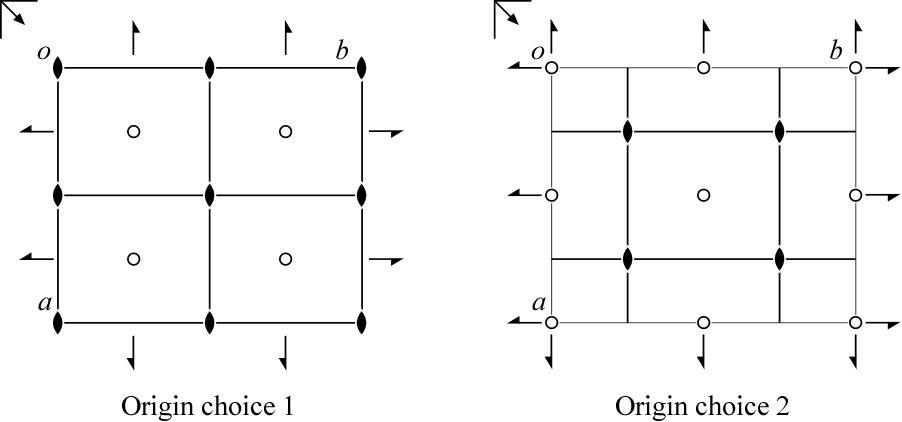
Above, we show the arrangement of symmetry operations for Origin choice 1 and Origin choice 2 of space group \(Pmmn\). The downward direction is the \(a\)-axis, the rightward direction is the \(b\)-axis, and the direction perpendicular to the page (toward the viewer) is the \(c\)-axis. The position marked \(“o”\) at the upper left is the origin. You can see that the left and right figures are related by a shift of \((\frac{1}{4} \frac{1}{4} 0)\).
The space groups that require consideration of these two origin settings belong to the orthorhombic, tetragonal, or cubic crystal systems, and there are 24 in total. All of them are listed below. If the space group of a crystal described in the literature corresponds to any of those listed below, please be careful to properly identify whether origin choice 1 or 2 is being used, as incorrect interpretation could result otherwise.
| Orthorhombic | Point group \(mmm\) | \(Pnnn, Pban, Pmmm, Ccce, Aeaa, Fddd\) |
| Tetragonal | Point group \(4/m\) | \(P4/n, P4_2/n, I4_1/a\) |
| Point group \(4/mmm\) | \(P4/nbm, P4/nmm, P4/ncc, P4_2/nbc, P4_2/nnm\) \(P4_2/nmc, P4_2/ncm, I4_1/amd, I4_1/acd\) | |
| Cubic | Point group \(m\bar{3}\) | \(Pn\bar{3}, Fd\bar{3}\) |
| Point group \(m\bar{3}m\) | \(Pn\bar{3}n, Pn\bar{3}m, Fd\bar{3}m, Fd\bar{3}c\) |
To reiterate, the properties of the crystal do not change whether origin choice 1 or 2 is used. Either representation is acceptable, but if discussing phenomena involving phase transitions (space group changes), it is advisable to choose an origin that is consistent with the origin of the space group being compared.