Up to this point, symmetry elements have appeared repeatedly, but detailed individual explanations were omitted. Here we will explain them in detail again.
Symmetry Elements Without Translation
Symmetry elements without translation include the identity, inversion center, mirror plane, rotation, and rotoinversion. Among these, the elements compatible with translation (existing in crystals) are as follows:
| Name | Notation | Description |
|---|---|---|
| Identity | \(1\) | Equivalent to 360° rotation |
| Inversion center | \(\bar{1}\ (=i)\) | Equivalent to 360° rotoinversion \(i\) notation is also used |
| Mirror plane | \(m\ (=\bar{2})\) | Equivalent to 180° rotoinversion |
| Rotation | \(2\), \(3\), \(4\), \(6\) | Expressed by the order of rotation (360°/rotation angle) |
| Rotoinversion | \(\bar{1}\ (=i)\), \(\bar{2}\ (=m)\), \(\bar{3}\), \(\bar{4}\), \(\bar{6}\) | Expressed by the order of rotation (360°/rotation angle) |
The identity element can be considered a type of rotation element, and mirror planes and inversion centers can be considered types of rotoinversion, so we will explain these together.
Rotation and Identity
In Hermann-Mauguin (HM) notation, the symbol \(n\) denotes an 𝑛-fold rotation axis. The orders of rotation compatible with translational symmetry are 1, 2, 3, 4, and 6. Below is a diagram showing the properties of each rotation element.
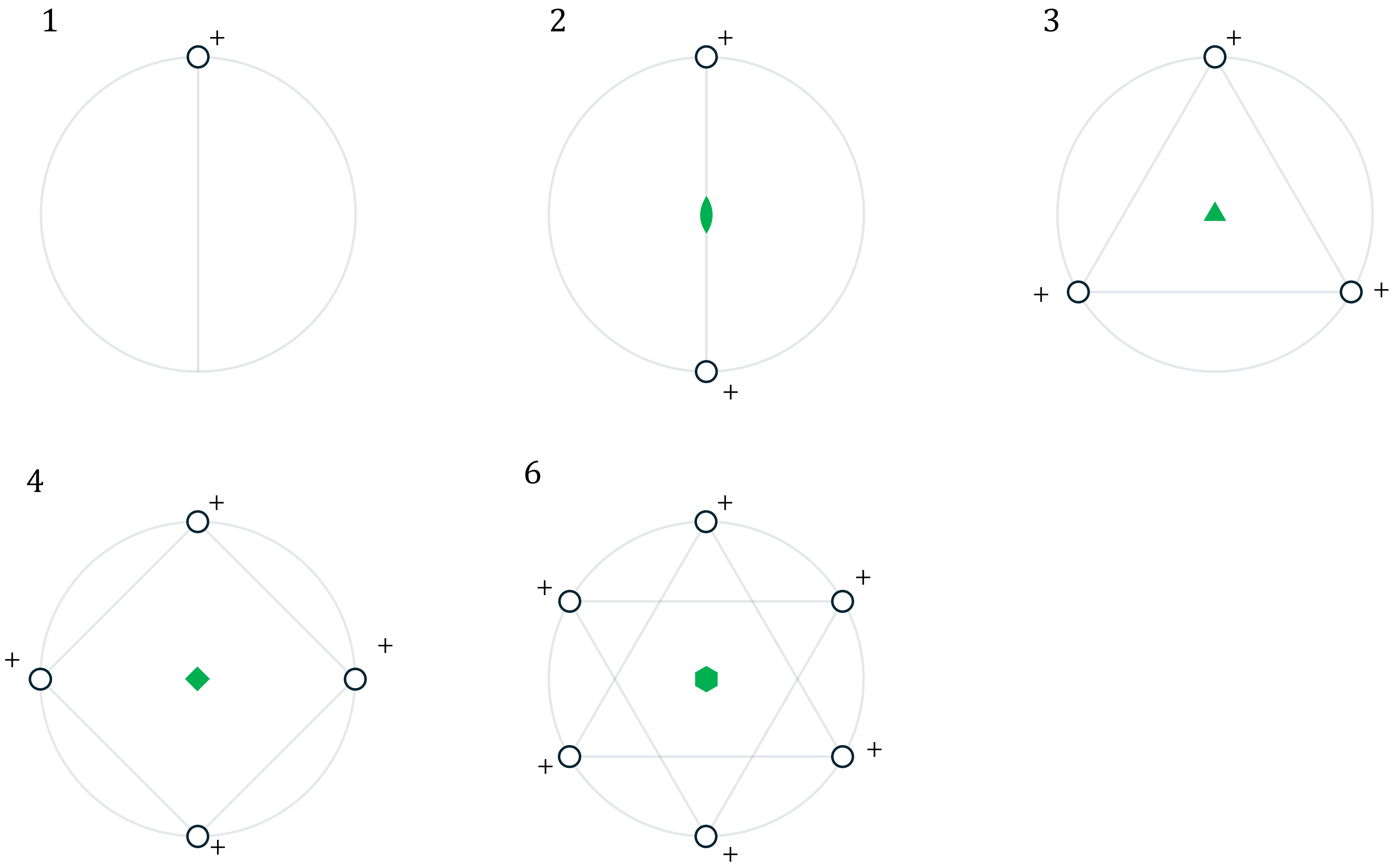
A note on reading the diagram:
- The green shapes in the diagram represent rotation axes perpendicular to the plane of the paper. Basically, they are expressed using regular polygons corresponding to the order, but since \(1\) is the identity element, no shape is defined, and \(2\) is expressed as a shape like a dorayaki (since a two-sided polygon cannot be drawn).
- The white circles
 around the symmetry element represent some kind of object. They are expressed as white circles just to keep the diagram simple, but imagine that they actually have much more complex shapes. The white circles are arranged so that their symmetry around the rotation axis is satisfied, and this is called the general position with respect to the symmetry element.
 - The “\(\bf +\)” near the white circles represents the distance (height) from the plane of the paper, and is shorthand notation for “\(\bf 0+z\)” (\(\bf z\) is any value). You might think such notation is not really necessary, but you will appreciate its value when we explain the following symmetry elements.
Rotoinversion, Inversion Center, and Mirror Plane
In HM notation, the symbol \(\bar{n}\) denotes an 𝑛-fold rotoinversion. Rotoinversion is an operation that consists of a rotation followed by an inversion through a point. Remember it as rotate then invert. Below we show the general positions of each rotoinversion element.
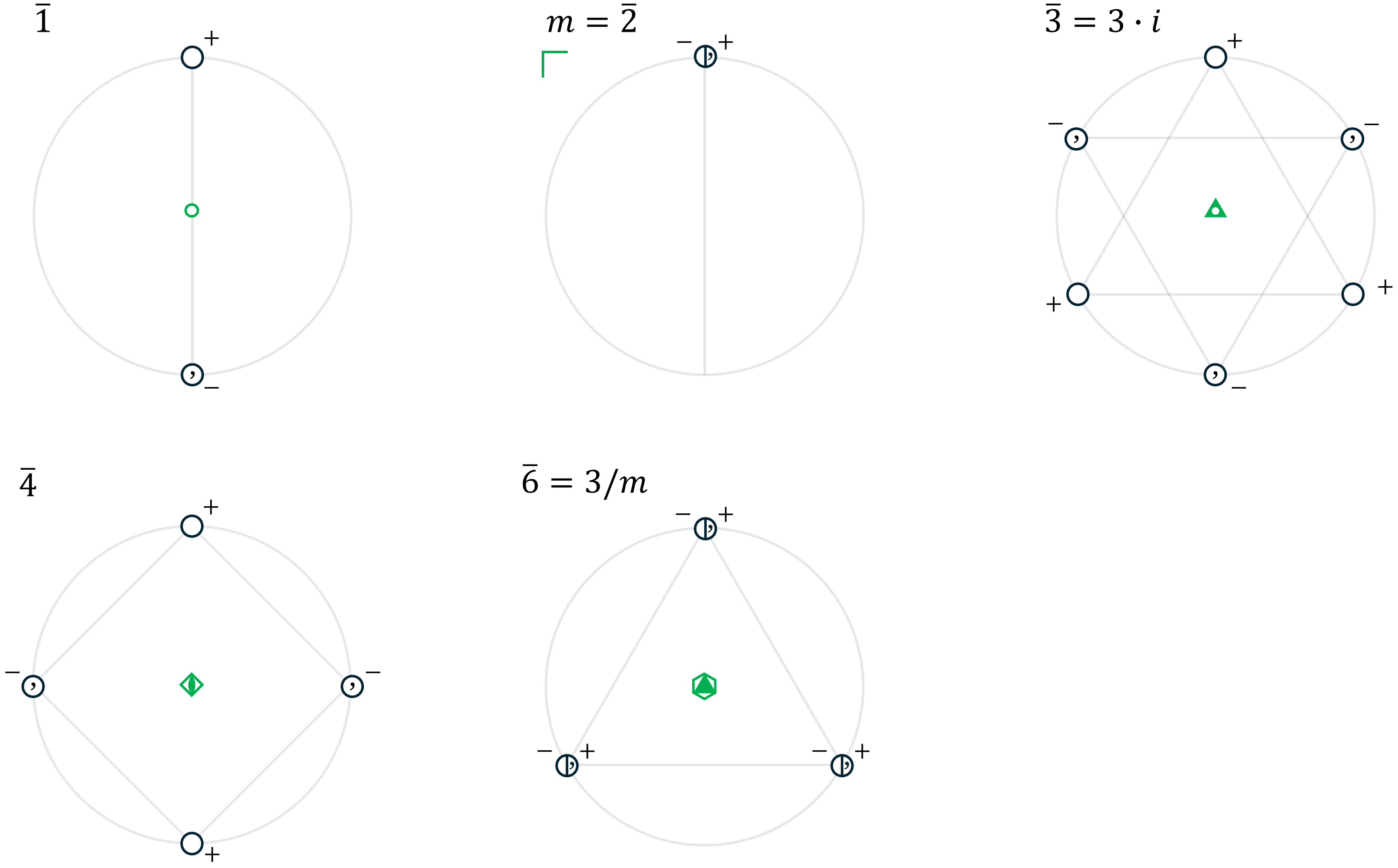
The symmetry element symbols are expressed in green, as in the rotation explanation. Below are supplementary notes:
- 1-fold rotoinversion is essentially an inversion center, and the small white circle is the symmetry element symbol.
- There is no symmetry element symbol corresponding to 2-fold rotoinversion, but since it is equivalent to a mirror plane \(m\), we use the mirror plane symbol (a bracket-like symbol) instead.
- The symbol with a comma “,” inside the white circle,
 (hereafter dotted circle), represents an object that is in an enantiomorphic relationship with the white circle. In other words, if the white circle is a right hand, then the dotted circle is a left hand.
 - The “–” symbol represents that the height from the plane of the paper is “0–z” (\(\bf{z}\) is any value).
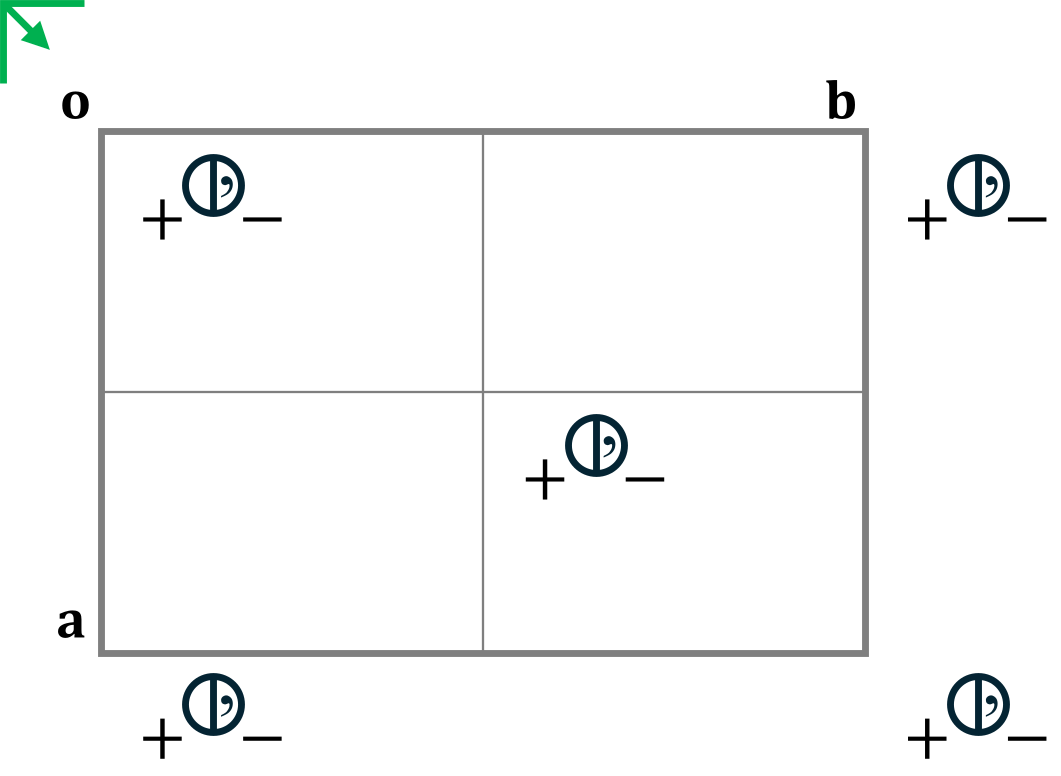
- The symbol with a divided circle,
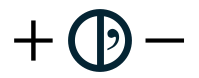 , represents a position where the white circle and dotted circle overlap when viewed from the projection direction (perpendicular to the plane of the paper), with height information for each written nearby. In this case, the white circle has height \(\bf 0+z\) and the dotted circle has height \(\bf 0–z\).
Rotoreflection
As a side note, there is a similar concept to the rotoinversion element. It is called a “rotoreflection” (𝑛-fold rotoreflection). In Schoenflies notation, the symbol \(S_n\) denotes an 𝑛-fold rotoreflection. A rotoreflection operation consists of a rotation followed by a reflection across a plane. Remember it as rotate then reflect.
Rotoinversion cannot be expressed in Schoenflies notation, and rotoreflection cannot be expressed in HM notation. However, an operation consisting of “rotation by an angle \(\theta\) followed by reflection” is equivalent to an operation of “rotation by \(\theta+180°\) followed by inversion through a point.” That is, rotoinversion and rotoreflection operations are equivalent when the phase of rotation differs by \(180°\) (assuming the inversion center lies in the reflection plane). When rotoinversion and rotoreflection operations are expressed by affine transformation (4×4 matrix), they are as follows:
$$
\bar{1}=S_2= \begin{pmatrix}
-1&0&0&0\\ 0&-1&0&0\\ 0&0&-1&0\\ 0&0&0&1
\end{pmatrix}\quad
\bar{2}=S_1= \begin{pmatrix}
1&0&0&0\\ 0&1&0&0\\ 0&0&-1&0\\ 0&0&0&1
\end{pmatrix}\quad
\bar{4}=S_4= \begin{pmatrix}
0&1&0&0\\ -1&0&0&0\\ 0&0&-1&0\\ 0&0&0&1
\end{pmatrix}
$$
$$
\bar{3}=S_6= \begin{pmatrix}
1/2&\sqrt{3}/2&0&0\\ -\sqrt{3}/2&1/2&0&0\\ 0&0&-1&0\\ 0&0&0&1
\end{pmatrix}\quad
\bar{6}=S_3= \begin{pmatrix}
-1/2&-\sqrt{3}/2&0&0\\ \sqrt{3}/2&-1/2&0&0\\ 0&0&1&0\\ 0&0&0&1
\end{pmatrix}
$$
Below is a summary table of correspondences:
| Hermann-Mauguin (HM) Notation | Schoenflies Notation |
|---|---|
| \(\bar{1} = i\) | \(S_2 = C_i\) |
| \(\bar{2} = m\) | \(S_i = C_s\) |
| \(\bar{4}\) | \(S_4\) |
| \(\bar{3} =3\cdot i\) | \(S_6 = C_{3i}\) |
| \(\bar{6}=3/m\) | \(S_3 = C_{3h}\) |
Symmetry Elements Involving Translation
Symmetry elements involving translation include lattice translations, screw axes, and glide planes.
| Name | Notation | Description |
|---|---|---|
| Lattice Translation | \(P\) \(A, B, C\) \(I\) \(F\) \(R\) | Primitive lattice Base-centered lattice Body-centered lattice Face-centered lattice Rhombohedral lattice |
| Screw axis | \(2_1\) \(3_1\), \(3_2\) \(4_1\), \(4_2\), \(4_3\) \(6_1\), \(6_2\), \(6_3\), \(6_4\), \(6_5\) | The first digit indicates the order of rotation, the second digit indicates the fraction of translation (translation distance = period along axis direction × second digit / first digit) |
| Glide plane | \(a\), \(b\), \(c\) \(n\) \(e\) \(d\) | Axial glide plane Diagonal glide plane Biaxial glide plane Diamond glide plane |
Normally, we would begin by explaining lattice translations, but here we will change the order slightly and explain screw axes first, followed by lattice translations and glide planes.
Screw Axes
A screw axis is represented by two digits. The first digit corresponds to the order of rotation, while the second digit (subscript) corresponds to the translation amount. The direction of the screw axis always coincides with the direction of a translation vector in the crystal (a vector connecting lattice points). The translation amount of the screw axis is defined as “second digit / first digit” relative to the minimum period of translation along the screw axis. For example, a crystal with a \(4_3\) symmetry element remains unchanged under the operation of “rotating by 90° and advancing by 3/4 of the period along the axis”. The notation is commonly read as, for example, “four-three screw” or “four sub three (screw)”.
Although it appears simple, screw axes are surprisingly easy to misunderstand. For instance, can you explain why a \(6_1\) element contains a \(2_1\) element, or why a \(4_2\) element does not contain a \(2_1\) element? If you are uncertain, the screw symmetry elements are illustrated below; study them carefully. Note that on this page, screw axes are drawn with a right-handed sense perpendicular to the page, pointing toward the viewer.
First, let us examine screw axes of orders 2 and 3.
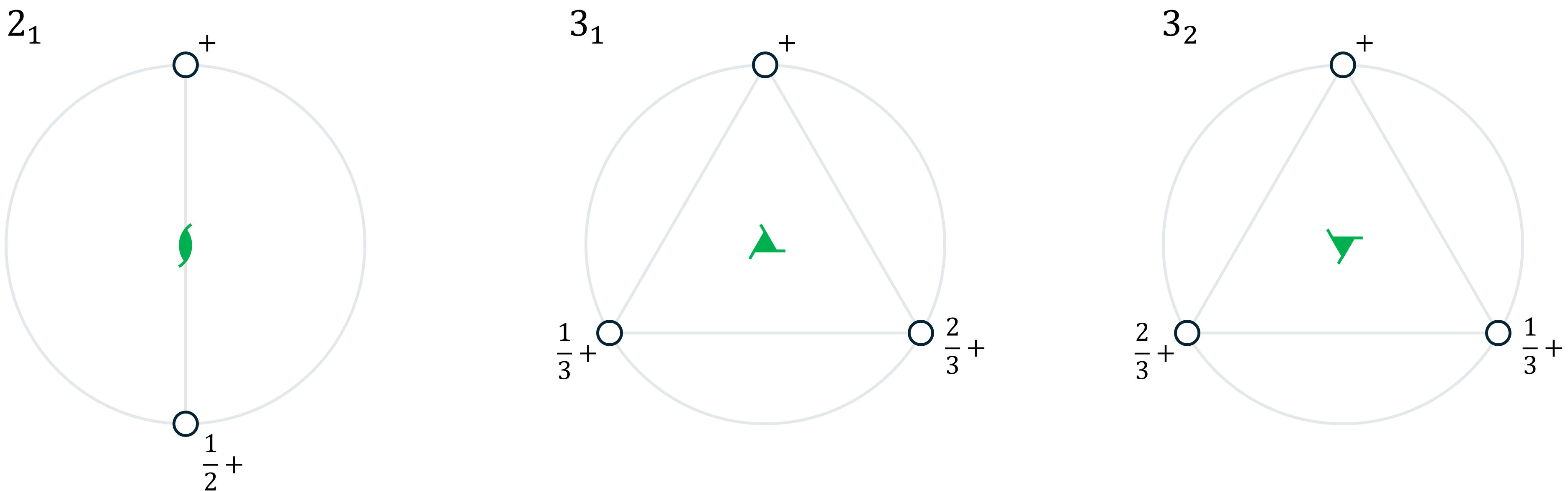
The green pinwheel-like symbols represent the screw axis symmetry elements. Below are some notes on how to read the diagram.
- For the \(2_1\) screw axis, the direction of rotation does not need to be considered. The \(3_1\) and \(3_2\) screw axes have similar symmetry symbols, but note that the direction of the pinwheel differs.
- ““\(\bf x+\)” means that the height from the page is “\(\bf x+z\)”. The unit of height is a fraction relative to one period along the axis direction. Note that this is not a quantity with a concrete unit.
- Since the screw operation involves translation, there are infinitely many open circles. For example, the open circle at height \(\bf \frac{1}{2}+\) is actually coincident with open circles at heights \(\bf \frac{3}{2}+\) and \(\bf -\frac{1}{2}+\). However, it is impossible and overly redundant to write all of these, so we show only the case where the number before “\(\bf +\)” is between 0 and 1.
Next, let us examine screw axes of order 6.
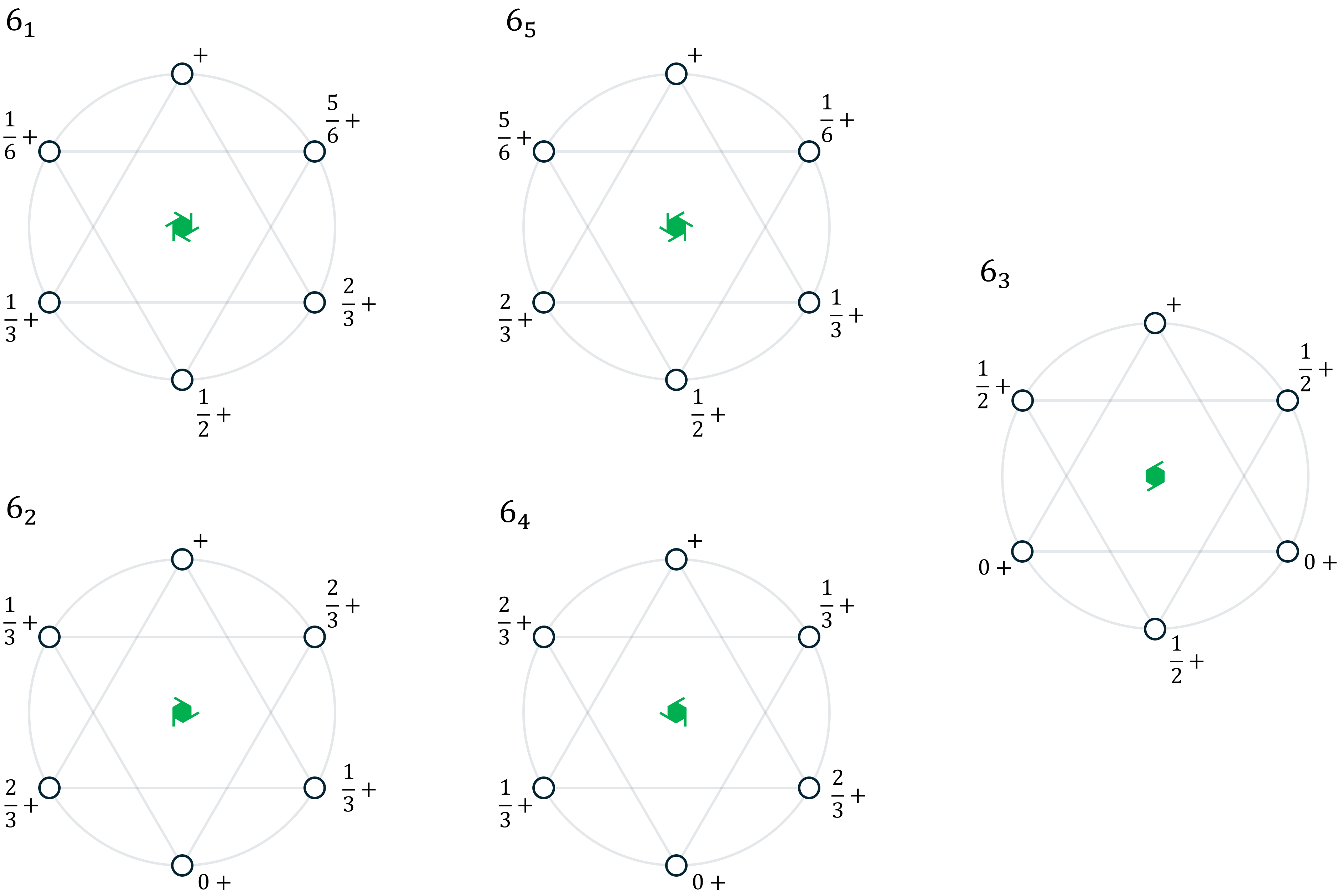
You should no longer need additional explanation for reading the diagram. Looking carefully at the arrangement of open and filled circles, you can see that, for example, \(6_3\) contains elements of \(3\) and \(2_1\).
Finally, let us examine screw axes of order 4.

You can see that \(4_1\) and \(4_3\) contain the \(2_1\) element, while \(4_2\) contains the \(2\) element.
Lattice Translation
Lattice translation elements are symmetry elements that all crystals possess. There are 7 types of lattice translation elements: \(P\), \(A\), \(B\), \(C\), \(I\), \(F\), and \(R\).
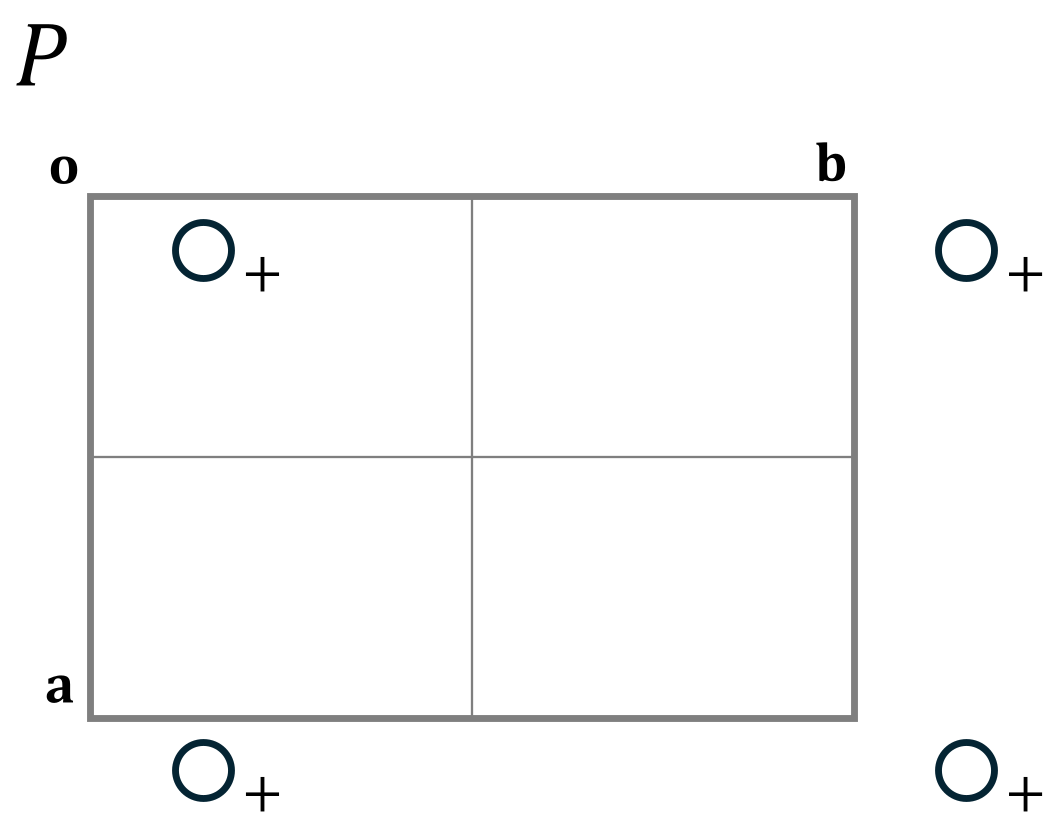
\(P\) is the simplest lattice translation and is called primitive lattice translation. The figure on the right (below on small screens) shows the general positions of primitive lattice translation. The gray rectangle represents the unit cell, with the origin at the top-left, the downward direction as the \(\textbf{a}\) axis, and the rightward direction as the \(\textbf{b}\) axis. In a right-handed coordinate system, the direction toward the front of the paper becomes the \(\textbf{c}\) axis. General positions are represented by white circles with height information, just as in previous diagrams, and are transferred to neighboring unit cells by translations along the \(\textbf{a}\), \(\textbf{b}\), and \(\textbf{c}\) axes. Note that general points also exist infinitely along the \(\textbf{c}\) axis direction (perpendicular to the screen), but only those with heights between 0 and 1 are shown.
In contrast to primitive lattice translation \(P\), the remaining six types are all centered lattices. Centered lattices have the properties of \(P\) (\(\textbf{a}\), \(\textbf{b}\), \(\textbf{c}\) translations) plus one or more additional translations, containing two or more general positions (lattice points) within the unit cell. Let us first show the general positions of base-centered lattice translations \(A\), \(B\), and \(C\).
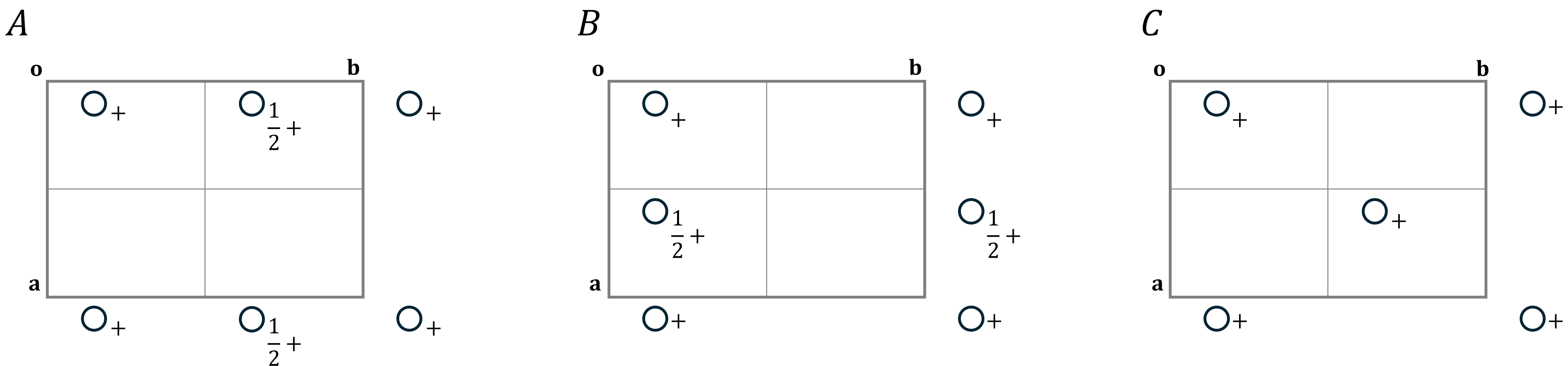
As you can see, two general positions exist within the unit cell. In addition to primitive lattice translation, \(A\) has a \(\frac{1}{2}(\textbf{b}+\textbf{c})\) translation, \(B\) has a \(\frac{1}{2}(\textbf{c}+\textbf{a})\) translation, and \(C\) has a \(\frac{1}{2}(\textbf{a}+\textbf{b})\) translation.
Finally, we show the general positions of lattice translations \(I\), \(F\), and \(R\).
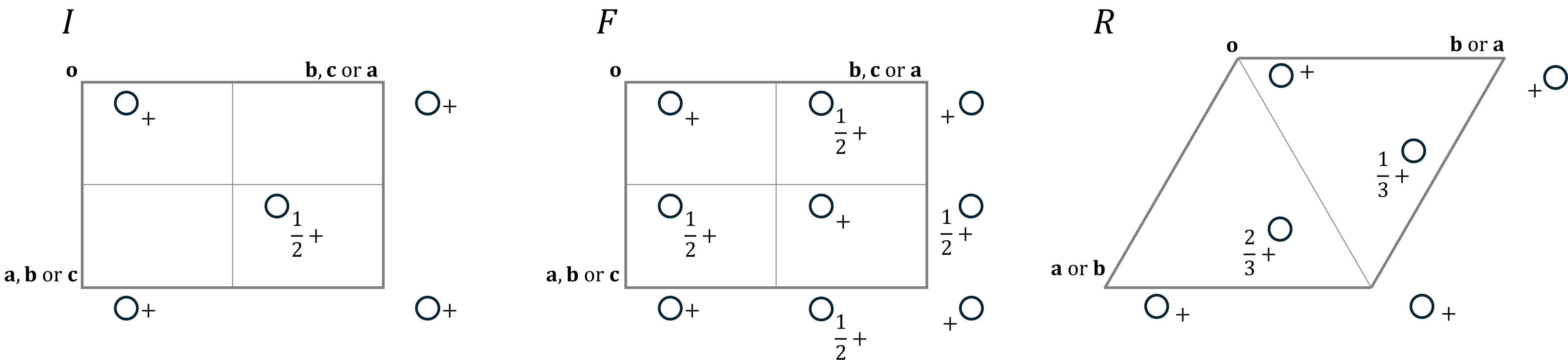
In the \(I\) lattice, a translation of \(\frac{1}{2}(\textbf{a}+\textbf{b}+\textbf{c})\) is added, and there are two general positions within the unit cell. In the \(F\) lattice, three translations of \(\frac{1}{2}(\textbf{a}+\textbf{b})\), \(\frac{1}{2}(\textbf{c}+\textbf{a})\), and \(\frac{1}{2}(\textbf{b}+\textbf{c})\) are added, resulting in four general positions. The \(R\) lattice is a symmetry element that appears only in the hexagonal lattice setting of the trigonal system. In the hexagonal lattice setting, \(\textbf{a}\) and \(\textbf{b}\) have equal length and meet at 120°. Translations of \(\frac{2}{3}\textbf{a}+\frac{1}{3}\textbf{b}+\frac{1}{3}\textbf{c}\) and \(\frac{1}{3}\textbf{a}+\frac{2}{3}\textbf{b}+\frac{2}{3}\textbf{c}\) are included.
Glide Reflection
Glide reflection is a symmetry operation in which a mirror reflection occurs, and then (rather than stopping there) translation occurs along the plane. Remember it as “mirror and then move.” The symmetry element symbols are one of \(a, b, c, n, e, d\). It is important to note that these symbols correspond to the direction of translation and do NOT contain information about the symmetry direction (normal direction) of the glide reflection plane.
Axial Glide Reflection (\(a\), \(b\), \(c\))
Axial glide reflection (axis glide) involves mirror reflection followed by translation in one of the \(\textbf{a}\), \(\textbf{b}\), or \(\textbf{c}\) directions by 1/2 of the period. They are denoted as \(a\), \(b\), or \(c\) corresponding to these directions. Since it would be redundant to explain all three types, here we describe \(c\) glide as an example.
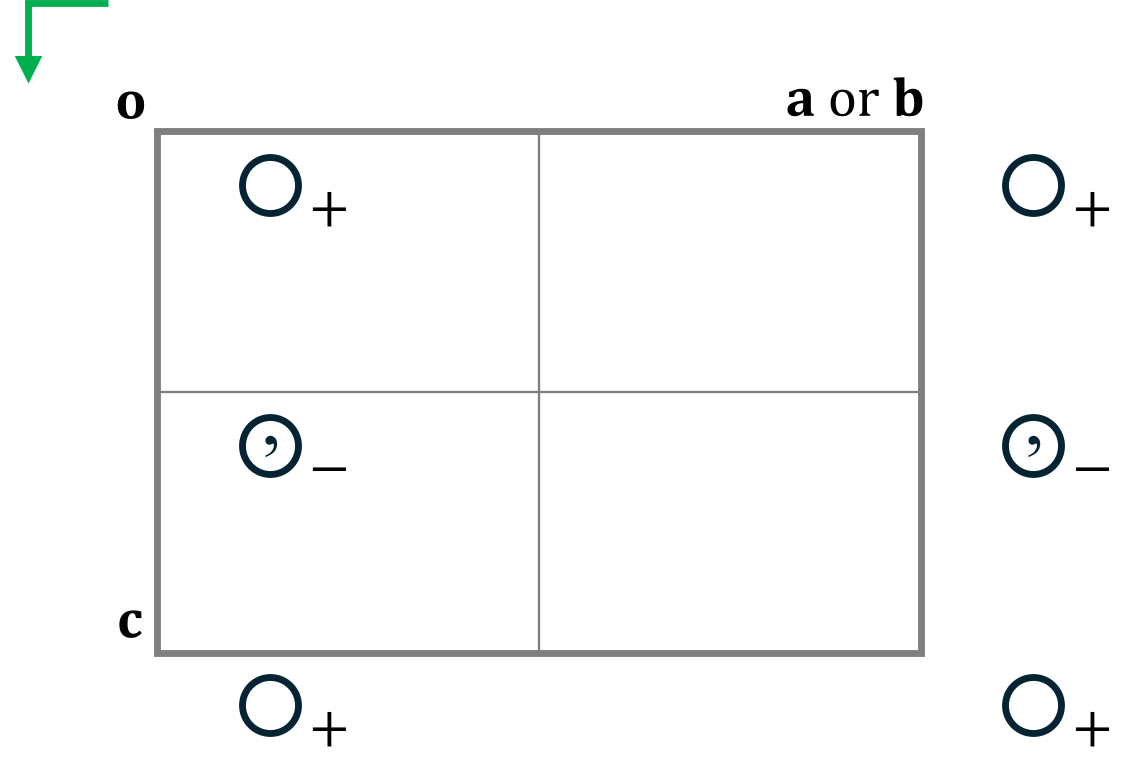
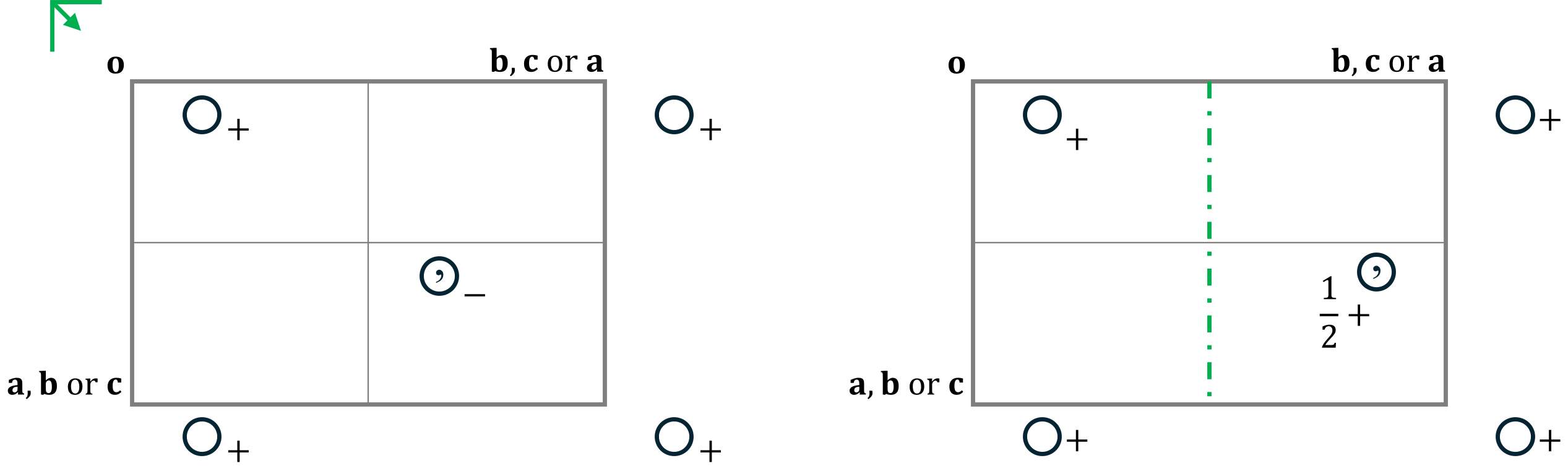
The following figure shows a situation where a \(c\) glide reflection plane exists parallel to the paper surface with zero height. The gray rectangle represents the unit cell, with the \(\textbf{c}\) axis pointing downward, the \(\textbf{a}\) or \(\textbf{b}\) axis pointing right, and the \(\textbf{b}\) or \(\textbf{a}\) axis perpendicular to the paper. That is, the symmetry direction (normal direction) of \(c\) is either \(\textbf{b}\) or \(\textbf{a}\), but this cannot be determined from the symmetry element symbol alone; the projection direction of the unit cell must be considered. The green symbol with an arrow at the top left bracket in the figure is the symmetry element symbol. The direction of the arrow indicates the direction of translation, which in this case is naturally the \(\textbf{c}\) axis (downward). By this glide reflection, the open circle (height \(+z\)) is mapped to the filled circle (height \(-z\)).
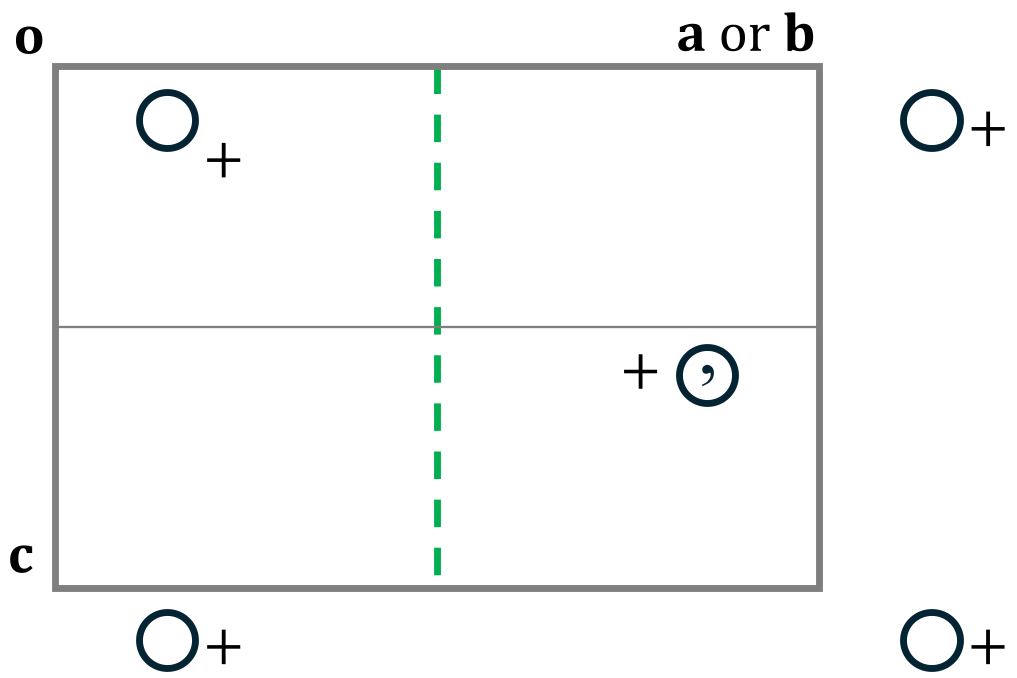
Now we consider a situation where the \(c\) glide reflection plane exists perpendicular to the paper surface rather than parallel to it. The orientation of the unit cell is the same as before. The green dashed line representing the symmetry element symbol indicates that the direction of translation is along the paper surface, which in this case is downward (the \(\textbf{c}\) axis). By this glide reflection, the open circle (height \(+z\)) is mapped to the filled circle (height \(+z\)).
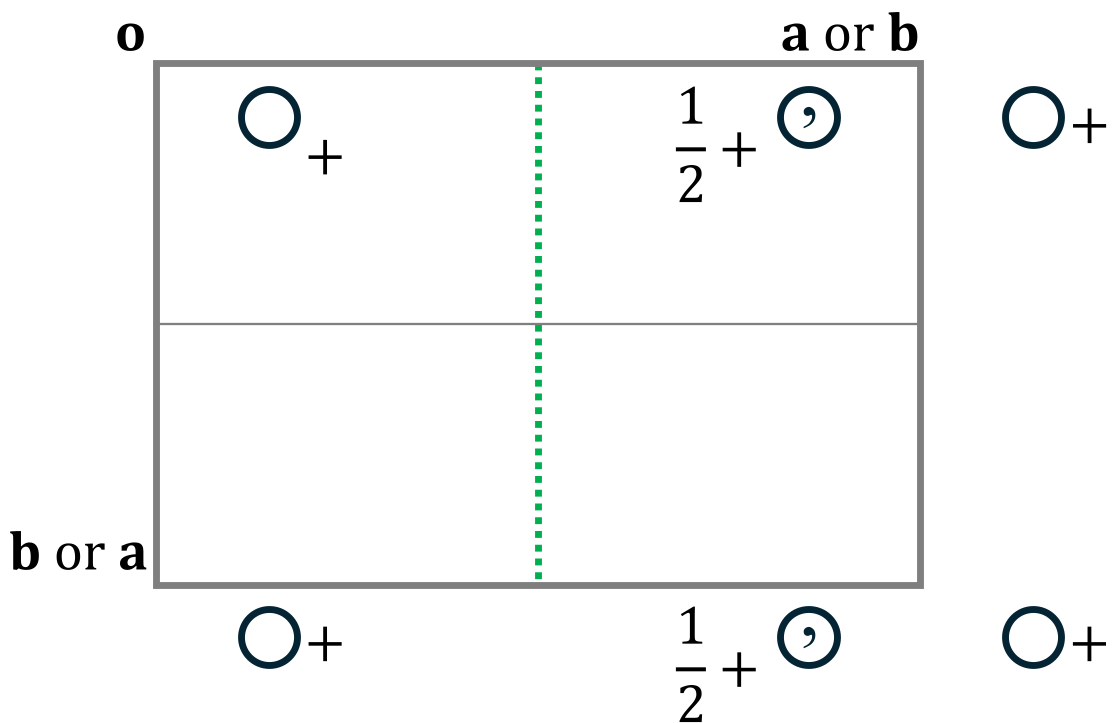
In the two previous figures, the direction of translation was downward, but we sometimes need to express cases where the direction of translation is perpendicular to the paper. The following figure shows a general position of a \(c\) glide reflection plane when the \(\textbf{c}\) axis is perpendicular to the paper surface. The right and downward directions are the \(\textbf{b}\) or \(\textbf{a}\) axes, with the \(\textbf{c}\) axis perpendicular to the paper. The green short dashed line representing the symmetry element symbol indicates that the direction of translation is perpendicular to the paper (that is, the \(\textbf{c}\) axis). By this glide reflection, the open circle (height \(+z\)) is mapped to the filled circle (height \(1/2+z\)). Note that the three figures shown so far represent the same information, just with different projection directions.
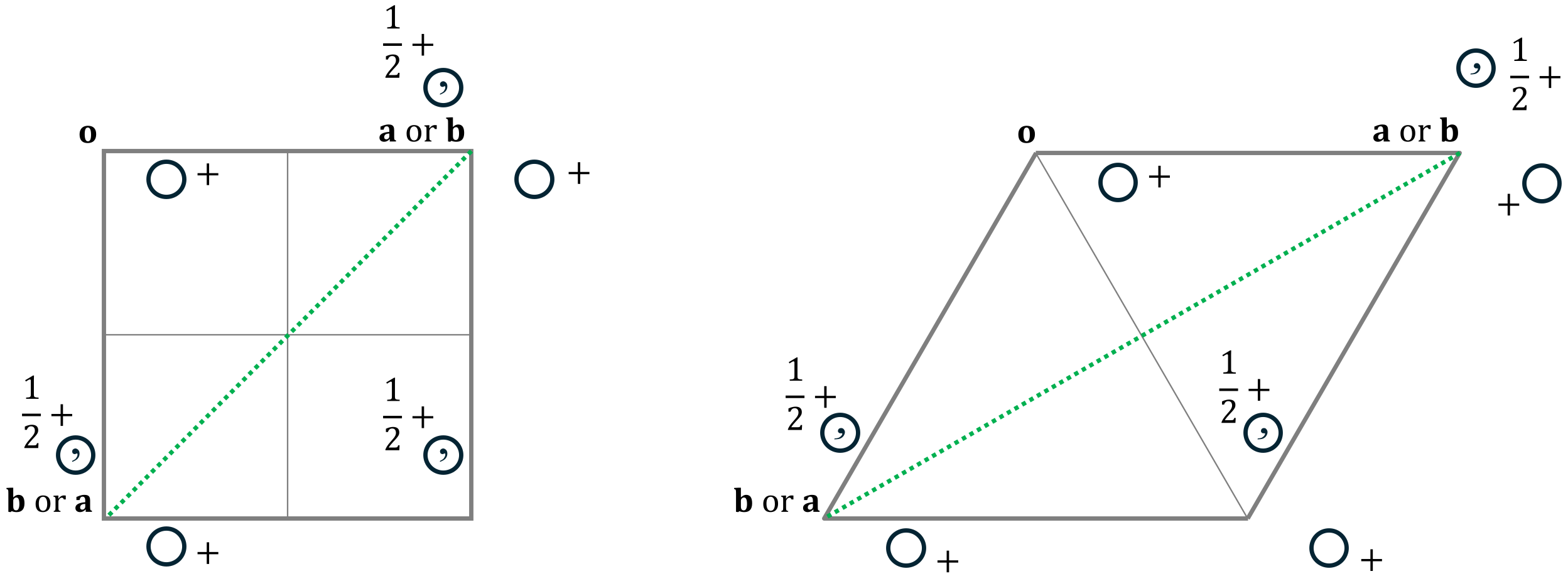
Finally, we introduce cases where the symmetry direction of axial glide reflection is a composite direction of two of the \(\textbf{a}\), \(\textbf{b}\), \(\textbf{c}\) axes. Such cases are observed in tetragonal, hexagonal, or cubic lattices.
The following figure shows a situation where a \(c\) glide reflection plane with a symmetry direction of [110] exists in a tetragonal lattice (left) or hexagonal lattice (right). In both cases, the \(\textbf{c}\) axis is perpendicular to the paper, so the symmetry element is shown with a short dashed line. By the glide reflection, the open circle (height \(+z\)) is mapped to the filled circle (height \(1/2+z\)).
Diagonal Glide Reflection (\(n\))
Diagonal glide reflection (diagonal glide) is denoted as \(n\). This element is a symmetry element that performs mirror reflection followed by translation by 1/2 of the resultant vector of two translation vectors that are orthogonal to the symmetry direction. This is a very confusing definition. For example, if the symmetry direction of an \(n\) glide reflection plane is the \(\textbf{b}\) axis, and the \(\textbf{a}\) and \(\textbf{c}\) axes are orthogonal to it, then the translation vector is \(\frac{1}{2} (\textbf{a}+\textbf{c})\). The name comes from the fact that the translation is in the direction of the diagonal of the parallelogram formed by the two axes perpendicular to the symmetry direction. Since neither the symmetry direction nor the translation direction can be determined from the symbol \(n\) alone, it is important to understand the context in which it is used.
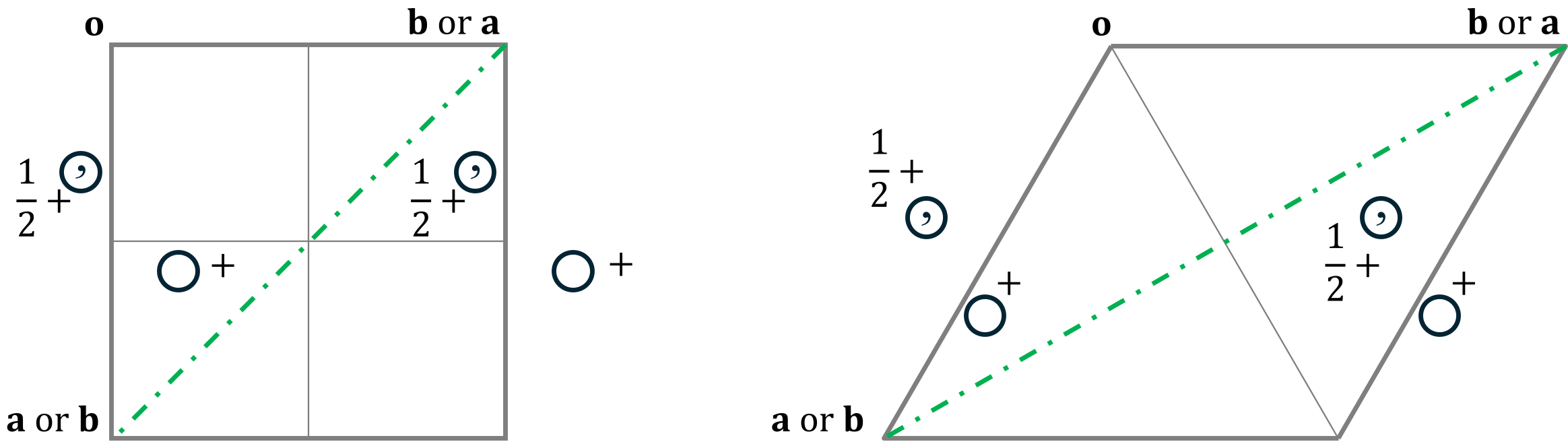
The following two figures show cases where the symmetry direction of an \(n\) glide plane is perpendicular to the paper (left) and parallel to the paper (right). The \(\textbf{a}\), \(\textbf{b}\), \(\textbf{c}\) axes correspond to right, down, and perpendicular to the paper. The symmetry element symbol is represented by a bracket with a diagonal arrow in the former case and by a dot-dash line1 in the latter case. The two figures represent the same information, just with different projection directions.
Similar to the case of axial glide reflection, there are also cases where the symmetry direction does not coincide with the \(\textbf{a}\), \(\textbf{b}\), \(\textbf{c}\) axes. The following figure shows \(n\) glide reflection planes with a [110] symmetry direction in a tetragonal lattice (left) or hexagonal lattice (right). Note that the translation is \(\frac{1}{2}(\pm\textbf{a}\mp\textbf{b}+\textbf{c})\).
Finally, we explain the relationship between \(n\) glide reflection and composite lattices. Composite lattices have additional lattice translation vectors beyond \(\textbf{a}\), \(\textbf{b}\), \(\textbf{c}\), but cases where the additional lattice translation vector matches the translation vector of \(n\) glide reflection do not need to be considered. For example, consider a \(C\) base-centered lattice with an \(n\) glide reflection plane perpendicular to the \(c\) axis. Both have a translation vector of \(\frac{1}{2}(\textbf{a}+\textbf{b})\). When drawn, the result looks like this, but upon closer inspection it can be understood as simply a mirror reflection \(m\) perpendicular to the \(c\) axis in operation. There is no need to invoke a \(n\) glide reflection plane. When the lattice translation vector and the translation vector of \(n\) glide reflection coincide in this way, \(n\) glide reflection can always be replaced by mirror reflection \(m\).
Now, if you are sharp, you might ask: what if the translation after mirroring is half of \(\frac{1}{2}(\textbf{a}+\textbf{b})\) (that is, \(\frac{1}{4}(\textbf{a}+\textbf{b})\))? Actually, that is the diamond glide reflection plane described later.
Double Glide Reflection (\(e\))
Double glide reflection is denoted as \(e\). This element exists only in lattice systems where the \(\textbf{a}\), \(\textbf{b}\), \(\textbf{c}\) axes are mutually orthogonal, and the symmetry direction is one of the \(\textbf{a}\), \(\textbf{b}\), \(\textbf{c}\) axes. The major difference from the axial and diagonal glide reflections described so far is that there are two translation vectors. That is, both axes perpendicular to the symmetry direction are translation directions, and the amount of translation is 1/2 of each. As a result, while axial and diagonal glide reflections produce two equivalent positions within the unit cell, double glide reflection produces four equivalent positions. For example, when the symmetry direction is the \(\textbf{c}\) axis, the translation vectors are \(\frac{1}{2}\textbf{a}\) and \(\frac{1}{2}\textbf{b}\). In essence, the axial glide reflection is doubled.
The following figure shows cases where the symmetry direction of an \(e\) glide plane is perpendicular to the paper (left) and parallel to the paper (right). The symmetry element symbol is represented by a two-directional arrow in the former case and by a double dotted line in the latter case. It can be seen that four equivalent positions appear within the unit cell.
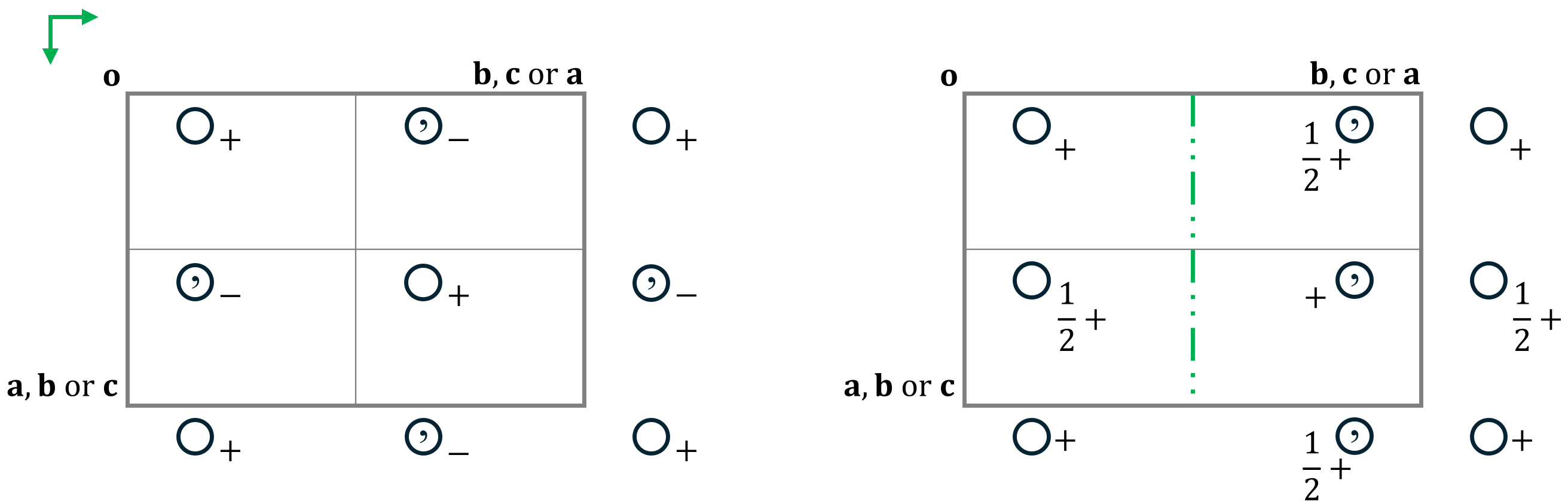
Let us examine this symmetry element a bit further. Looking at the position relationships of the open circles , you can see that they form a base-centered lattice translation relationship. Similarly, the filled circles also satisfy the symmetry of base-centered lattice translation. In other words, the operation of \(e\) glide reflection always introduces a base-centered lattice element2. For example, if a crystal has \(e\) glide reflection with the \(\textbf{c}\) axis as the symmetry direction, then the crystal must be a \(C\) base-centered lattice. If \(e\) glide reflection exists in two or more axial directions, the result is an \(F\) face-centered lattice; if it exists in the diagonal direction of two axes (for example, [110] in tetragonal or cubic), it becomes a \(I\) body-centered lattice. In other words, a space group with \(e\) glide reflection must have a composite lattice (\(A, B, C, I,\) or \(F\))3.
By the way, the symmetry element symbol \(e\) has been used since 1992. As a result, five space groups changed their notation at the 1992 boundary4, which is somewhat confusing. Please be careful when reading older literature.
| Space group number | 39 | 41 | 64 | 67 | 68 |
| Before 1992 | \(Abm2\) | \(Aba2\) | \(Cmca\) | \(Cmma\) | \(Ccca\) |
| After 1992 | \(Aem2\) | \(Aea2\) | \(Cmce\) | \(Cmme\) | \(Ccce\) |
Diamond Glide Reflection (\(d\))
Finally, we have diamond glide reflection. It is denoted as \(d\). Similar to the case of double glide reflection, space groups with \(d\) glide elements are limited to composite lattices (\(I\) or \(F\))5. This element performs mirror reflection followed by translation by 1/2 of the composite lattice translation vector other than \(\textbf{a}\), \(\textbf{b}\), \(\textbf{c}\). The composite lattice translation vectors other than \(\textbf{a}\), \(\textbf{b}\), \(\textbf{c}\) are \(\frac{1}{2}(\textbf{a}+\textbf{b}+\textbf{c})\) in the case of \(I\), and \(\frac{1}{2}(\textbf{a}+\textbf{b})\), \(\frac{1}{2}(\textbf{b}+\textbf{c})\), or \(\frac{1}{2}(\textbf{c}+\textbf{a})\) in the case of \(F\). Half of these vectors is the translation vector of \(d\) glide reflection. One more unique property of \(d\) glide planes is that they must exist in multiple sets. Since this is difficult to understand from text alone, the following explanation uses diagrams.
As a concrete example, consider a situation where a crystal with an \(F\) face-centered lattice has \(d\) glide reflection perpendicular to the \(\textbf{c}\) axis. In this case, the translation vector of \(d\) glide reflection is \(\frac{1}{4}(\textbf{a}+\textbf{b})\). The following figure shows this crystal projected from the \(\textbf{c}\) axis. The downward direction is the \(\textbf{a}\) axis and the rightward direction is the \(\textbf{b}\) axis. Let the \(d\) glide reflection plane be at a height of \(\frac{1}{2}\) from the paper surface. Its symmetry element symbol is the same as for \(n\) glide reflection, represented by a bracket with a diagonal arrow6, with height information \(\frac{1}{2}\) added. The four open circles in the unit cell correspond to the general positions of the \(F\) face-centered lattice. By the action of \(d\) glide reflection, four filled circles are generated.
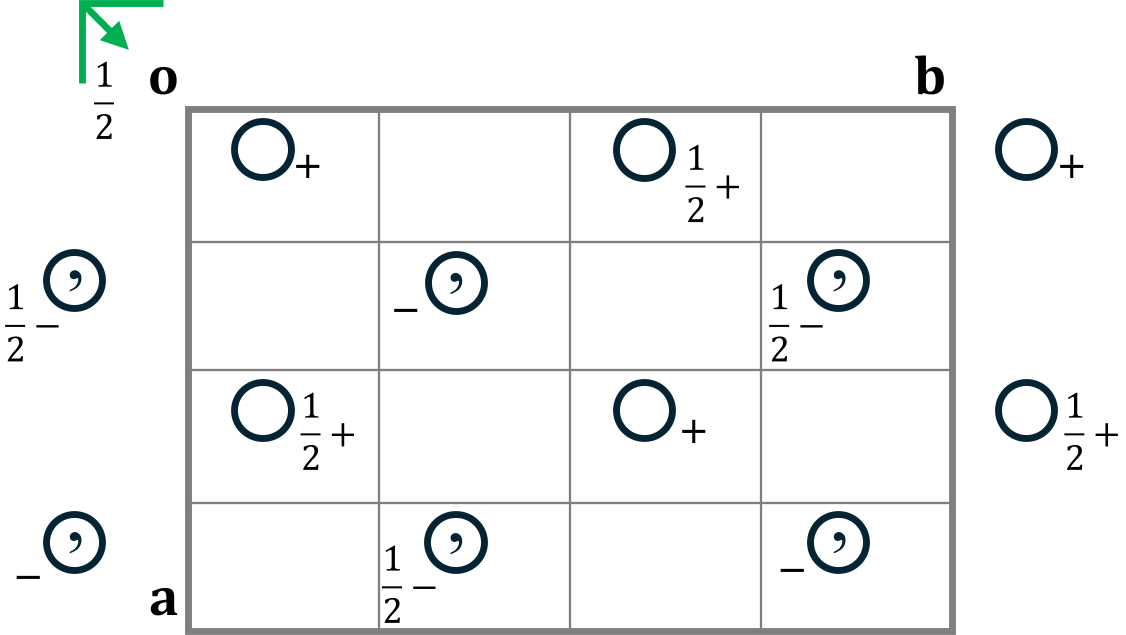
This figure shows the exact same situation as the above, but projected from the \(\textbf{b}\) axis. Now the origin is at the top right, with the downward direction being the \(\textbf{a}\) axis, the leftward direction being the \(\textbf{c}\) axis, and the vertical forward direction being the \(\textbf{b}\) axis. The symmetry element symbol of the \(d\) glide plane is represented by an arrow-marked dotted line. Note that the height changes by +1/4 in the direction of the arrow. Although the arrangement is different, the unit cell contains four open circles corresponding to the general positions of the \(F\) face-centered lattice, and four filled circles mapped by \(d\) glide reflection.
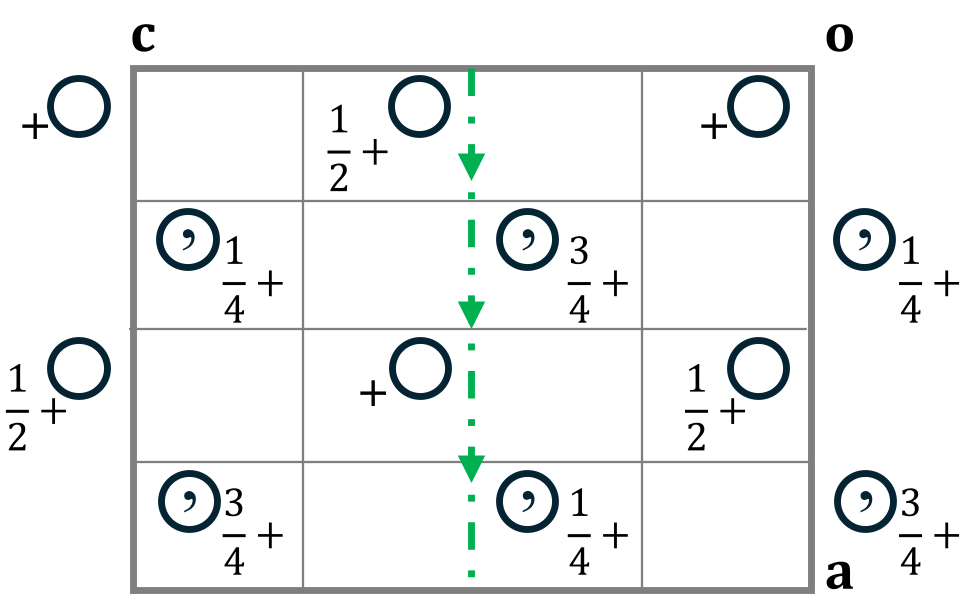
Now, look carefully at the two figures above. Do you notice that glide reflection exists not only in the \(\frac{1}{4}(\textbf{a}+\textbf{b})\) direction, but also in the \(\frac{1}{4}(\textbf{a}-\textbf{b})\) direction? That is, the complete version of the two figures above is as follows. This is the correct way to write the symmetry element symbols.
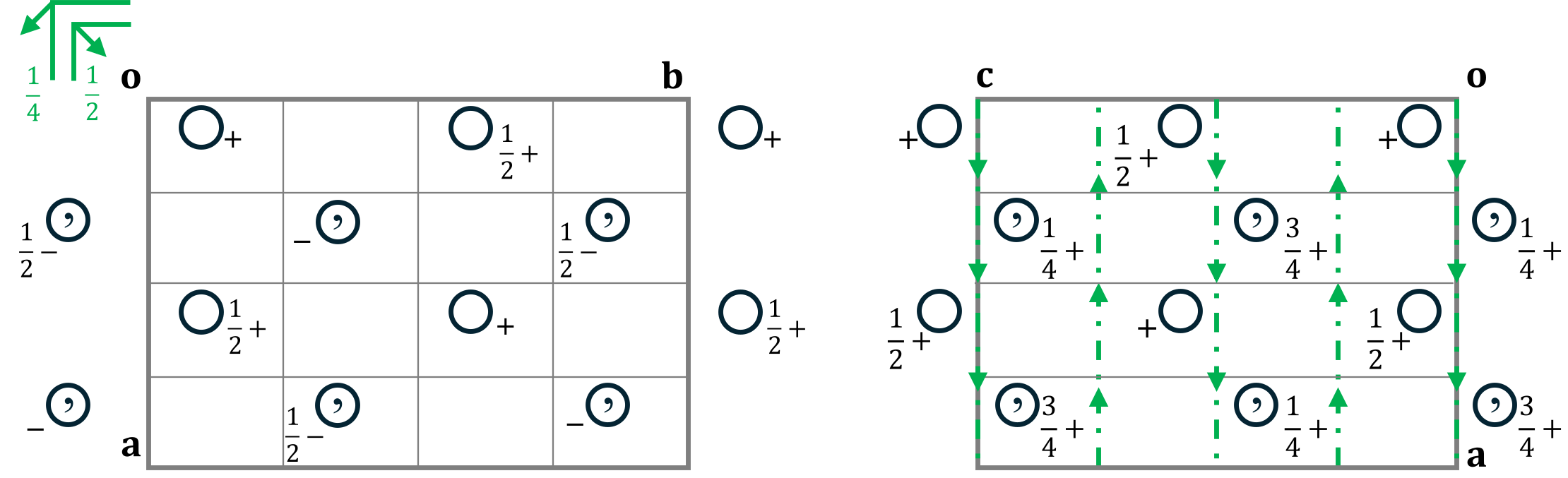
As this lengthy explanation shows, \(d\) glide reflection always exists as multiple planes in the same symmetry element direction. They are spaced 1/4 of the period in the symmetry element direction, with translation vectors alternating (for example, \(\frac{1}{4}(\textbf{a}+\textbf{b})\) and \(\frac{1}{4}(\textbf{a}-\textbf{b})\)). Note that \(d\) glide reflection may also exist perpendicular to the [110] (and [1\bar{1}0]) direction in tetragonal and cubic systems with \(I\) body-centered lattice, but the approach is exactly the same, so we omit it.
Types of Glide Reflection Planes and Symmetry Directions
Not all glide reflections can exist in all symmetry directions. For example, \(a\) glide reflection planes translate in the direction of the \(\textbf{a}\) axis, so the symmetry direction (normal direction) of the glide reflection plane must be orthogonal to \(\textbf{a}\). There is no \(a\) glide reflection plane with \(\textbf{a}\) as the symmetry direction. Below is a summary of which glide reflection planes may appear in which crystal classes (point groups) and in which symmetry directions (primary, secondary, and tertiary axes). Note that crystal classes without any glide reflection planes are omitted.
Monoclinic
| Crystal class | Primary axis: \(\textbf{b}\) |
|---|---|
| \(m\), \(2/m\) | \(a,c,n\) |
Orthorhombic
| Crystal class | Primary axis: \(\textbf{a}\) | Secondary axis: \(\textbf{b}\) | Tertiary axis: \(\textbf{c}\) | |
|---|---|---|---|---|
| \(mm2\) | \(b,c,n,e,d\) | \(a,c,n,e,d\) | – | |
| \(mmm\) | \(b,c,n,e,d\) | \(a,c,n,e,d\) | \(a,b,n,e,d\) | |
Tetragonal
| Crystal class | Primary axis: \(\textbf{c}\) | Secondary axis: \(\textbf{a}\) (=\(\textbf{b})\) | Tertiary axis: \(\langle110\rangle\) | |
|---|---|---|---|---|
| \(4/m\) | \(a,b,n\) | – | – | |
| \(4mm\) | – | \(a,b,c,n\) | \(c,n,d\) | |
| \(\bar{4}2m\) | \(\bar{4}2m\) | – | – | \(c,n,d\) |
| \(\bar{4}m2\) | – | \(a,b,c,n\) | – | |
| \(4/mmm\) | \(a,b,n\) | \(a,b,c,n\) | \(c,n,d\) | |
Cubic
| Crystal class | Primary axis: \(\textbf{c}\)(=\(\textbf{a}\)=\(\textbf{b})\) | Secondary axis: \(\langle111\rangle\) | Tertiary axis: \(\langle110\rangle\) | |
|---|---|---|---|---|
| \(m\bar{3}\) | \(a,b,n,d\) | – | – | |
| \(\bar{4}3m\) | – | – | \(c,n,d\) | |
| \(m\bar{3}m\) | \(a,b,n,d\) | – | \(c,n,d\) | |
Trigonal, Hexagonal
| Crystal class | Primary axis: \(\textbf{c}\) | Secondary axis: \(\textbf{a}\)(=\(\textbf{b}\)=\([\bar{1}\bar{1}0])\) | Tertiary axis: \(\langle1\bar{1}0\rangle\) | |
|---|---|---|---|---|
| \(3m\) | \(3m1\) | – | \(c\) | – |
| \(31m\) | – | – | \(a,c,n\) | |
| \(3m\) | – | \(c,n\) | – | |
| \(\bar{3}m\) | \(\bar{3}m1\) | – | \(c\) | – |
| \(\bar{3}1m\) | – | – | \(a,c,n\) | |
| \(\bar{3}m\) | – | \(c,n\) | – | |
| \(6mm\), \(6/mmm\) | – | \(c\) | \(c\) | |
| \(\bar{6}m2\) | \(\bar{6}m2\) | – | \(c\) | – |
| \(\bar{6}m2\) | – | – | \(c\) | |
Relationships Between Symmetry Elements
There exist “contains/is contained by” relationships between certain symmetry elements. For example, an object possessing the symmetry element \(4\) permits rotational operations of 90°, 180°, 270°, and 360°, and therefore naturally also possesses the symmetry element \(2\). In other words, \(4\) contains \(2\); however, it is usually sufficient to record only the higher-order symmetry element. Below, we have illustrated such relationships graphically.
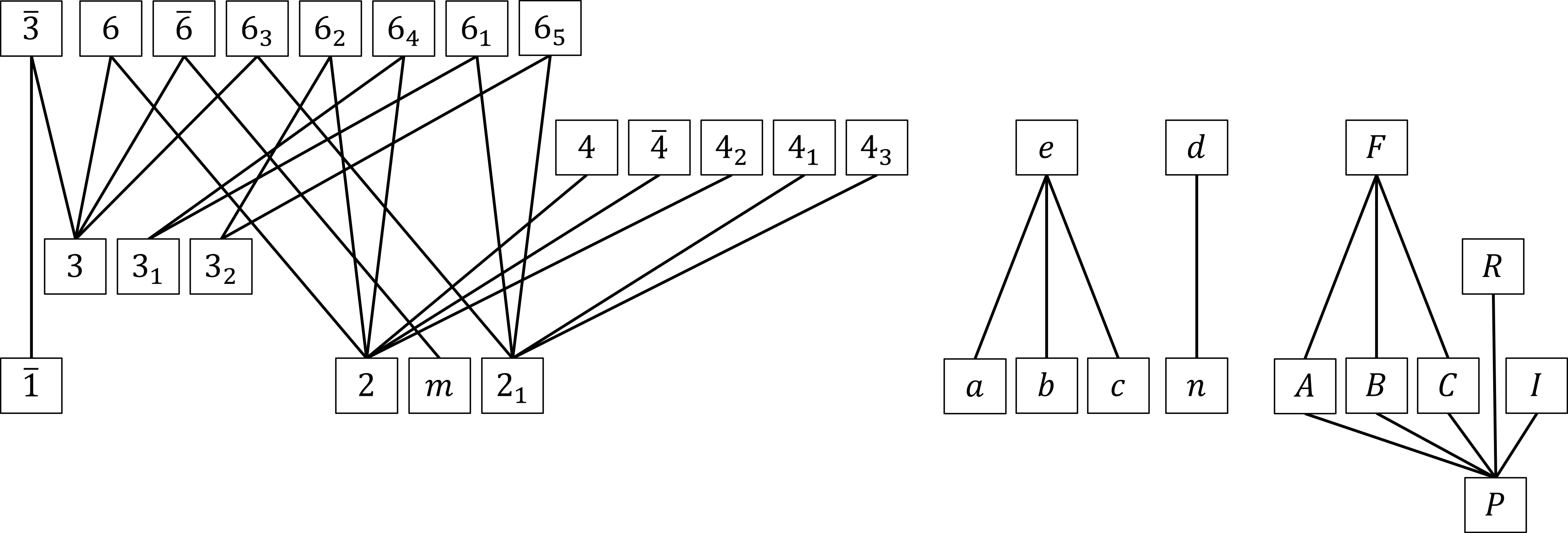
Two symmetry elements connected by a line have a relationship in which the higher-order element contains the lower-order element. At the lowest level, \(1\) naturally exists, and strictly speaking, all symmetry elements should be connected with downward lines; however, such a diagram would become too complex and is therefore omitted here.