Among the space groups belonging to point group \(32\), there are \(P321\) and \(P312\). Since point group \(321\) and point group \(312\) are algebraically identical in structure, there is no need to distinguish between them when discussing point groups alone, and it is customary to omit the \(1\) and simply write \(32\). However, in the context of space groups, the correspondence between translational directions and rotation axis directions must be taken into account, so \(P321\) and \(P312\) are distinct space groups. Moreover, as discussed below, care is needed when dealing with tensor quantities. This page introduces cases where HM symbols may appear similar but the order carries important meaning.
\(P321\) and \(P312\)
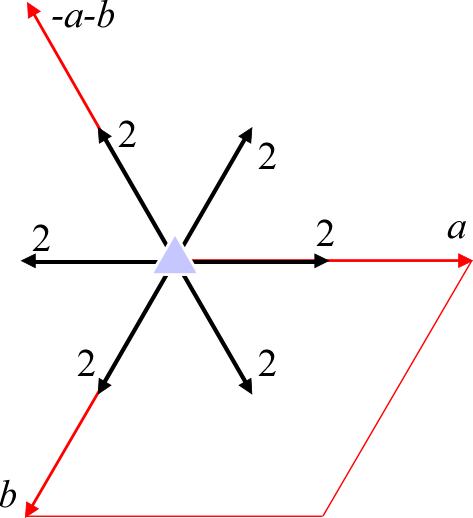
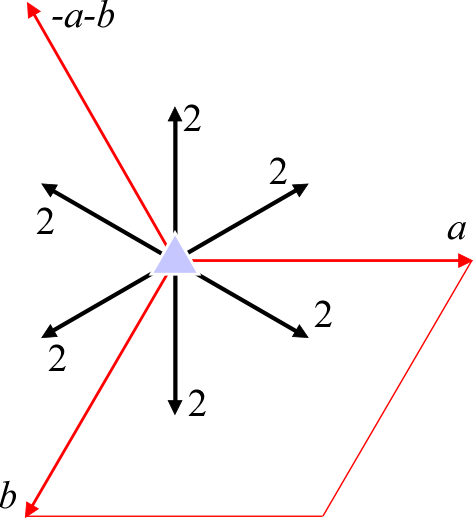
\(P321\) and \(P312\) are not simply “rearrangements of the same symbols.” The directions in which the \(2\)-fold axes exist are different. To explain concretely, let us take the \(3\)-fold rotation axis along the \(c\) axis, and let \(a,b\) be the translation vectors in the basal plane perpendicular to it. Due to the requirement of \(3\)-fold rotation, \(2\)-fold rotation axes appear in 3 directions within the basal plane (6 directions if we distinguish signs). However, their orientations are not arbitrary; when the space group is to be valid, only the following two cases are possible.
- Case 1: The \(2\)-fold axes lie along the \(a\) and \(b\) directions.
- Case 2: The \(2\)-fold axes lie along the \(a-b\) and \(a+2b\) directions.
These two cases are offset by \(30^\circ\) when viewed from the basal plane.
Case 1: 2-fold rotation axes coincide with the \(a\) and \(b\) directions
Case 2: 2-fold rotation axes coincide with the \(a-b\) and \(a+2b\) directions
If we arrange the symmetry operations as in Case 1 or Case 2, we can use them as generators to construct the following space groups.
Case 1 (\(P321\))

Case 2 (\(P312\))

Comparing the two, we see that neither the positions of symmetry elements nor the positions of general points coincide, so they are clearly different space groups.
As explained on the page 6.3. Choice of Axes and Axis Transformations, in the trigonal or hexagonal system, the principal axis is \(c\), the secondary symmetry direction is \(a\) = \(b\) = \([\bar{1}\bar{1}0]\), and the tertiary symmetry direction is \([1\bar{1}0]\) = \([120]\) = \([\bar{2}\bar{1}0]\). In Case 1, the \(2\)-fold rotation lies along the secondary direction, and in Case 2, it lies along the tertiary direction, corresponding to the space groups \(P321\) and \(P312\) in HM notation, respectively. That is, \(P321\) and \(P312\) are not synonyms with similar names, but entirely different space groups in substance.
Space Groups with the Same Relationship
The relationship where “the order of the 2nd and 3rd positions in the HM symbol appears to differ, but they are actually different space groups” occurs in the trigonal, hexagonal, and tetragonal systems. Representative examples are as follows.
Trigonal
- \(P312\) and \(P321\) (point group \(32\))
- \(P3_112\) and \(P3_121\) (point group \(32\))
- \(P3_212\) and \(P3_221\) (point group \(32\))
- \(P3m1\) and \(P31m\) (point group \(3m\))
- \(P3c1\) and \(P31c\) (point group \(3m\))
- \(P\bar{3}1m\) and \(P\bar{3}m1\) (point group \(\bar{3}m\))
- \(P\bar{3}1c\) and \(P\bar{3}c1\) (point group \(\bar{3}m\))
Hexagonal
- \(P6_3cm\) and \(P6_3mc\) (point group \(6mm\))
- \(P\bar{6}m2\) and \(P\bar{6}2m\) (point group \(\bar{6}m2\))
- \(P\bar{6}c2\) and \(P\bar{6}2c\) (point group \(\bar{6}m2\))
- \(P6_3/mcm\) and \(P6_3/mmc\) (point group \(6/mmm\))
Tetragonal
- \(P4_2cm\) and \(P4_2mc\) (point group \(4mm\))
- \(P\bar{4}2m\) and \(P\bar{4}m2\) (point group \(\bar{4}2m\))
- \(P\bar{4}2c\) and \(P\bar{4}c2\) (point group \(\bar{4}2m\))
- \(I\bar{4}2m\) and \(I\bar{4}m2\) (point group \(\bar{4}2m\))
- \(P4_2/mmc\) and \(P4_2/mcm\) (point group \(4/mmm\))
- \(P4_2/nmc\) and \(P4_2/ncm\) (point group \(4/mmm\))
All of these belong to the same crystal class when viewed from the point group alone. However, as space groups, they differ in “which symmetry direction aligns with which lattice translation \(a,b,c\),” and therefore must be treated as distinct space groups.
Caution When Dealing with Physical Property Tensors
This distinction becomes particularly important when dealing with physical quantities whose components are written relative to the coordinate axes, such as the elastic stiffness tensor, the piezoelectric tensor, the electro-optic tensor, and the nonlinear optical tensor.
Naturally, the allowed form and the number of independent components of a physical property tensor are determined fundamentally by the point group (or in some cases by the Laue class). Since both \(P321\) and \(P312\) belong to point group \(32\), the number of independent components is the same. However, this does not mean that the tensor components can be directly identified with each other. The tensor forms found in the literature are usually written in a standard coordinate system where the \(2\)-fold axis is taken along the \(x\) axis (i.e., point group \(321\) setting). However, in \(P312\), the \(2\)-fold axes point in different directions relative to the \(a,b\) axes. Therefore, when the components are expressed in a fixed crystal axis system \((a,b,c)\), the positions and sign relations of the non-zero components change.
For example, consider applying the elastic stiffness tensor or piezoelectric tensor given in the standard form for point group \(32\) to a crystal with space group \(P312\) or \(P312\). If we express the elastic stiffness tensor in Voigt notation \(C_{\alpha\beta}\) as a \(6 \times 6\) matrix and write the point group \(321\) setting and the point group \(312\) setting side by side, the difference becomes immediately apparent.$$
C_{\alpha\beta}^{(321)} = \begin{pmatrix}
C_{11} & C_{12} & C_{13} & C_{14} & 0 & 0 \\
C_{12} & C_{11} & C_{13} & -C_{14} & 0 & 0 \\
C_{13} & C_{13} & C_{33} & 0 & 0 & 0 \\
C_{14} & -C_{14} & 0 & C_{44} & 0 & 0 \\
0 & 0 & 0 & 0 & C_{44} & C_{14} \\
0 & 0 & 0 & 0 & C_{14} & (C_{11} – C_{12})/2 \end{pmatrix}
$$
$$
C_{\alpha\beta}^{(312)} = \begin{pmatrix}
C_{11} & C_{12} & C_{13} & 0 & C_{15} & 0 \\
C_{12} & C_{11} & C_{13} & 0 & -C_{15} & 0 \\
C_{13} & C_{13} & C_{33} & 0 & 0 & 0 \\
0 & 0 & 0 & C_{44} & 0 & -C_{15} \\
C_{15} & -C_{15} & 0 & 0 & C_{44} & 0 \\
0 & 0 & 0 & -C_{15} & 0 & (C_{11} – C_{12})/2 \end{pmatrix}
$$In the \(321\) setting, \(C_{14}\) is non-zero and \(C_{15}\) is zero, while in the \(312\) setting, \(C_{15}\) is non-zero and \(C_{14}\) is zero, showing that the positions of the off-diagonal components are swapped. The number of independent components is 6 in both cases, but whether the standard form from the literature can be used as-is depends on which setting your crystal corresponds to. Even if the number of independent components is the same, the component arrangement as seen in a fixed crystal axis system may differ, so always be sure to verify the axis definitions when using literature values.
This caution applies not only to \(P321/P312\) but also to all the other pairs listed on this page. When dealing with tensor quantities in space groups of the trigonal, hexagonal, and tetragonal systems, pay attention to the order of the HM symbols.
A Different Topic That Is Easy to Confuse
Note that what this page discusses is the distinction of the type “the order of the 2nd and 3rd positions in the HM symbol differs.” This is a separate matter from enantiomorphic pairs of space groups, which are related by handedness (right-handed vs. left-handed). For example, the relationship between \(P3_121\) and \(P3_221\) is a different kind of distinction from the main topic of this page. Please do not confuse the two.