So far, we have learned various representations related to spherical geometry and rotations. By mobilizing all of that knowledge, we will now consider misorientation distributions for objects possessing rotational symmetry, such as actual crystals.
Case of Point Groups \(1, 2, 3, 4, 6 \)
Let us first consider the simplest symmetry element: an \(n\)-fold rotation about a single axis. That is, the question is: “When objects possessing an \(n\)-fold rotation element about a single axis are distributed in completely random orientations in large numbers, what form does the distribution function of the misorientation \(\theta\) between two objects take?” This is equivalent to selecting one object from the collection, treating it as the reference (the origin in Rodrigues space), and determining the misorientation distribution with respect to the other objects. Furthermore, aligning the rotation axis of the reference object with any direction in Rodrigues space (for example, the X-axis) does not cause any loss of generality. Moreover, as discussed on the previous page, rotation operations cause Rodrigues space to be folded (distant points from the origin become equivalent to nearby points), so the region to be considered must be restricted.
Point Group \(1\)
For confirmation, let us repeat the explanation for the case where the only symmetry is the identity transformation (i.e., point group \(1\)). The surface area of the sphere formed by the set of points at distance \( \rho = \|\textbf{r}\| =\tan\frac{\theta}{2}\) from the Rodrigues origin is \(4\pi\rho^2\), and since the \(SO(3)\) density on this sphere is \(P(\rho) = \pi^{-2}(1+ \rho^2)^{-2}\), the misorientation distribution function \(F\) is$$
F(\rho) = \frac{4 \rho^2}{\pi (1+ \rho^2)^2}\\
F(\theta) = F(\rho)\frac{d\rho}{d\theta} = \frac{1-\cos\theta}{\pi}$$as we derived previously. Plotting this as a graph1 gives the following.
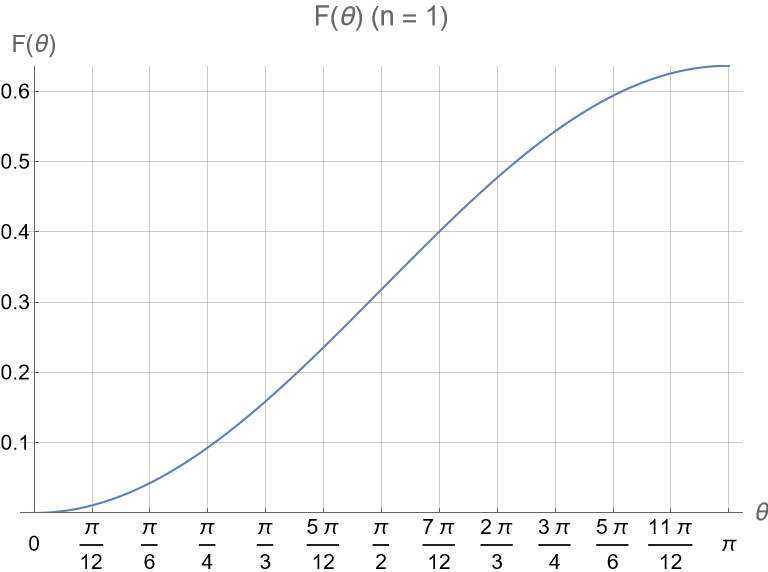
Misorientation distribution for point group \(1\)
Point Groups \(2, 3, 4, 6\)
By the \(n\)-fold rotation, as described at the end of the previous page, the folded region is \(|x| \le \tan(\pi/2n)\). The \(SO(3)\) density function \(P(\rho)\) within this region becomes \(n\) times larger (the multiplicity or order of the group) compared to the case without symmetry operations, but the shape does not change. Therefore, for \(\rho \le \tan(\pi/2n)\) or \(0 \le \theta \le \pi/n\), the entire sphere is contained within the region, so we simply multiply the above result by \(n\) and we are done.
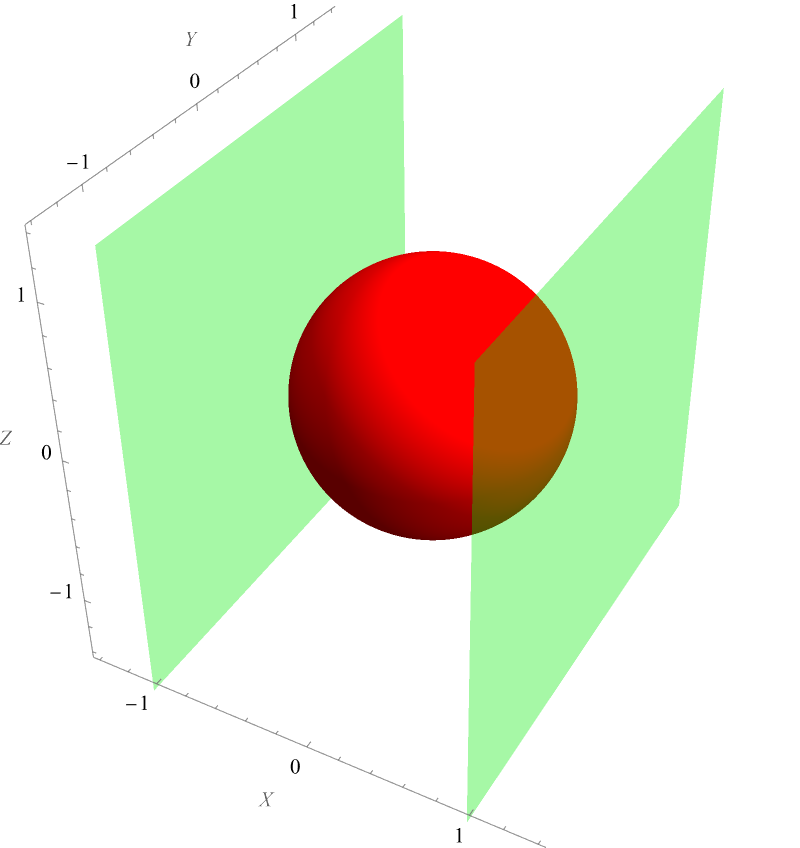
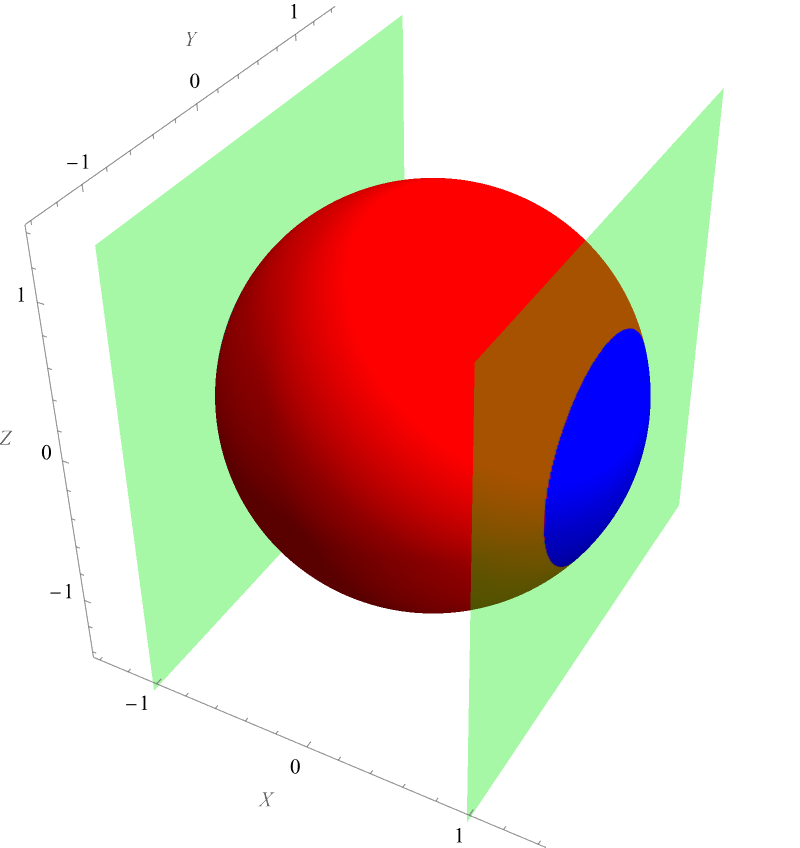
\(\rho > \tan(\pi/2n)\) case
(Figure shows the case \(n=2\))
For the case \(\rho > \tan(\pi/2n)\), we need to remove the spherical surface area outside the region, namely the area of the blue caps. The cap area, as described on the Spherical Geometry page, is \(2\pi\rho\left\{\rho-\tan(\pi/2n)\right\}\), and since there are two of them, the spherical surface area (red) contained within the region is $$
4\pi\rho^2 -2\times2\pi\rho\left\{\rho-\tan(\pi/2n)\right\} = 4\pi\rho\tan\frac{\pi}{2n}
$$Thus, the misorientation distribution function \(F\) becomes $$
F(\rho) = 4\pi\rho\tan\frac{\pi}{2n} P_n(\rho) = \frac{4n\rho\tan(\pi/2n)}{\pi (1+ \rho^2)^2}\\
F(\theta) = F(\rho)\frac{d\rho}{d\theta} = F(\rho) \frac{1+\rho^2}{2} = \frac{2n\rho}{\pi(1+\rho^2)} \tan\frac{\pi}{2n}\\
=\frac{2n}{\pi}\frac{\tan(\theta/2)}{1+\tan^2(\theta/2)}\tan\frac{\pi}{2n} = \frac{n}{\pi}\sin\theta \tan\frac{\pi}{2n}
$$which takes a simple form. Here, note that the folded density function \(P_n(\rho)\) is simply \(P(\rho)\) uniformly multiplied by \(n\), and the latter half applies trigonometric identities3. To summarize, when objects possessing an \(n\)-fold rotation element about a single axis are randomly oriented, their misorientation distribution function \(F\) is as follows:$$
F(\theta) = \frac{n}{\pi}(1-\cos\theta) \qquad (\theta \le \pi/n\ )\\
F(\theta) = \frac{n}{\pi}\sin\theta \tan\frac{\pi}{2n} \qquad (\pi/n\ \lt \theta \lt \pi )$$
Misorientation Distribution Graphs for Point Groups \(2, 3, 4, 6\)
The ranges for each interval for each point group are summarized below.
| Point Group | First Interval | Second Interval |
|---|---|---|
| \(2\) | \(\rho \le 1\) or \(\theta \le \pi/2=90^\circ\) | \(1< \rho\) or \(\pi/2=90^\circ \lt \theta \le \pi =180^\circ\) |
| \(3\) | \(\rho \le \sqrt{3}/3\) or \(\theta \le \pi/3=60^\circ\) | \(\sqrt{3}/3 \lt \rho\) or \(\pi/3=60^\circ \lt \theta \le \pi =180^\circ\) |
| \(4\) | \(\rho \le \sqrt{2}-1\) or \(\theta \le \pi/4=45^\circ\) | \(\sqrt{2}-1 \lt \rho\) or \(\pi/4=45^\circ \lt \theta \le \pi =180^\circ\) |
| \(6\) | \(\rho \le 2-\sqrt{3}\) or \(\theta \le \pi/6=30^\circ\) | \(2-\sqrt{3} \lt \rho\) or \(\pi/6=30^\circ \lt \theta \le \pi =180^\circ\) |
The specific shapes of these functions are shown below. In the range where the entire sphere is contained within the region (first interval), the function increases rapidly. When the sphere protrudes beyond the region boundary, the increase becomes gradual, reaching a maximum at \(\theta = \pi/2\). After that, it turns to decrease, reaching zero at \(\theta = \pi\).
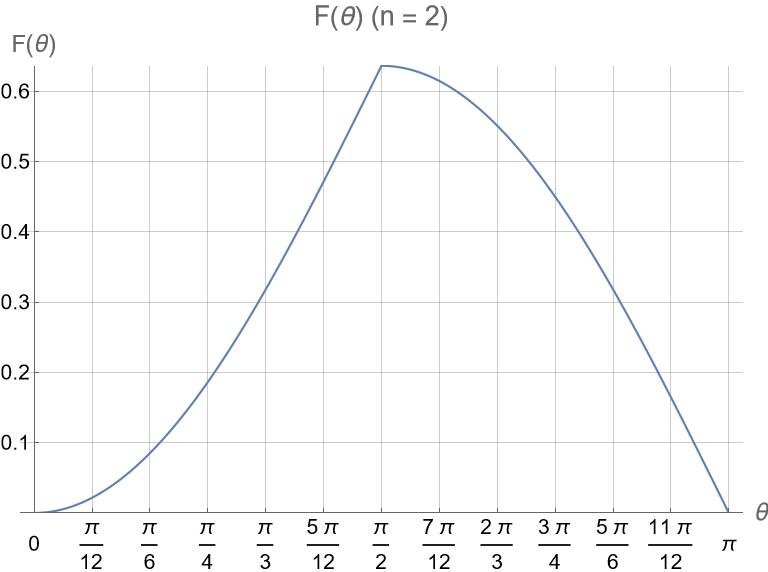
Misorientation distribution for point group \(2\)
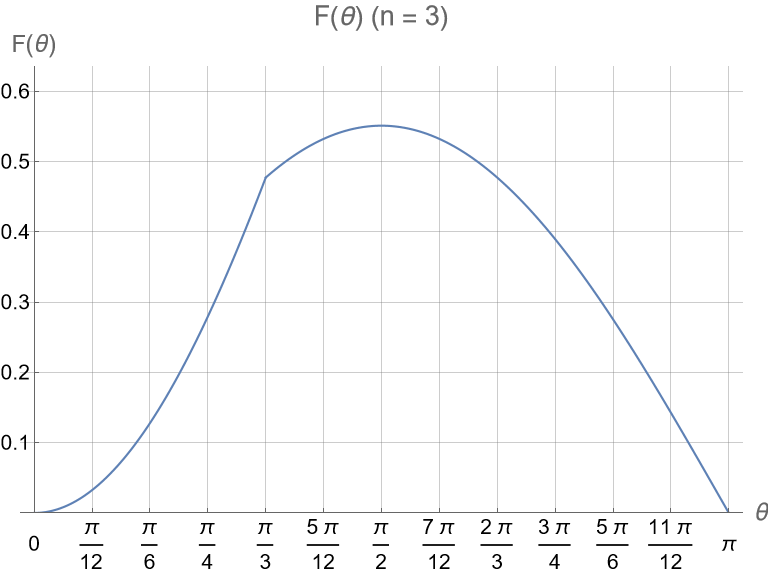
Misorientation distribution for point group \(3\)
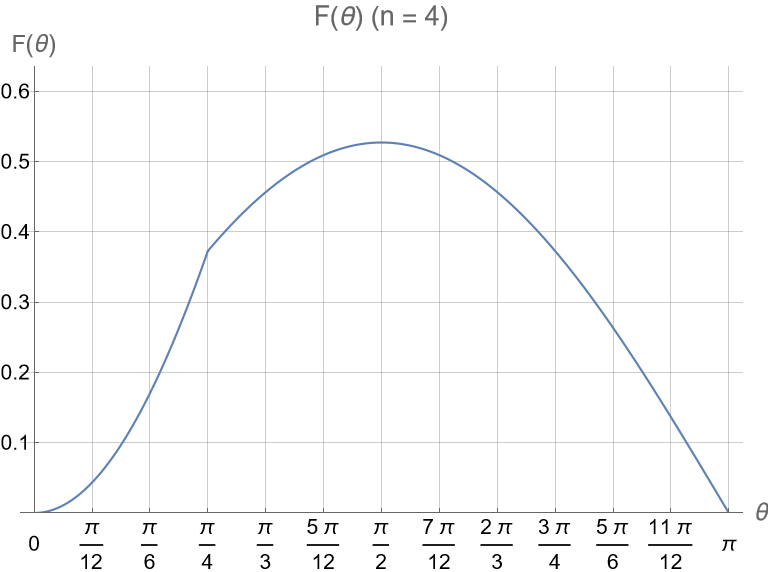
Misorientation distribution for point group \(4\)
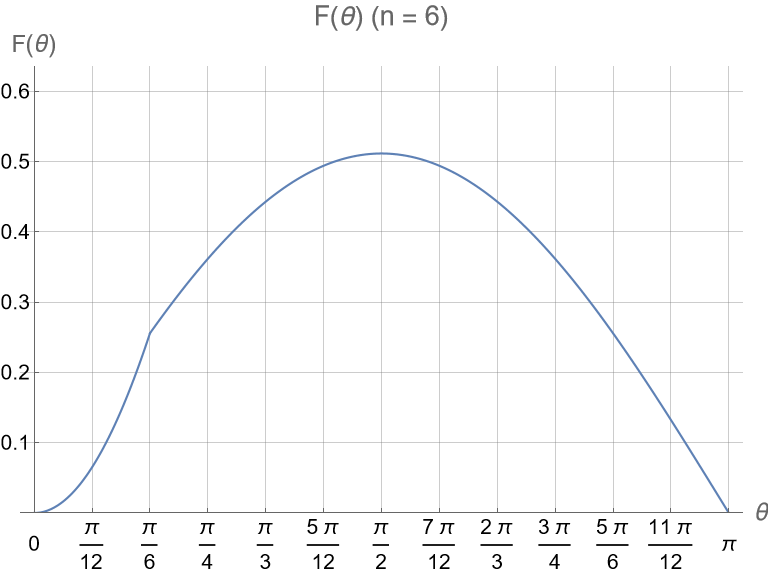
Misorientation distribution for point group \(6\)
Case of Point Groups \(222, 32, 422, 622\)
Next, let us consider the case where, in addition to a single \(n\)-fold rotation axis, there exist \(2\)-fold rotation axes perpendicular to it. Note that for all the following point groups, case distinctions by the range of \(\rho\) or \(\theta\) are necessary. We will denote the spherical surface areas corresponding to each range (interval) as \(A_1, A_2, ..\) and the misorientation distribution functions as \(F_1, F_2, ..\).
Point Group \(222\)
Point group \(222\) possesses three mutually orthogonal 2-fold rotation axes. When these are aligned with the X, Y, and Z axes, the folded region becomes \(|x| \le 1\ \&\ |y| \le 1\ \&\ |z| \le 1\) (i.e., a cube with edge length 2). Since the multiplicity is 4, the density function is also uniformly multiplied by 4.
First Interval
When \(\rho\) is small, no special treatment is needed. For the range \(\rho \le 1\) or \(0 \le \theta \le \pi/2\), as shown in the following figure4, the entire sphere is contained within the region, so the spherical area is$$A_1(\rho) = 4\pi \rho^2$$For \(F(\rho)\), noting that the density function has 4 times the density:$$
F_1(\rho) = A_1(\rho) P_{222}(\rho) = \frac{16 \rho^2}{\pi (1+ \rho^2)^2}
$$Furthermore, transforming \(\textbf{r} \to \theta\):$$
F_1(\theta) = F_1(\rho)\frac{d\rho}{d\theta} = F_1(\rho) \frac{1+\rho^2}{2} = \frac{8}{\pi} \frac{\rho^2}{1+\rho^2} \\
= \frac{4}{\pi} (1- \cos\theta ) \qquad (0 \lt \theta \le \pi/2)$$
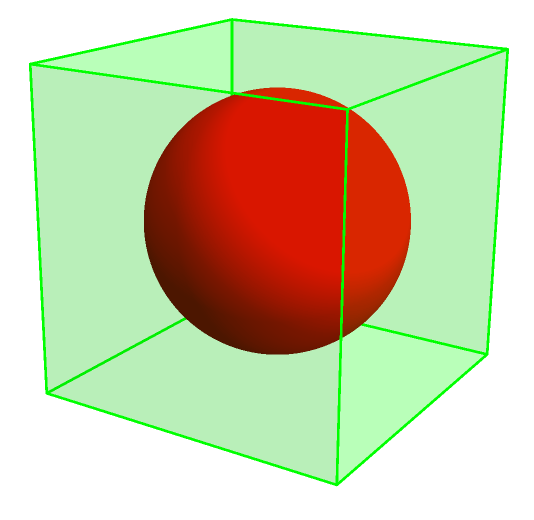
First interval \(\rho \le 1\)
(Figure shows the case \(\rho=0.8\))
Second Interval
Next is the range \(1< \rho \le \sqrt{2}\) or \(\pi/2 < \theta \le 2\tan^{-1}\sqrt{2}\). In this range, as shown in the following figure, part of the sphere protrudes from the cube, so the red area \(A_2\) is obtained by subtracting 6 blue caps from the full sphere: $$
A_2(\rho)=A_1(\rho) -6\times 2\pi \rho (\rho-1) = 12\pi \rho -2A_1(\rho)
$$In this range, \(F(\rho)\) becomes:$$
F_2(\rho) = A_2(\rho)P_{222}(\rho) = \frac{48 \rho}{\pi (1+ \rho^2)^2} -2A_1(\rho)P_{222}(\rho)
$$Furthermore, transforming \(\textbf{r} \to \theta\):$$
F_2(\theta) = F_2(\rho)\frac{d\rho}{d\theta} = F_2(\rho) \frac{1+\rho^2}{2} = \frac{24}{\pi} \frac{\rho}{1+\rho^2} -2F_1(\theta)\\
= \frac{12\sin\theta}{\pi} -2F_1(\theta) \qquad (\pi/2 < \theta \le 2\tan^{-1}\sqrt{2}\ )
$$is obtained.
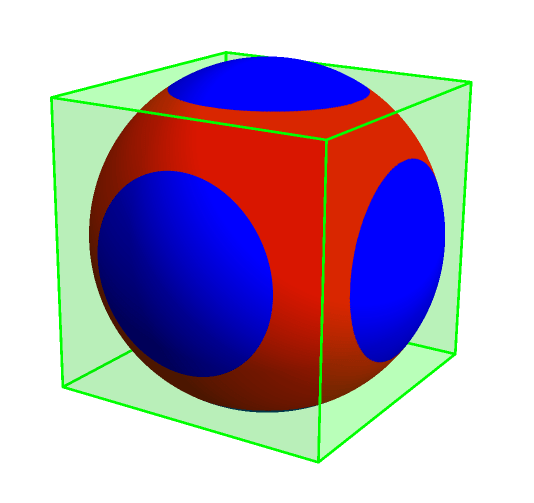
Second interval \(1< \rho \le \sqrt{2}\)
(Figure shows the case \(\rho=1.2\))
Third Interval
Finally, we consider the range \(\sqrt{2}< \rho \le \sqrt{3}\) or \(2\tan^{-1}\sqrt{2} \lt \theta \le 2\tan^{-1}\sqrt{3} = 2\pi/3\). In this range, as shown in the following figure, we need to account for the overlap between protruding caps. As described on the Spherical Geometry page, when two caps on a unit sphere are orthogonal and have the same half-angle, the overlap area \(S\) is:$$
S=2\cos^{-1}( \cot^2 \Theta) -4\cos\Theta \cos^{-1}(\cot \Theta)
$$where \(\Theta\) is the half-angle of the cap. The cap overlaps exist near each edge of the cube, so there are 12 in total. Therefore, the spherical area contained within the cube \(A\) is obtained by subtracting 6 caps from the full sphere and adding back 12 cap overlaps.
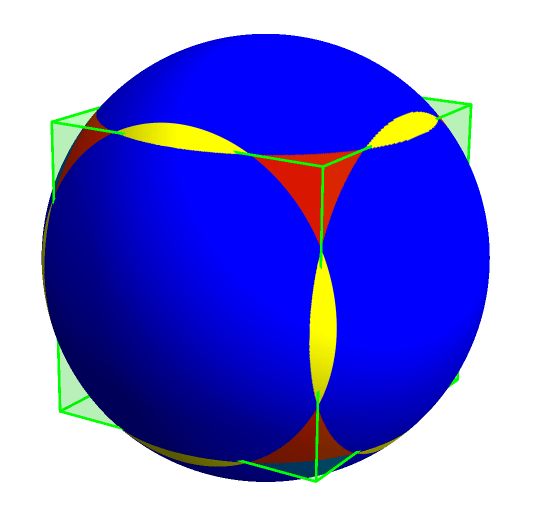
Third interval \(\sqrt{2}< \rho \le \sqrt{3}\)
(Figure shows the case \(\rho=1.6\))
With this, the approach is determined. First, for the cap overlap, considering that the sphere has radius \(\rho\) (i.e., a factor of \(\rho^2\) is needed) and that \(\cos\Theta = 1/\rho\):$$
A_3(\rho)= A_2(\rho) +12 \times \left[ 2\rho^2\cos^{-1}( \cot^2 \Theta) -4\rho\cos^{-1}(\cot \Theta) \right]
$$From this, let us derive \(F\):$$
F_3(\rho) = A_3(\rho) P_{222}(\rho) =A_2(\rho)P_{222}(\rho) + 96\frac{\rho^2\cos^{-1}( \cot^2 \Theta) -2\rho\cos^{-1}(\cot \Theta)}{\pi^2 (1+ \rho^2)^2}
$$Transforming \(\textbf{r} \to \theta\):$$
F_3(\theta) = F_3(\rho)\frac{d\rho}{d\theta} = F_3(\rho) \frac{1+\rho^2}{2}
= F_2(\theta) + \frac{48}{\pi^2}\frac{\rho^2\cos^{-1}( \cot^2 \Theta) -2\rho\cos^{-1}(\cot \Theta)}{1+ \rho^2}\\
= F_2(\theta) +\frac{24}{\pi^2} \left[ \cos^{-1}( \cot^2 \Theta)(1-\cos\theta)-2\cos^{-1}(\cot \Theta)\sin\theta \right]
$$Finally, substituting$$
\cot^2\Theta = \frac{ \cos^2\Theta}{\sin^2\Theta} = \frac{1}{\rho^2-1} = -\frac{1+\cos\theta}{2 \cos\theta}
$$we obtain:$$
F_3(\theta)= F_2(\theta) + \frac{24}{\pi^2} \left[\cos^{-1}\left(-\frac{1+\cos\theta}{2 \cos\theta}\right) (1-\cos\theta) -2\cos^{-1}\left(\sqrt{-\frac{1+\cos\theta}{2 \cos\theta}}\right)\sin\theta \right] \\ (2\tan^{-1}\sqrt{2} \lt \theta \le 2\pi/3 )
$$
Point Groups \(32, 422, 622\)
Since the derivation procedure is common for point groups \(32, 422, 622\), we present them together. These point groups possess an \(n\)-fold axis (the first number) as the principal axis and \(n\) 2-fold axes perpendicular to it. The folded region is a regular \(2n\)-gonal prism. The distance from the center to the top and bottom faces is \(\tan(\pi/2n)\), and the distance to the side faces is \(1\). The multiplicity (order) of these groups is \(2n\). First, we show schematic diagrams of the interval divisions.
Intervals for Point Group \(32\)
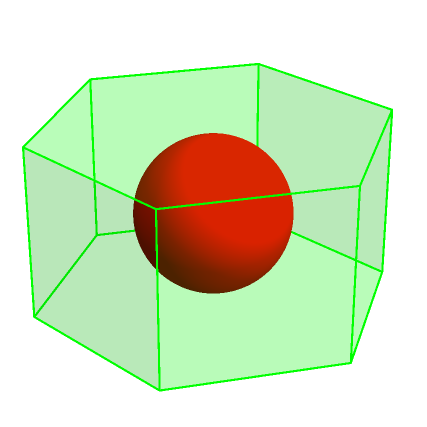
First interval
\(\rho \le \sqrt{3}/3\)
(Figure for \(\rho=0.5\))
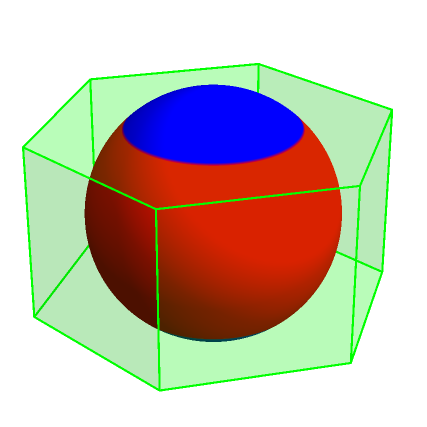
Second interval
\(\sqrt{3}/3 \lt \rho \le 1\)
(Figure for \(\rho=0.8\))
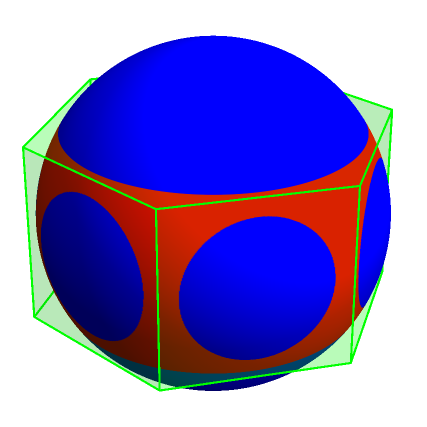
Third interval
\(1 \lt \rho \le 2\sqrt{3}/3\)
(Figure for \(\rho=1.1\))
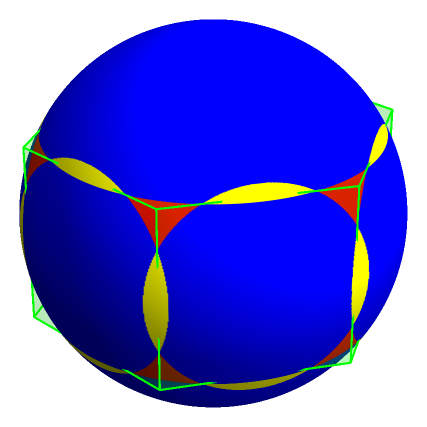
Fourth interval
\(2\sqrt{3}/3 \lt \rho \le \sqrt{5/3}\)
(Figure for \(\rho=1.2\))
Intervals for Point Group \(422\)
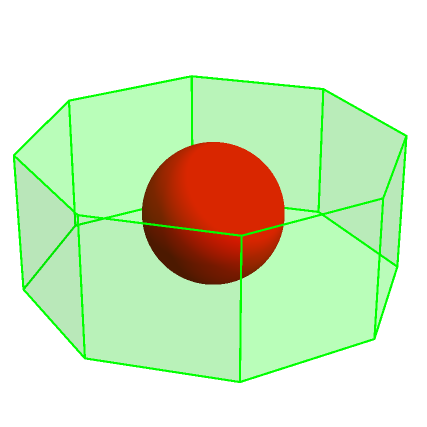
First interval
\(\rho \le \sqrt{2}-1\)
(Figure for \(\rho=0.4\))
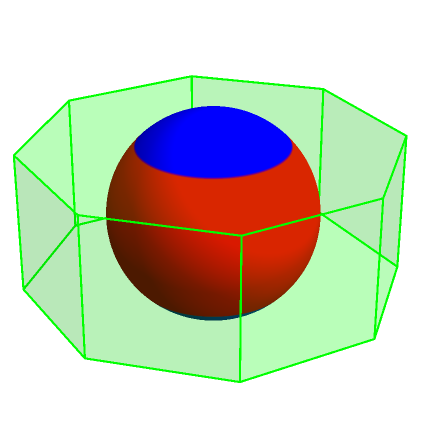
Second interval
\(\sqrt{2}-1 \lt \rho \le 1\)
(Figure for \(\rho=0.6\))
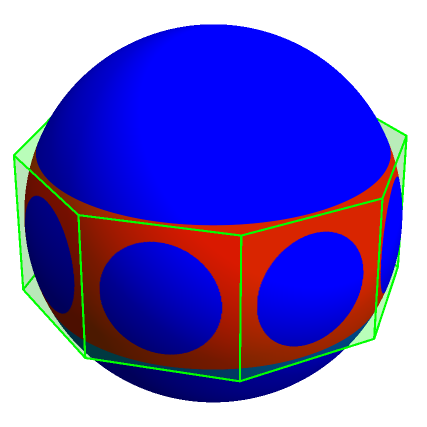
Third interval
\(1 \lt \rho \le \sqrt{4-2\sqrt{2}}\)
(Figure for \(\rho=1.05\))
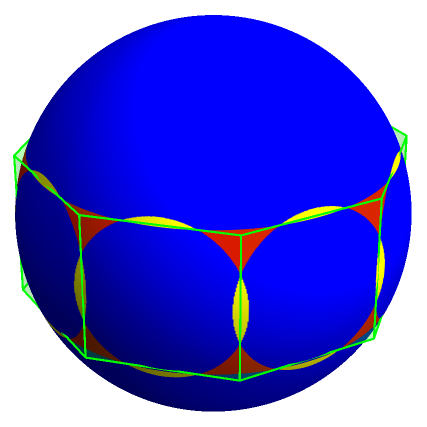
Fourth interval
\( \sqrt{4-2\sqrt{2}} \lt \rho \le \sqrt{7-4\sqrt{2}}\)
(Figure for \(\rho=1.1\))
Intervals for Point Group \(622\)
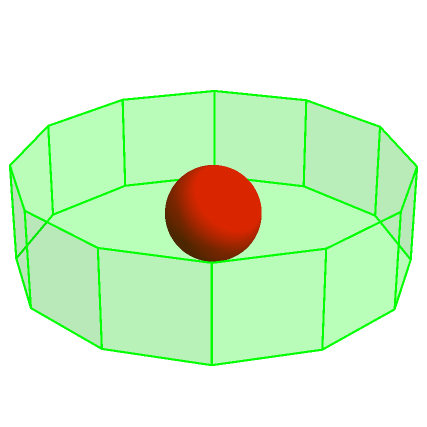
First interval
\(\rho \le 2-\sqrt{3}\)
(Figure for \(\rho=0.25\))
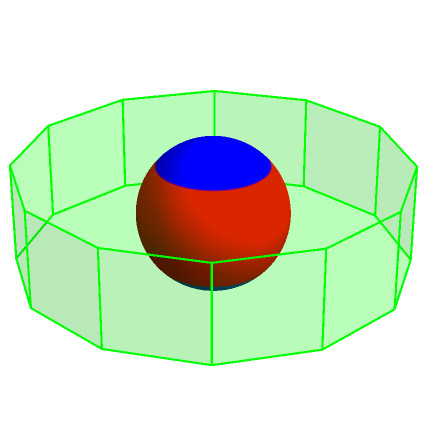
Second interval
\(2-\sqrt{3} \lt \rho \le 1\)
(Figure for \(\rho=0.4\))
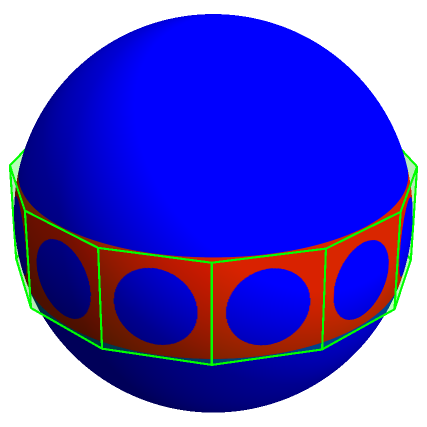
Third interval
\(1 \lt \rho \le \sqrt{6}-\sqrt{2}\)
(Figure for \(\rho=1.02\))
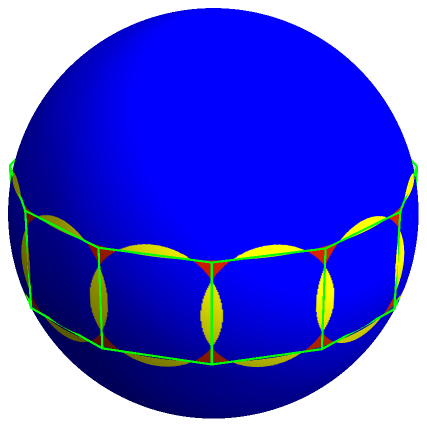
Fourth interval
\(\sqrt{6}-\sqrt{2} \lt \rho \le \sqrt{15-8\sqrt{3}}\)
(Figure for \(\rho=1.05\))
First, Second, and Third Intervals
The first interval is the case where the entire sphere is contained within the regular \(2n\)-gonal prism. As before:$$
A_1(\rho) = 4\pi\rho^2\\
F_1(\theta) = \frac{2n}{\pi} (1-\cos\theta )
$$The second interval is the case where the sphere protrudes only from the two top/bottom faces, and similarly to the derivation for point groups \(2, 3, 4, 6\):$$
A_2(\rho)=A_1(\rho) -4\pi\rho\left(\rho-\tan\frac{\pi}{2n}\right) = 4\pi\rho\tan\frac{\pi}{2n}\\
F_2(\theta)=\frac{2n}{\pi}\sin\theta \tan\frac{\pi}{2n}
$$The third interval is the case where the sphere also protrudes from the \(2n\) side faces. The spherical area within the solid \(A_3\) in this interval is:$$
A_3(\rho)= A_2(\rho) -2n\times2\pi \rho (\rho-1) = -n A_1(\rho) +A_2(\rho) + 4n\pi\rho
$$Focusing only on the \(4n\pi\rho\) part and expanding, we easily obtain:$$
F_3(\theta)=-nF_1(\theta) +F_2(\theta) + \frac{2n^2}{\pi}\sin\theta$$Up to this point, it is straightforward.
Fourth Interval
In the final fourth interval, we account for overlaps between caps. Letting the half-angles of the side-face caps and top/bottom-face caps be \(\Theta_1, \Theta_2\) respectively:$$
\cos\Theta_1= \frac{1}{\rho},\ \sin\Theta_1=\frac{\sqrt{\rho^2-1}}{\rho},\ \cos\Theta_2=\frac{\tan(\pi/2n)}{\rho},\ \sin\Theta_2=\frac{\sqrt{\rho^2-\tan^2(\pi/2n)}}{\rho}\
$$The overlap area \(S_1\) between a side-face cap and a top/bottom-face cap (which are perpendicular) is (noting the factor of \(\rho^2\) for a sphere of radius \(\rho\)):$$
S_1(\rho)=2\rho^2\left\{ \cos^{-1} (\cot \Theta_1 \cot \Theta_2)
-\cos\Theta_1 \cos^{-1}\left( \frac{\cos\Theta_2 }{\sin\Theta_1} \right)
-\cos\Theta_2 \cos^{-1} \left( \frac{\cos\Theta_1}{\sin\Theta_2} \right)\right\} \\
=2\rho^2 \cos^{-1} \left( \frac{\tan\frac{\pi}{2n}}{\sqrt{(\rho^2-1)(\rho^2 -\tan^2\frac{\pi}{2n})}} \right)
-2\rho \left\{ \cos^{-1}\left( \frac{\tan\frac{\pi}{2n}}{\sqrt{\rho^2-1}} \right)
+\tan\frac{\pi}{2n} \cos^{-1} \left( \frac{1}{\sqrt{\rho^2 -\tan^2\frac{\pi}{2n}}} \right) \right\}
$$ For ease of subsequent development, we write this as$$S_1(\rho)= 2 \rho^2\, S_{11}(\rho) -2\rho\, S_{12}(\rho)$$Next, the overlap between side-face caps. Since the angle between caps is \(\alpha=\pi/n\) and the half-angles \(\Theta= \Theta_1\) are identical, the overlap area \(S_2\) is:$$
S_2(\rho)= 2\rho^2 \left\{ \cos^{-1} \left( \frac{\cos^2 \Theta -\cos\alpha}{\sin^2\Theta}\right)
-2\cos\Theta \cos^{-1}\left( \frac{1 -\cos\alpha}{\tan\Theta \sin\alpha} \right) \right\} \\
= 2\rho^2 \cos^{-1} \left( \frac{1 -\rho^2\cos\frac{\pi}{n}}{\rho^2-1}\right)
-4\rho \cos^{-1}\left( \frac{1 -\cos\frac{\pi}{n}}{\sqrt{\rho^2-1} \sin\frac{\pi}{n} } \right)
$$We also write this as$$S_2(\rho)= 2 \rho^2\, S_{21}(\rho) -2\rho\, S_{22}(\rho)$$Thus, the spherical area within the solid for this interval \(A_4\) is obtained by adding \(4n\) copies of \(S_1\) and \(2n\) copies of \(S_2\) to \(A_3\):$$
A_4(\rho)= A_3(\rho) + 4n S_1(\rho) + 2n S_2(\rho) = A_3(\rho) + 4n \left[\rho^2 \left\{2S_{11}(\rho) + S_{21}(\rho) \right\}-\rho \left\{2S_{12}(\rho) + S_{22}(\rho) \right\} \right]
$$Therefore, \(F_4(\theta)\) is:$$
F_4(\theta) = F_3(\theta) + \frac{2n^2 }{\pi^2} \left[ (1-\cos\theta) \left\{ 2S_{11}(\theta) + S_{21}(\theta) \right\} – \sin\theta \left\{ 2S_{12}(\theta) + S_{22}(\theta) \right\} \right]
$$where \(S_{11}(\theta),S_{12}(\theta),S_{21}(\theta),S_{22}(\theta)\) are:$$
S_{11}(\theta) = \cos^{-1} \left( \frac{\tan\frac{\pi}{2n}}{\sqrt{(\rho^2-1)(\rho^2 -\tan^2\frac{\pi}{2n})}} \right), \quad
S_{12}(\theta) = \cos^{-1}\left( \frac{\tan\frac{\pi}{2n}}{\sqrt{\rho^2-1}} \right)
+\tan\frac{\pi}{2n} \cos^{-1} \left( \frac{1}{\sqrt{\rho^2 -\tan^2\frac{\pi}{2n}}} \right) \\
S_{21}(\theta)=\cos^{-1} \left( \frac{1 -\rho^2\cos\frac{\pi}{n}}{\rho^2-1}\right), \quad
S_{22}(\theta)=2\cos^{-1}\left( \frac{1 -\cos\frac{\pi}{n}}{\sqrt{\rho^2-1} \sin\frac{\pi}{n} } \right)
$$and of course \(\rho(\theta) = \tan(\theta/2)\).
Misorientation Distribution Graphs for Point Groups \(222, 32, 422, 622\)
The ranges for each interval for each point group are summarized below.
| Point Group | First Interval | Second Interval | Third Interval | Fourth Interval |
|---|---|---|---|---|
| \(222\) | \(\rho \le 1\) \(\theta \le \pi/2=90^\circ\) | \(1< \rho \le \sqrt{2}\) \(\pi/2=90^\circ \lt \theta \le 109.47^\circ\) | \(\sqrt{2} \lt \rho \le \sqrt{3}\) \(109.47^\circ< \theta \le 2\pi/3=120^\circ\) | |
| \(32\) | \(\rho \le \sqrt{3}/3\) \(\theta \le \pi/3=60^\circ\) | \(\sqrt{3}/3 \lt \rho \le 1\) \(\pi/3=60^\circ \lt \theta \le \pi/2=90^\circ\) | \(1 \lt \rho \le 2\sqrt{3}/3\) \(\pi/2=90^\circ \lt \theta \le 98.21^\circ\) | \(2\sqrt{3}/3 \lt \rho \le \sqrt{5/3}\) \(98.21^\circ \lt \theta \le 104.48^\circ\) |
| \(422\) | \(\rho \le \sqrt{2}-1\) \(\theta \le \pi/4=45^\circ\) | \(\sqrt{2}-1 \lt \rho \le 1\) \(\pi/4=45^\circ \lt \theta \le \pi/2=90^\circ\) | \(1 \lt \rho \le \sqrt{4-2\sqrt{2}}\) \(\pi/2=90^\circ \lt \theta \le 94.53^\circ\) | \( \sqrt{4-2\sqrt{2}} \lt \rho \le \sqrt{7-4\sqrt{2}}\) \(94.53^\circ \lt \theta \le 98.42^\circ\) |
| \(622\) | \(\rho \le 2-\sqrt{3}\) \(\theta \le \pi/6=30^\circ\) | \(2-\sqrt{3} \lt \rho \le 1\) \(\pi/6=30^\circ \lt \theta \le \pi/2=90^\circ\) | \(1 \lt \rho \le \sqrt{6}-\sqrt{2}\) \(\pi/2=90^\circ \lt \theta \le 91.99^\circ\) | \(\sqrt{6}-\sqrt{2} \lt \rho \le \sqrt{15-8\sqrt{3}}\) \(91.99^\circ \lt \theta \le 93.84^\circ\) |
The misorientation distribution graphs are shown below. In the range where the entire sphere is contained within the solid (first interval), the function increases rapidly. Then, when the sphere protrudes from the top/bottom faces (second interval for point groups \(32, 422, 622\)), the increase becomes gradual. When the sphere also protrudes from the side faces (second interval for point group \(222\) or third interval for point groups \(32, 422, 622\)), a rapid decrease begins. Finally, when cap overlaps begin to occur (third interval for point group \(222\) or fourth interval for point groups \(32, 422, 622\)), the decrease becomes gradual as the function drops to 0.
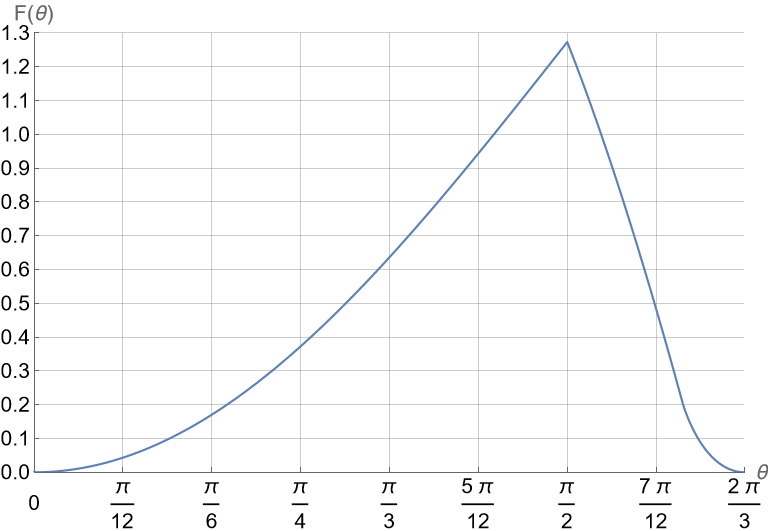
Misorientation distribution for point group \(222\)
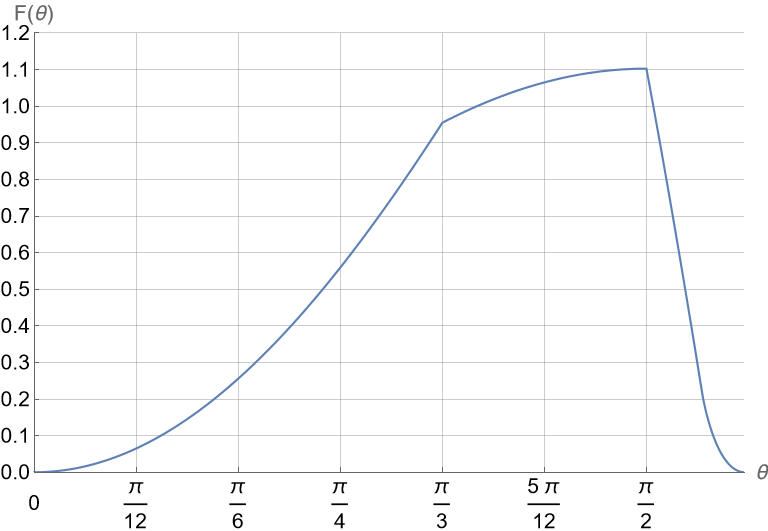
Misorientation distribution for point group \(32\)
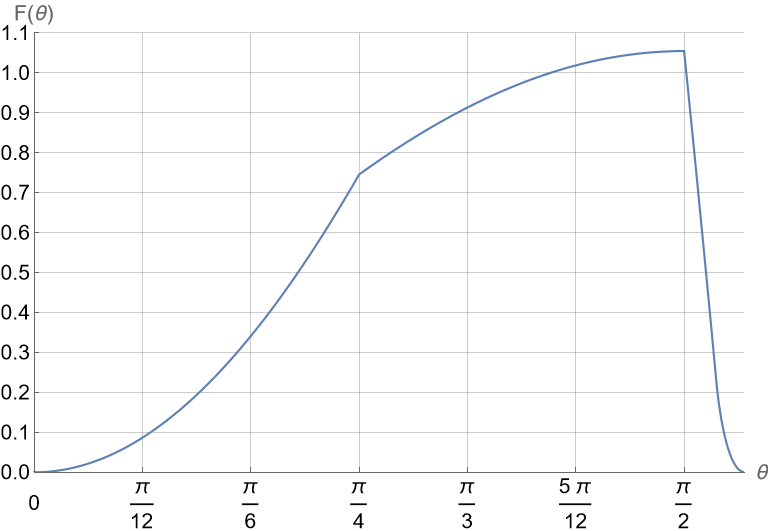
Misorientation distribution for point group \(422\)
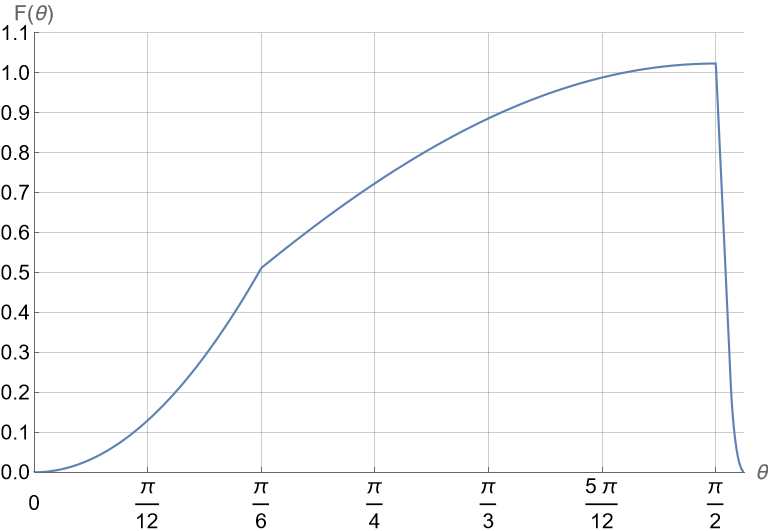
Misorientation distribution for point group \(622\)
Case of Point Groups \(23, 432\)
Finally, we address point groups \(23, 432\).
Point Group \(23\)
In point group \(23\), four 3-fold rotation axes fold Rodrigues space into an octahedral shape. The distance from the center to each face is \(\sqrt{3}/3\). The vertex directions of the octahedron correspond to the 2-fold rotation axes, but they do not affect the shape. The multiplicity is 12, and the orientation density is uniformly 12 times higher.
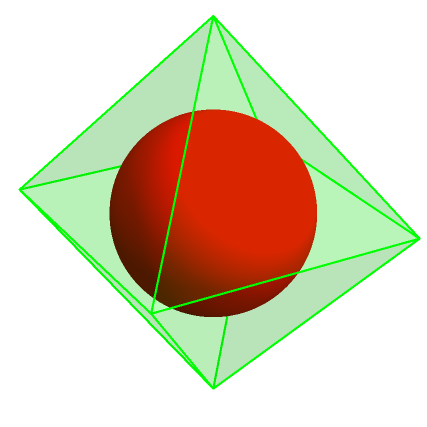
First interval
\(\rho \le \sqrt{3}/3\)
(Figure for \(\rho=0.5\))
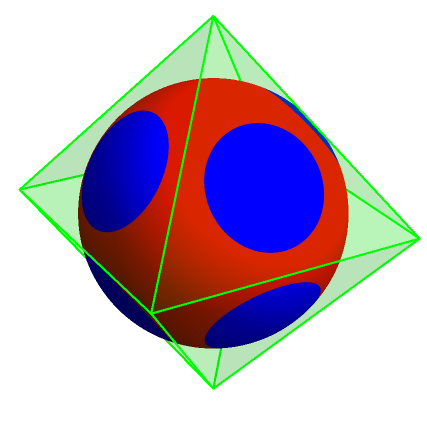
Second interval
\(\sqrt{3}/3 \lt \rho \le \sqrt{2}/2\)
(Figure for \(\rho=0.65\))
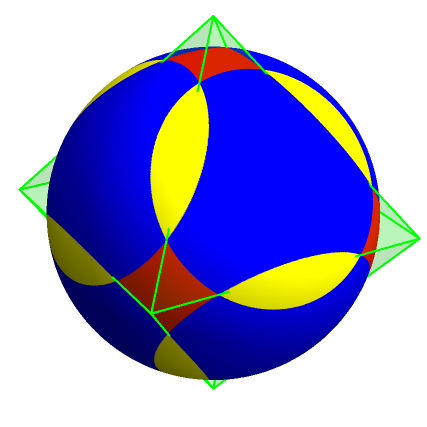
Third interval
\(\sqrt{2}/2 \lt \rho \le 1\)
(Figure for \(\rho=0.8\))
First and Second Intervals
Let us proceed with the same approach as before. The first interval is the case where the entire sphere is contained within the octahedron. As before:$$
A_1(\rho) = 4\pi\rho^2\\
F_1(\theta) = \frac{12}{\pi} (1-\cos\theta )
$$The second interval is the case where the sphere protrudes from the eight faces:$$
A_2(\rho)=A_1(\rho) -8\times 2\pi\rho\left(\rho-\tan\frac{\pi}{6}\right) = -3A_1(\rho) +\frac{16}{\sqrt{3}}\pi\rho\\
F_2(\theta)= -3F_1(\theta) + \frac{48}{\sqrt{3}\pi} \sin\theta
$$Up to this point, it is straightforward.
Third Interval
The third interval accounts for cap overlaps. Since the half-angles \(\Theta\) are identical:$$
\cos\Theta=\frac{1}{\sqrt{3}\rho},\ \sin\Theta=\frac{\sqrt{3\rho^2-1}}{\sqrt{3}\rho}
$$Also, letting the angle between caps be \(\alpha\) for the octahedron:$$\cos\alpha=\frac{1}{3},\quad \sin\alpha=\frac{2\sqrt{2}}{3}$$ The overlap area \(S\) is:$$
S(\rho)= 2\rho^2 \cos^{-1} \left( \frac{1 -\rho^2}{3\rho^2-1}\right)
-\frac{4\rho}{\sqrt{3}} \cos^{-1}\left( \frac{1}{ \sqrt{6\rho^2-2}} \right)
$$Since the octahedron has 12 edges:$$
A_3(\rho)=A_2(\rho) +12S(\rho)=A_2(\rho) + 24\rho^2 \cos^{-1} \left( \frac{1 -\rho^2}{3\rho^2-1}\right)
-\frac{48\rho}{\sqrt{3}} \cos^{-1}\left( \frac{1}{ \sqrt{6\rho^2-2}} \right)
$$Finally:$$
F_3(\theta)=F_2(\theta) + \frac{72}{\pi^2} \cos^{-1} \left( \frac{1 -\rho^2}{3\rho^2-1}\right) (1-\cos\theta) -\frac{144}{\sqrt{3}\pi^2} \cos^{-1}\left( \frac{1}{ \sqrt{6\rho^2-2}} \right) \sin\theta\\
=F_2(\theta) + \frac{72}{\pi^2}
\left\{ \cos^{-1} \left( \frac{1 -\tan^2\frac{\theta}{2}}{3\tan^2\frac{\theta}{2}-1}\right) (1-\cos\theta) -\frac{2}{\sqrt{3}} \cos^{-1}\left( \frac{1}{ \sqrt{6\tan^2\frac{\theta}{2}-2}} \right) \sin\theta \right\}
$$
Point Group \(432\)
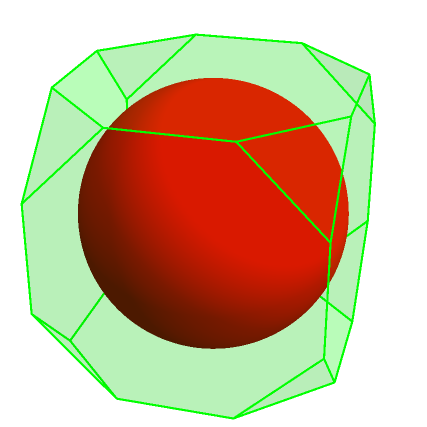
First interval
\(\rho \le \sqrt{2}-1\)
(Figure for \(\rho=0.4\))
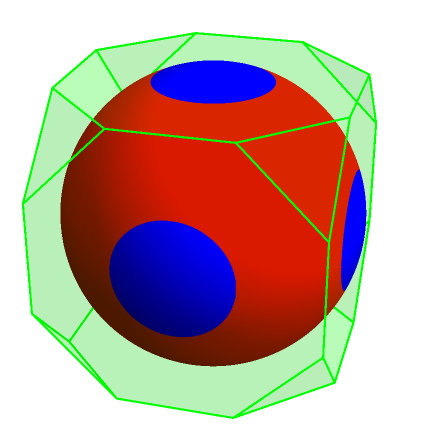
Second interval
\(\sqrt{2}-1 \lt \rho \le \sqrt{3}/3\)
(Figure for \(\rho=0.45\))
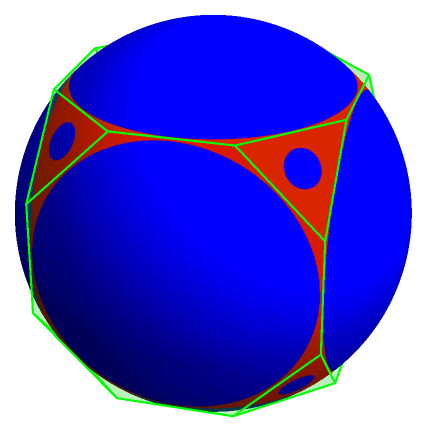
Third interval
\(\sqrt{3}/3 \lt \rho \le 2-\sqrt{2}\)
(Figure for \(\rho=0.58\))
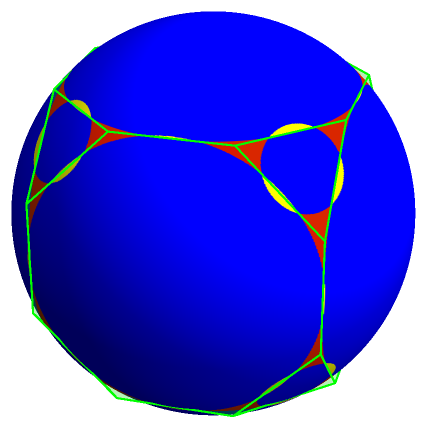
Fourth interval
\(2-\sqrt{2} \lt \rho \le \sqrt{23-16\sqrt{2}}\)
(Figure for \(\rho=0.59\))
Finally, we consider point group \(432\). The folded region has a shape like a cube with each vertex truncated5, a solid bounded by regular octagons and equilateral triangles. The regular octagons arise from the three 4-fold rotation axes, and the distance from the center is \(\sqrt{2}-1\). The multiplicity is 24, and the orientation density is uniformly 24 times higher.
First, Second, and Third Intervals
The first interval is the case where the entire sphere is contained within the solid. As before:$$
A_1(\rho) = 4\pi\rho^2\\
F_1(\theta) = \frac{24}{\pi} (1-\cos\theta )
$$The second interval is the case where the sphere protrudes from the regular octagonal faces (6 faces):$$
A_2(\rho)=A_1(\rho) -6\times 2\pi\rho\left(\rho-\tan\frac{\pi}{8}\right) = -2A_1(\rho) +12(\sqrt{2}-1)\pi\rho\\
F_2(\theta)= -2F_1(\theta) + \frac{72(\sqrt{2}-1)}{\pi} \sin\theta
$$The third interval accounts for protrusion from the faces constituting the octahedral portion, so referring to the second interval of point group \(23\):$$
A_3(\rho)=A_2(\rho)-8\times 2\pi\rho\left(\rho-\frac{1}{\sqrt{3}}\right) =- 4A_1(\rho)+ A_2(\rho) +\frac{16}{\sqrt{3}}\pi\rho\\
F_3(\theta)= -4F_1(\theta) + F_2(\theta) + \frac{96}{\sqrt{3}\pi} \sin\theta
$$
Fourth Interval
The fourth interval involves overlaps between caps protruding from the octahedral faces and caps protruding from the cubical faces. Letting the half-angles be \(\Theta_1, \Theta_2\):$$
\cos\Theta_1=\frac{1}{\sqrt{3}\rho},\quad
\sin\Theta_1=\frac{\sqrt{3\rho^2-1}}{\sqrt{3}\rho},\quad
\cos\Theta_2=\frac{\sqrt{2}-1}{\rho},\quad
\sin\Theta_2=\frac{\sqrt{\rho^2 -3+2\sqrt{2}}}{\rho}
$$Also, letting the angle between caps be \(\alpha\):$$\cos\alpha=\frac{1}{\sqrt{3}},\quad \sin\alpha=\sqrt{\frac{2}{3}}$$ The overlap area \(S\) is:$$
S(\rho)
=2\rho^2 \cos^{-1}\left[ \frac{\sqrt{2}-1-\rho^2}{\sqrt{3\rho^2-1}\sqrt{\rho^2 -3+2\sqrt{2}} }\right]
-2\rho \left\{ \frac{1}{\sqrt{3}} \cos^{-1}\left[\frac{3-2\sqrt{2}}{\sqrt{3\rho^2-1}} \right]
+(\sqrt{2}-1) \cos^{-1} \left[\frac{\sqrt{2}-1}{\sqrt{\rho^2 -3+2\sqrt{2}}} \right] \right\}
$$Since there are 24 such cap overlaps in total, the area \(A_4\) is:$$
A_4(\rho) = A_3(\rho) +24 S(\rho)
$$Finally, \(F_4(\theta)\) for this interval is:$$\begin{array}{l}
F_4(\theta) = F_3(\theta) +\Large{\frac{96}{\pi^2}}\\
\qquad \times \left\{
3(1-\cos\theta) \cos^{-1}\left[ \frac{\sqrt{2}-1-\rho^2}{\sqrt{3\rho^2-1}\sqrt{\rho^2 -3+2\sqrt{2}} }\right]
-\sqrt{3}\sin\theta \cos^{-1}\left[\frac{3-2\sqrt{2}}{\sqrt{3\rho^2-1}} \right]
-3(\sqrt{2}-1)\sin\theta \cos^{-1} \left[\frac{\sqrt{2}-1}{\sqrt{\rho^2 -3+2\sqrt{2}}} \right]
\right\}\end{array}
$$where of course \(\rho(\theta) = \tan(\theta/2)\).
Misorientation Distribution Graphs for Point Groups \(23, 432\)
The ranges for each interval and the misorientation distribution graphs are summarized below.
| Point Group | First Interval | Second Interval | Third Interval | Fourth Interval |
|---|---|---|---|---|
| \(23\) | \(\rho \le \sqrt{3}/3\) \(\theta \le \pi/3=60^\circ\) | \(\sqrt{3}/3 \lt \rho \le \sqrt{2}/2\) \(\pi/3=60^\circ \lt \theta \le 70.53^\circ\) | \(\sqrt{2}/2 \lt \rho \le 1\) \(70.53^\circ \lt \theta \le \pi/2=90^\circ\) | |
| \(432\) | \(\rho \le \sqrt{2}-1\) \(\theta \le \pi/4=45^\circ\) | \(\sqrt{2}-1 \lt \rho \le \sqrt{3}/3\) \(\pi/4=45^\circ \lt \theta \le \pi/3=60^\circ\) | \(\sqrt{3}/3 \lt \rho \le 2-\sqrt{2}\) \(\pi/3=60^\circ \lt \theta \le 60.72^\circ\) | \(2-\sqrt{2} \lt \rho \le \sqrt{23-16\sqrt{2}}\) \(60.72^\circ \lt \theta \le 62.80^\circ\) |
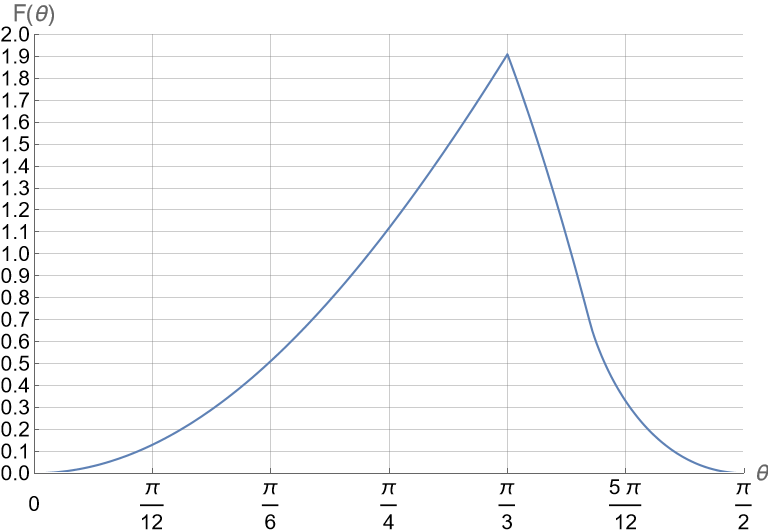
Misorientation distribution for point group \(23\)
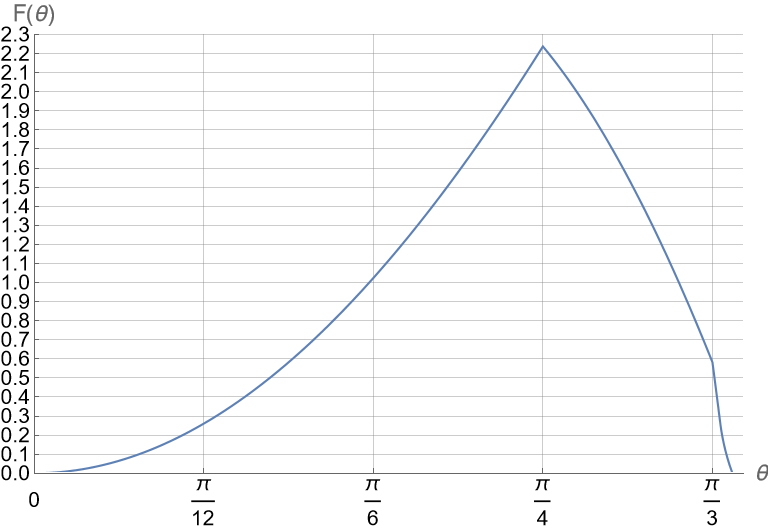
Misorientation distribution for point group \(432\)
- In Mathematica, with the following command
n = 1;
f[[Theta]_] := Piecewise[{{(n/Pi) (1 – Cos[[Theta]]), [Theta] <= Pi/n}, {(n/Pi) Sin[[Theta]] Tan[Pi/(2 n)], Pi/n < [Theta] <= Pi}}];
tickStyle = 16;
xticks = Table[{k Pi/12, Style[If[k == 0, 0, TraditionalForm[k Pi/12]], tickStyle]}, {k, 0, 12}];
yticks = Table[{y, Style[TraditionalForm[y], tickStyle]}, {y, 0, 1, 0.1}];
g = Plot[f[[Theta]], {[Theta], 0, Pi}, PlotRange -> {0, 2/Pi}, Ticks -> {xticks, yticks}, AxesLabel -> (Style[#, 18] & /@ {“[Theta]”, “F([Theta])”}), PlotLabel -> Style[Row[{“F([Theta]) (n = “, n, “)”}], 20], PlotPoints -> 2000, MaxRecursion -> 2,
GridLines -> {Range[0, Pi, Pi/12], Automatic}, ImageSize -> Large];
g
CopyToClipboard[g] ↩︎ - In Mathematica, with the following command
r = 0.8; a = 1; L = 1.3;
sphere = ParametricPlot3D[r {Sin[th] Cos[ph], Sin[th] Sin[ph], Cos[th]}, {th, 0, Pi}, {ph, 0, 2 Pi}, Mesh -> None, PlotPoints -> 600, MaxRecursion -> 4, PerformanceGoal -> “Quality”, ColorFunctionScaling -> False, ColorFunction ->
Function[{x, y, z, th, ph}, If[Abs[x] > a, Blue, Red]]];
planePos = Graphics3D[{Directive[Green, Opacity[0.35]], Polygon[{{a, -r2, -r2}, {a, r2, -r2}, {a, r2, r2}, {a, -r2, r2}}]}];
planeNeg = Graphics3D[{Directive[Green, Opacity[0.35]], Polygon[{{-a, -r2, -r2}, {-a, r2, -r2}, {-a, r2, r2}, {-a, -r2, r2}}]}];
g = Show[sphere, planePos, planeNeg, PlotRange -> {{-L, L}, {-L, L}, {-L, L}}, PlotRangeClipping -> True, BoxRatios -> {1, 1, 1}, Boxed -> False, Axes -> True, AxesLabel -> {Style[“X”, FontFamily -> “Times”, FontSlant -> Italic, FontSize -> 16], Style[“Y”, FontFamily -> “Times”, FontSlant -> Italic, FontSize -> 16], Style[“Z”, FontFamily -> “Times”, FontSlant -> Italic, FontSize -> 16]}, LabelStyle -> Directive[FontFamily -> “Times”, 16], Lighting -> “Neutral”, ImageSize -> 600];
CopyToClipboard[g] ↩︎ - ↩︎
- In Mathematica, with the following command
r = 1.5;
sphere = ParametricPlot3D[ r {Sin[th] Cos[ph], Sin[th] Sin[ph], Cos[th]}, {th, 0, Pi}, {ph, 0, 2 Pi}, Mesh -> None, ColorFunction -> Function[{x, y, z, th, ph}, With[{v = Abs[{x, y, z}]}, Which[Max[v] < 1, Red, Sort[v][[-2]] > 1, Yellow, True, Blue]]], ColorFunctionScaling -> False, PlotPoints -> {1280, 1280}, MaxRecursion -> 2, PerformanceGoal -> “Quality”, PlotRange -> All];
cube = Graphics3D[{FaceForm[Directive[Green, Opacity[0.15]]], EdgeForm[{Thick, Green}], Cuboid[{-1, -1, -1}, {1, 1, 1}]}];
Show[sphere, cube, PlotRange -> All, Boxed -> False, Axes -> False, ImageSize -> 400]
↩︎ - This shape is also sometimes called a truncated hexahedron. ↩︎