Let us consider the microstructure formed when a crystal with space group \(G\) undergoes a phase transition to a subgroup \(H\) due to environmental changes (such as a decrease in temperature).
Twins
When \(H\) is a t-subgroup (Type I) of \(G\), twinning may form as a result of the phase transition. The orientation relationship between domains in the twin microstructure follows the coset group (point group) relationship of \(G\) modulo \(H\). Since this is difficult to understand with words alone, let me explain further using an actual example.
Quartz (SiO2) is a mineral that has space group \(P6_222\) (high-temperature quartz) above 573°C and space group \(P3_221\) (low-temperature quartz) below 573°C. \(P3_221\) is a t-subgroup (Type I) of \(P6_222\), and the phase transition \(P6_222 \rightarrow P3_221\) results in the formation of twins1. Since the coset group of \(P6_222\) modulo \(P3_221\) is the point group \(2_{001}\), the symmetry relationship between the two domains forming the twin means they are related by a 180° rotation about the c-axis. Let us verify this using a multiplication table.
The following is a multiplication table for the space group \(P6_222\) of high-temperature quartz. The symmetry operations contained in one unit cell are listed using Seitz notation.
| 1 | 2 | 3 | 4 | 5 | 6 | 7 | 8 | 9 | 10 | 11 | 12 | ||
| \(\{1|0\}\) | \(\{3^+_{001}|0,0,\frac{2}{3}\}\) | \(\{3^-_{001}|0,0,\frac{1}{3}\}\) | \(\{2_{001}|0\}\) | \(\{6^-_{001}|0,0,\frac{2}{3}\}\) | \(\{6^+_{001}|0,0,\frac{1}{3}\}\) | \(\{2_{110}|0,0,\frac{2}{3}\}\) | \(\{2_{100}|0\}\) | \(\{2_{010}|0,0,\frac{1}{3}\}\) | \(\{2_{1\bar{1}0}|0,0,\frac{2}{3}\}\) | \(\{2_{120}|0\}\) | \(\{2_{210}|0,0,\frac{1}{3}\}\) | ||
| 1 | \(\{1|0\}\) | \(\{1|0\}\) | \(\{3^+_{001}|0,0,\frac{2}{3}\}\) | \(\{3^-_{001}|0,0,\frac{1}{3}\}\) | \(\{2_{001}|0\}\) | \(\{6^-_{001}|0,0,\frac{2}{3}\}\) | \(\{6^+_{001}|0,0,\frac{1}{3}\}\) | \(\{2_{110}|0,0,\frac{2}{3}\}\) | \(\{2_{100}|0\}\) | \(\{2_{010}|0,0,\frac{1}{3}\}\) | \(\{2_{1\bar{1}0}|0,0,\frac{2}{3}\}\) | \(\{2_{120}|0\}\) | \(\{2_{210}|0,0,\frac{1}{3}\}\) |
| 2 | \(\{3^+_{001}|0,0,\frac{2}{3}\}\) | \(\{3^+_{001}|0,0,\frac{2}{3}\}\) | \(\{3^-_{001}|0,0,\frac{1}{3}\}\) | \(\{1|0\}\) | \(\{6^-_{001}|0,0,\frac{2}{3}\}\) | \(\{6^+_{001}|0,0,\frac{1}{3}\}\) | \(\{2_{001}|0\}\) | \(\{2_{100}|0\}\) | \(\{2_{010}|0,0,\frac{1}{3}\}\) | \(\{2_{110}|0,0,\frac{2}{3}\}\) | \(\{2_{120}|0\}\) | \(\{2_{210}|0,0,\frac{1}{3}\}\) | \(\{2_{1\bar{1}0}|0,0,\frac{2}{3}\}\) |
| 3 | \(\{3^-_{001}|0,0,\frac{1}{3}\}\) | \(\{3^-_{001}|0,0,\frac{1}{3}\}\) | \(\{1|0\}\) | \(\{3^+_{001}|0,0,\frac{2}{3}\}\) | \(\{6^+_{001}|0,0,\frac{1}{3}\}\) | \(\{2_{001}|0\}\) | \(\{6^-_{001}|0,0,\frac{2}{3}\}\) | \(\{2_{010}|0,0,\frac{1}{3}\}\) | \(\{2_{110}|0,0,\frac{2}{3}\}\) | \(\{2_{100}|0\}\) | \(\{2_{210}|0,0,\frac{1}{3}\}\) | \(\{2_{1\bar{1}0}|0,0,\frac{2}{3}\}\) | \(\{2_{120}|0\}\) |
| 4 | \(\{2_{001}|0\}\) | \(\{2_{001}|0\}\) | \(\{6^-_{001}|0,0,\frac{2}{3}\}\) | \(\{6^+_{001}|0,0,\frac{1}{3}\}\) | \(\{1|0\}\) | \(\{3^+_{001}|0,0,\frac{2}{3}\}\) | \(\{3^-_{001}|0,0,\frac{1}{3}\}\) | \(\{2_{1\bar{1}0}|0,0,\frac{2}{3}\}\) | \(\{2_{120}|0\}\) | \(\{2_{210}|0,0,\frac{1}{3}\}\) | \(\{2_{110}|0,0,\frac{2}{3}\}\) | \(\{2_{100}|0\}\) | \(\{2_{010}|0,0,\frac{1}{3}\}\) |
| 5 | \(\{6^-_{001}|0,0,\frac{2}{3}\}\) | \(\{6^-_{001}|0,0,\frac{2}{3}\}\) | \(\{6^+_{001}|0,0,\frac{1}{3}\}\) | \(\{2_{001}|0\}\) | \(\{3^+_{001}|0,0,\frac{2}{3}\}\) | \(\{3^-_{001}|0,0,\frac{1}{3}\}\) | \(\{1|0\}\) | \(\{2_{120}|0\}\) | \(\{2_{210}|0,0,\frac{1}{3}\}\) | \(\{2_{1\bar{1}0}|0,0,\frac{2}{3}\}\) | \(\{2_{100}|0\}\) | \(\{2_{010}|0,0,\frac{1}{3}\}\) | \(\{2_{110}|0,0,\frac{2}{3}\}\) |
| 6 | \(\{6^+_{001}|0,0,\frac{1}{3}\}\) | \(\{6^+_{001}|0,0,\frac{1}{3}\}\) | \(\{2_{001}|0\}\) | \(\{6^-_{001}|0,0,\frac{2}{3}\}\) | \(\{3^-_{001}|0,0,\frac{1}{3}\}\) | \(\{1|0\}\) | \(\{3^+_{001}|0,0,\frac{2}{3}\}\) | \(\{2_{210}|0,0,\frac{1}{3}\}\) | \(\{2_{1\bar{1}0}|0,0,\frac{2}{3}\}\) | \(\{2_{120}|0\}\) | \(\{2_{010}|0,0,\frac{1}{3}\}\) | \(\{2_{110}|0,0,\frac{2}{3}\}\) | \(\{2_{100}|0\}\) |
| 7 | \(\{2_{110}|0,0,\frac{2}{3}\}\) | \(\{2_{110}|0,0,\frac{2}{3}\}\) | \(\{2_{010}|0,0,\frac{1}{3}\}\) | \(\{2_{100}|0\}\) | \(\{2_{1\bar{1}0}|0,0,\frac{2}{3}\}\) | \(\{2_{210}|0,0,\frac{1}{3}\}\) | \(\{2_{120}|0\}\) | \(\{1|0\}\) | \(\{3^-_{001}|0,0,\frac{1}{3}\}\) | \(\{3^+_{001}|0,0,\frac{2}{3}\}\) | \(\{2_{001}|0\}\) | \(\{6^+_{001}|0,0,\frac{1}{3}\}\) | \(\{6^-_{001}|0,0,\frac{2}{3}\}\) |
| 8 | \(\{2_{100}|0\}\) | \(\{2_{100}|0\}\) | \(\{2_{110}|0,0,\frac{2}{3}\}\) | \(\{2_{010}|0,0,\frac{1}{3}\}\) | \(\{2_{120}|0\}\) | \(\{2_{1\bar{1}0}|0,0,\frac{2}{3}\}\) | \(\{2_{210}|0,0,\frac{1}{3}\}\) | \(\{3^+_{001}|0,0,\frac{2}{3}\}\) | \(\{1|0\}\) | \(\{3^-_{001}|0,0,\frac{1}{3}\}\) | \(\{6^-_{001}|0,0,\frac{2}{3}\}\) | \(\{2_{001}|0\}\) | \(\{6^+_{001}|0,0,\frac{1}{3}\}\) |
| 9 | \(\{2_{010}|0,0,\frac{1}{3}\}\) | \(\{2_{010}|0,0,\frac{1}{3}\}\) | \(\{2_{100}|0\}\) | \(\{2_{110}|0,0,\frac{2}{3}\}\) | \(\{2_{210}|0,0,\frac{1}{3}\}\) | \(\{2_{120}|0\}\) | \(\{2_{1\bar{1}0}|0,0,\frac{2}{3}\}\) | \(\{3^-_{001}|0,0,\frac{1}{3}\}\) | \(\{3^+_{001}|0,0,\frac{2}{3}\}\) | \(\{1|0\}\) | \(\{6^+_{001}|0,0,\frac{1}{3}\}\) | \(\{6^-_{001}|0,0,\frac{2}{3}\}\) | \(\{2_{001}|0\}\) |
| 10 | \(\{2_{1\bar{1}0}|0,0,\frac{2}{3}\}\) | \(\{2_{1\bar{1}0}|0,0,\frac{2}{3}\}\) | \(\{2_{210}|0,0,\frac{1}{3}\}\) | \(\{2_{120}|0\}\) | \(\{2_{110}|0,0,\frac{2}{3}\}\) | \(\{2_{010}|0,0,\frac{1}{3}\}\) | \(\{2_{100}|0\}\) | \(\{2_{001}|0\}\) | \(\{6^+_{001}|0,0,\frac{1}{3}\}\) | \(\{6^-_{001}|0,0,\frac{2}{3}\}\) | \(\{1|0\}\) | \(\{3^-_{001}|0,0,\frac{1}{3}\}\) | \(\{3^+_{001}|0,0,\frac{2}{3}\}\) |
| 11 | \(\{2_{120}|0\}\) | \(\{2_{120}|0\}\) | \(\{2_{1\bar{1}0}|0,0,\frac{2}{3}\}\) | \(\{2_{210}|0,0,\frac{1}{3}\}\) | \(\{2_{100}|0\}\) | \(\{2_{110}|0,0,\frac{2}{3}\}\) | \(\{2_{010}|0,0,\frac{1}{3}\}\) | \(\{6^-_{001}|0,0,\frac{2}{3}\}\) | \(\{2_{001}|0\}\) | \(\{6^+_{001}|0,0,\frac{1}{3}\}\) | \(\{3^+_{001}|0,0,\frac{2}{3}\}\) | \(\{1|0\}\) | \(\{3^-_{001}|0,0,\frac{1}{3}\}\) |
| 12 | \(\{2_{210}|0,0,\frac{1}{3}\}\) | \(\{2_{210}|0,0,\frac{1}{3}\}\) | \(\{2_{120}|0\}\) | \(\{2_{1\bar{1}0}|0,0,\frac{2}{3}\}\) | \(\{2_{010}|0,0,\frac{1}{3}\}\) | \(\{2_{100}|0\}\) | \(\{2_{110}|0,0,\frac{2}{3}\}\) | \(\{6^+_{001}|0,0,\frac{1}{3}\}\) | \(\{6^-_{001}|0,0,\frac{2}{3}\}\) | \(\{2_{001}|0\}\) | \(\{3^-_{001}|0,0,\frac{1}{3}\}\) | \(\{3^+_{001}|0,0,\frac{2}{3}\}\) | \(\{1|0\}\) |
The blue cells correspond to the results of selecting and operating two symmetry operations from 1, 2, 3, 7, 8, 9, and those results are any of the symmetry operations 1, 2, 3, 7, 8, 9. In other words, the set of symmetry operations 1, 2, 3, 7, 8, 9 is a subgroup with space group notation \(P3_221\). On the other hand, examining the pink cells corresponding to operations 4, 5, 6, 10, 11, 12, they have exactly the same structure as the blue cells. This means we can extract two subgroups \(P3_221\) from \(P6_222\). The subgroup \(P3_221\) corresponding to blue and the subgroup \(P3_221\) corresponding to pink are related by a 180° rotation about the c-axis. In group-theoretic terms, this situation is expressed as: “the coset group of \(P6_222\) modulo \(P3_221\) is the point group \(2_{001}\).”
Below are the general positions of \(P6_222\) and \(P3_221\) projected along the \(\textbf{c}\) axis direction. The numbers written inside the circles ◯ correspond to the symmetry operations in the multiplication table. When one \(P3_221\) is rotated 180 degrees, it coincides with the other.
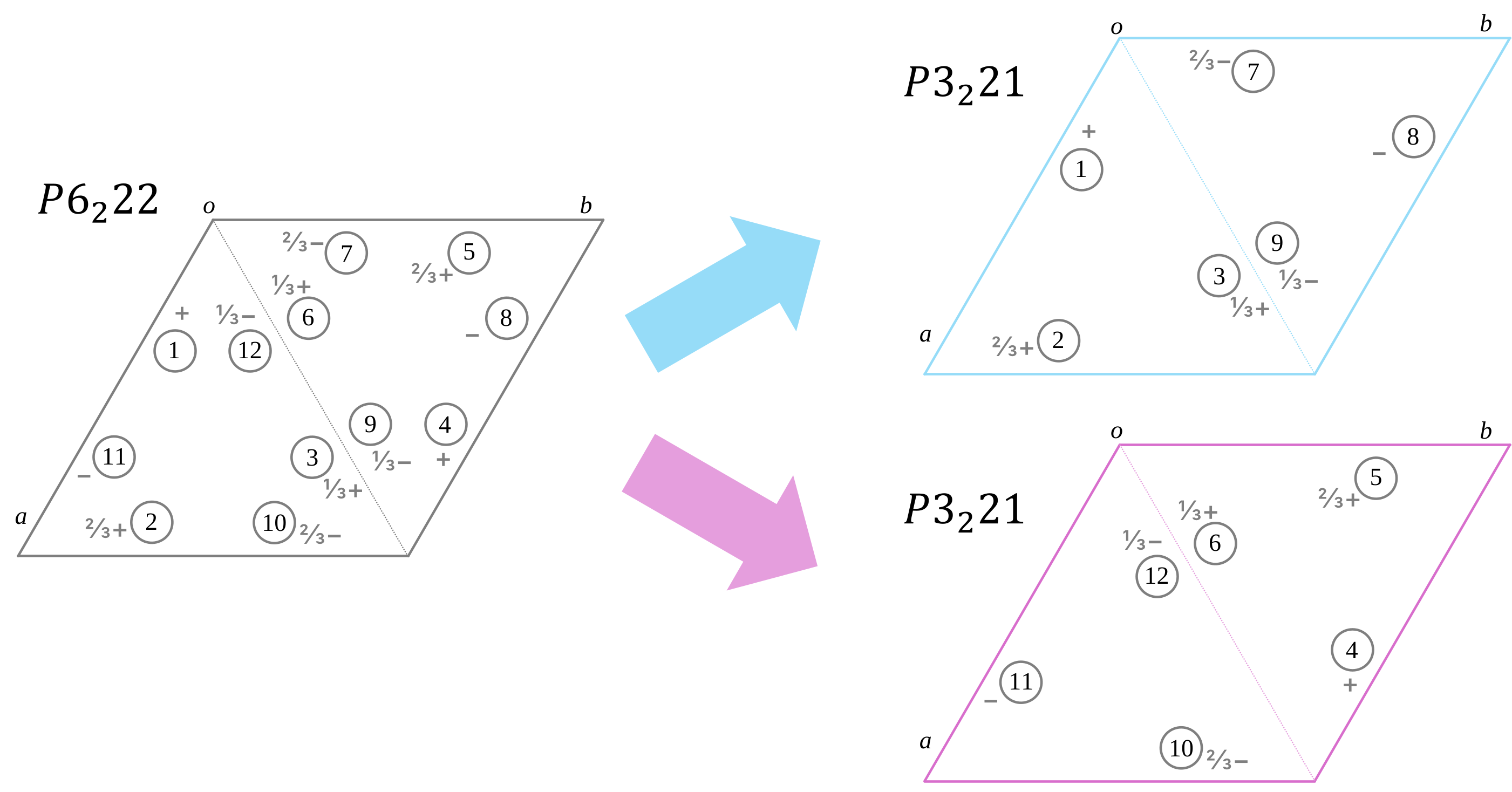
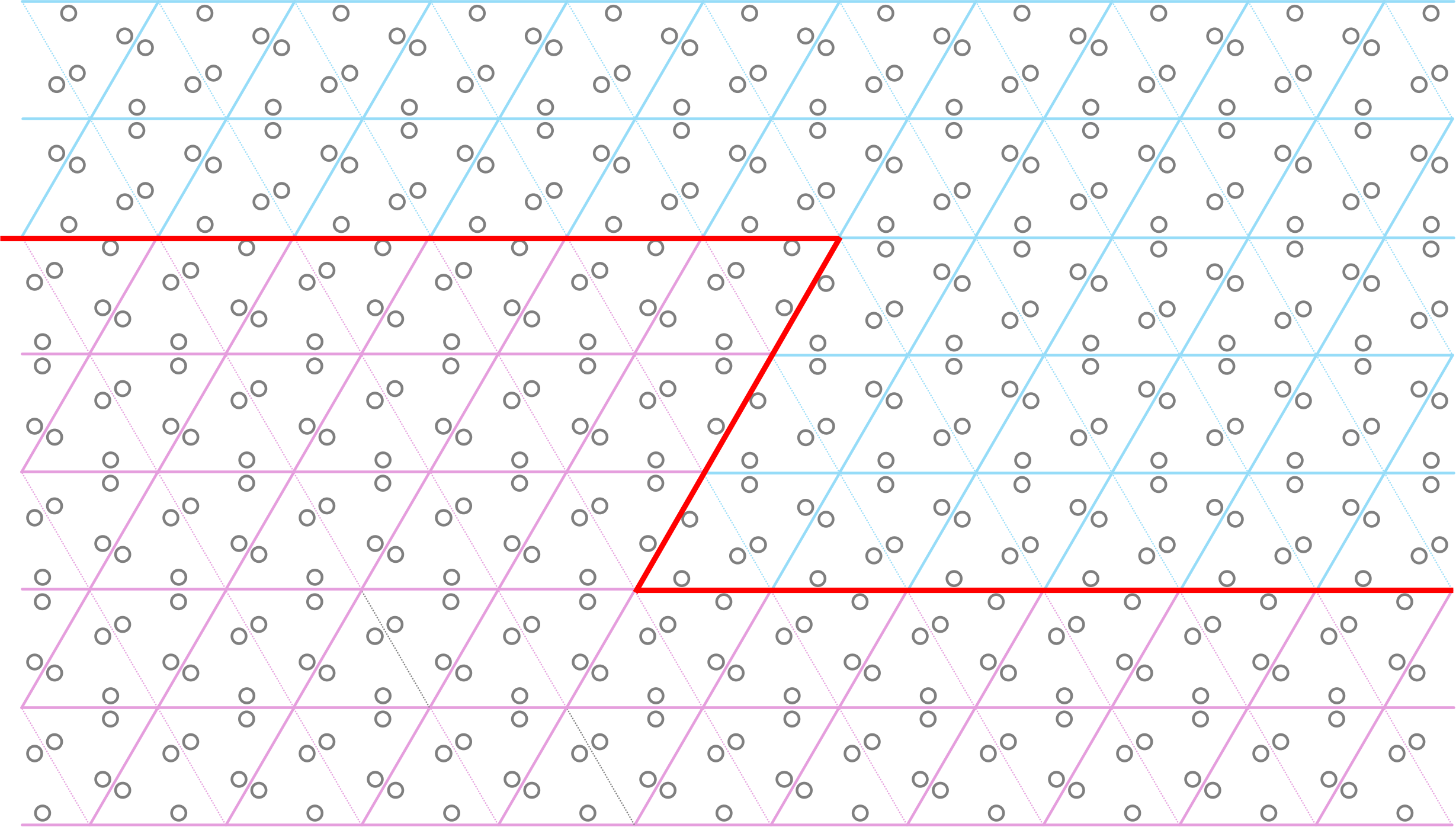
When high-temperature quartz undergoes a phase transition to low-temperature quartz, whether the symmetry operations corresponding to blue (1, 2, 3, 7, 8, 9) or those corresponding to pink (4, 5, 6, 10, 11, 12) are retained is completely accidental. If low-temperature quartz corresponding to blue begins to grow in one region, and low-temperature quartz corresponding to pink begins to grow in another region, they will eventually collide with each other and form an interface. This is called a twin boundary. In the figure below, the twin boundary is shown as a red line. To reiterate, the two domains separated by the red line are related by a 180-degree rotation perpendicular to the page (about the c-axis).
Antiphase Domains
When \(H\) is a k-subgroup (Type II) of \(G\), antiphase domains may form as a result of the phase transition. Similar to the twin case, there is a coset group relationship of \(G\) modulo \(H\) between domains in antiphase relationship. However, in this case, the coset group is not a point group but a translation group.
We explain this using pigeonite as an example. Pigeonite is a mineral known to have space group \(C2/c\) at high temperature and \(P2_1/c\) at low temperature, with a phase transition occurring around 900–1000°C. \(P2_1/c\) is a Type IIa subgroup of \(C2/c\) because it has the same unit cell but loses the translation symmetry element, and it forms antiphase domains upon phase transition. Let us also verify this using a multiplication table.
The following is a multiplication table for the space group \(C2/c\) of high-temperature pigeonite.
| 1 | 2 | 3 | 4 | 5 | 6 | 7 | 8 | ||
| \(\{1|0\}\) | \(\{2_{010}|0,0,\frac{1}{2}\}\) | \(\{\bar{1}|0\}\) | \(\{m|0,0,\frac{1}{2}\}\) | \(\{1|\frac{1}{2},\frac{1}{2},0\}\) | \(\{2_{010}|\frac{1}{2},\frac{1}{2},\frac{1}{2}\}\) | \(\{\bar{1}|\frac{1}{2},\frac{1}{2},0\}\) | \(\{m|\frac{1}{2},\frac{1}{2},\frac{1}{2}\}\) | ||
| 1 | \(\{1|0\}\) | \(\{1|0\}\) | \(\{2_{010}|0,0,\frac{1}{2}\}\) | \(\{\bar{1}|0\}\) | \(\{m|0,0,\frac{1}{2}\}\) | \(\{1|\frac{1}{2},\frac{1}{2},0\}\) | \(\{2_{010}|\frac{1}{2},\frac{1}{2},\frac{1}{2}\}\) | \(\{\bar{1}|\frac{1}{2},\frac{1}{2},0\}\) | \(\{m|\frac{1}{2},\frac{1}{2},\frac{1}{2}\}\) |
| 2 | \(\{2_{010}|0,0,\frac{1}{2}\}\) | \(\{2_{010}|0,0,\frac{1}{2}\}\) | \(\{1|0\}\) | \(\{m|0,0,\frac{1}{2}\}\) | \(\{\bar{1}|0\}\) | \(\{2_{010}|\frac{1}{2},\frac{1}{2},\frac{1}{2}\}\) | \(\{1|\frac{1}{2},\frac{1}{2},0\}\) | \(\{m|\frac{1}{2},\frac{1}{2},\frac{1}{2}\}\) | \(\{\bar{1}|\frac{1}{2},\frac{1}{2},0\}\) |
| 3 | \(\{\bar{1}|0\}\) | \(\{\bar{1}|0\}\) | \(\{m|0,0,\frac{1}{2}\}\) | \(\{1|0\}\) | \(\{2_{010}|0,0,\frac{1}{2}\}\) | \(\{\bar{1}|\frac{1}{2},\frac{1}{2},0\}\) | \(\{m|\frac{1}{2},\frac{1}{2},\frac{1}{2}\}\) | \(\{1|\frac{1}{2},\frac{1}{2},0\}\) | \(\{2_{010}|\frac{1}{2},\frac{1}{2},\frac{1}{2}\}\) |
| 4 | \(\{m|0,0,\frac{1}{2}\}\) | \(\{m|0,0,\frac{1}{2}\}\) | \(\{\bar{1}|0\}\) | \(\{2_{010}|0,0,\frac{1}{2}\}\) | \(\{1|0\}\) | \(\{m|\frac{1}{2},\frac{1}{2},\frac{1}{2}\}\) | \(\{\bar{1}|\frac{1}{2},\frac{1}{2},0\}\) | \(\{2_{010}|\frac{1}{2},\frac{1}{2},\frac{1}{2}\}\) | \(\{1|\frac{1}{2},\frac{1}{2},0\}\) |
| 5 | \(\{1|\frac{1}{2},\frac{1}{2},0\}\) | \(\{1|\frac{1}{2},\frac{1}{2},0\}\) | \(\{2_{010}|\frac{1}{2},\frac{1}{2},\frac{1}{2}\}\) | \(\{\bar{1}|\frac{1}{2},\frac{1}{2},0\}\) | \(\{m|\frac{1}{2},\frac{1}{2},\frac{1}{2}\}\) | \(\{1|0\}\) | \(\{2_{010}|0,0,\frac{1}{2}\}\) | \(\{\bar{1}|0\}\) | \(\{m|0,0,\frac{1}{2}\}\) |
| 6 | \(\{2_{010}|\frac{1}{2},\frac{1}{2},\frac{1}{2}\}\) | \(\{2_{010}|\frac{1}{2},\frac{1}{2},\frac{1}{2}\}\) | \(\{1|\frac{1}{2},\frac{1}{2},0\}\) | \(\{m|\frac{1}{2},\frac{1}{2},\frac{1}{2}\}\) | \(\{\bar{1}|\frac{1}{2},\frac{1}{2},0\}\) | \(\{2_{010}|0,0,\frac{1}{2}\}\) | \(\{1|0\}\) | \(\{m|0,0,\frac{1}{2}\}\) | \(\{\bar{1}|0\}\) |
| 7 | \(\{\bar{1}|\frac{1}{2},\frac{1}{2},0\}\) | \(\{\bar{1}|\frac{1}{2},\frac{1}{2},0\}\) | \(\{m|\frac{1}{2},\frac{1}{2},\frac{1}{2}\}\) | \(\{1|\frac{1}{2},\frac{1}{2},0\}\) | \(\{2_{010}|\frac{1}{2},\frac{1}{2},\frac{1}{2}\}\) | \(\{\bar{1}|0\}\) | \(\{m|0,0,\frac{1}{2}\}\) | \(\{1|0\}\) | \(\{2_{010}|0,0,\frac{1}{2}\}\) |
| 8 | \(\{m|\frac{1}{2},\frac{1}{2},\frac{1}{2}\}\) | \(\{m|\frac{1}{2},\frac{1}{2},\frac{1}{2}\}\) | \(\{\bar{1}|\frac{1}{2},\frac{1}{2},0\}\) | \(\{2_{010}|\frac{1}{2},\frac{1}{2},\frac{1}{2}\}\) | \(\{1|\frac{1}{2},\frac{1}{2},0\}\) | \(\{m|0,0,\frac{1}{2}\}\) | \(\{\bar{1}|0\}\) | \(\{2_{010}|0,0,\frac{1}{2}\}\) | \(\{1|0\}\) |
The blue cells correspond to the results of selecting and operating two symmetry operations from 1, 4, 6, 7, and they correspond to any of the symmetry operations 1, 4, 6, 7. Therefore, the set of symmetry operations 1, 4, 6, 7 is a subgroup with space group notation \(P2_1/c\). The pink cells corresponding to symmetry operations 2, 3, 5, 8 have exactly the same structure as the blue cells, and they also form a \(P2_1/c\) subgroup. The subgroup \(P2_1/c\) corresponding to the pink cells and the subgroup \(P2_1/c\) corresponding to the blue cells are related by a translation operation \((\frac{1}{2},\frac{1}{2},0)+\). In group-theoretic terms, this is expressed as: “the coset group of \(C2/c\) modulo \(P2_1/c\) is the translation group \((\frac{1}{2},\frac{1}{2},0)+\).”
Below are the general positions of \(C2/c\) and \(P2_1/c\) projected along the \(\textbf{c*}\) axis direction. The numbers in the circles correspond to the symmetry operations in the multiplication table. White circles ◯ and black circles ● show a chiral relationship (right-handed and left-handed). When the pink \(P2_1/c\) is shifted by \(1/2\) in the \(\textbf{a}\) and \(\textbf{c}\) directions respectively, it coincides with the blue \(P2_1/c\).
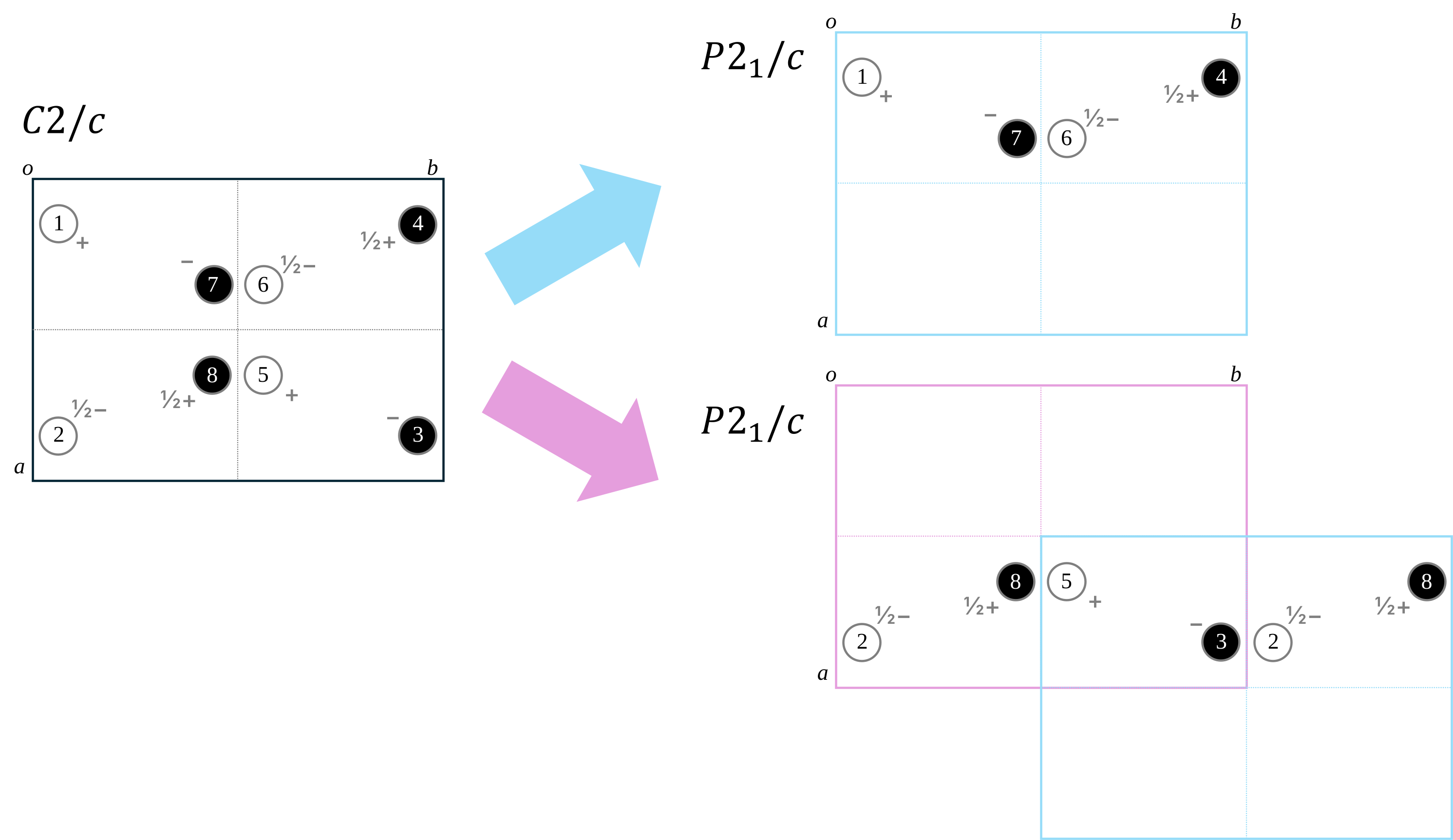
By analogy with the twin case discussion, when \(C2/c\) undergoes a phase transition to \(P2_1/c\), there are two choices: either the blue or pink variant grows. When two domains grow and collide, the interface they form is an antiphase domain boundary (anti-phase domain boundary) (shown as a red line in the figure below), where the phase is shifted by \((\frac{1}{2},\frac{1}{2},0)\).

In general, twins can sometimes be easily distinguished from the external shape of the crystal, but antiphase domains are microstructures at the unit cell level and cannot be recognized with the naked eye. Therefore, observation with a transmission electron microscope is necessary.
Footnotes
- In the field of mineralogy, such twins in quartz are called “Dauphiné twins.” ↩︎