未完了
Real space is the space with dimensions of length that we normally perceive. On the other hand, reciprocal space is a space that reflects the periodicity of real space and has dimensions of inverse length. Reciprocal space has a singular point at the origin0, and the direction and distance from the origin correspond to the direction and wavelength of periodicity in real space.
Fourier Transform
The relationship between real space and reciprocal space is mathematically nothing other than a Fourier transform. For a one-dimensional function \(f(x)\) and the function \(g(u)\) obtained by Fourier transforming it, the following relationship holds: $$
g(u) = \int^{\infty}_{-\infty}f(x)\exp(-2\pi i x u) dx
$$ For the two-dimensional case: $$
g(u,v) = \int^{\infty}_{-\infty}\int^{\infty}_{-\infty}f(x,y)\exp(-2\pi i [x u +y v]) dx
$$ To extend this to three dimensions, simply add the \(z\) and \(w\) symbols accordingly. In any case, if \(f\) is a function representing some quantity0 in real space, then \(g\) corresponds to its reciprocal space.
Diffraction Gratings
However, simply being shown the mathematical equations of Fourier transforms may not be very intuitive for many people. Here, I would like to provide a more intuitive explanation to deepen the understanding of reciprocal space. There is a simple experiment that directly relates real space to reciprocal space. It is the “diffraction grating” experiment shown below.
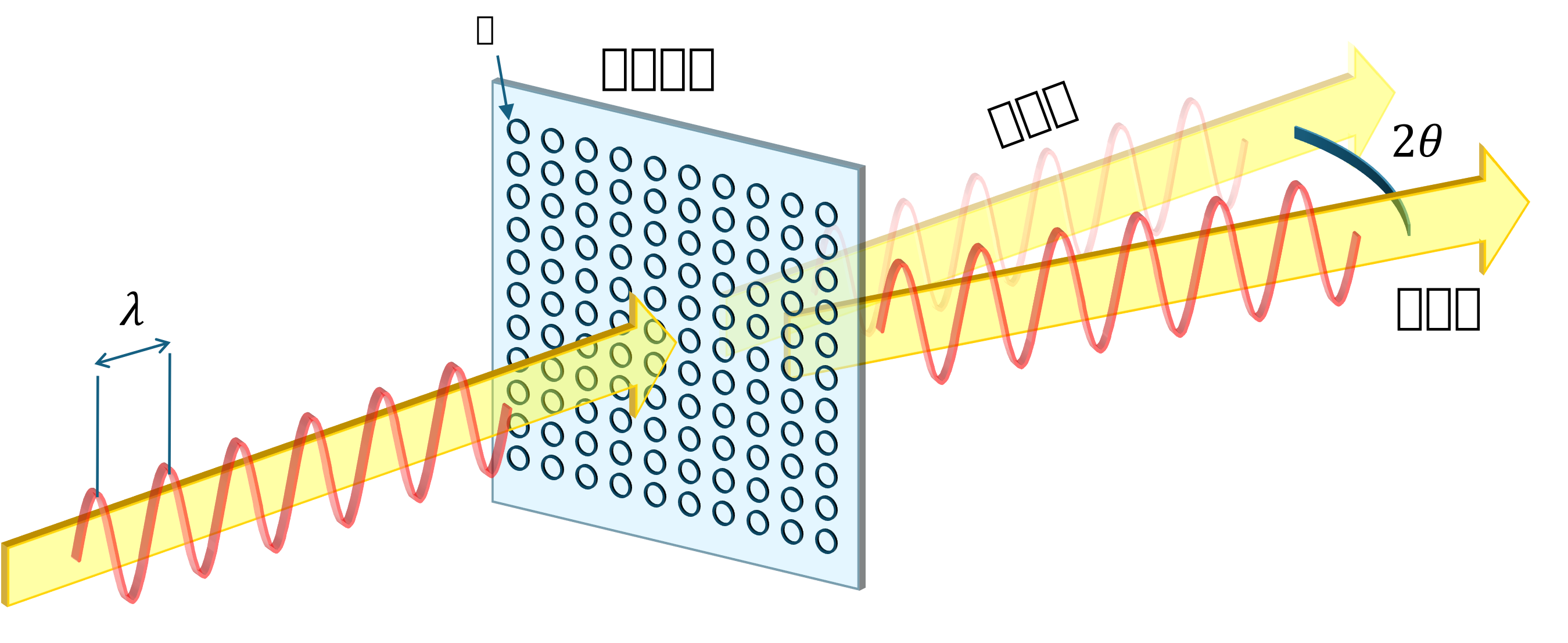
A diffraction grating has numerous holes. We will call the arrangement of these holes the “lattice pattern.” When light with a wavelength much shorter than the hole spacing is directed at the grating, the light that passes through the holes undergoes interference. We then photograph the resulting interference pattern at a location sufficiently far from the grating. We will call this pattern the “diffraction pattern.” As you may have guessed, when we view the lattice pattern as real space, the diffraction pattern corresponds to its reciprocal space0. For the background and significance of this wonderful experiment, please refer to Wikipedia. From here on, let us show examples of what kind of diffraction patterns arise from what kind of lattice patterns.
Example 1: Perfect Crystal
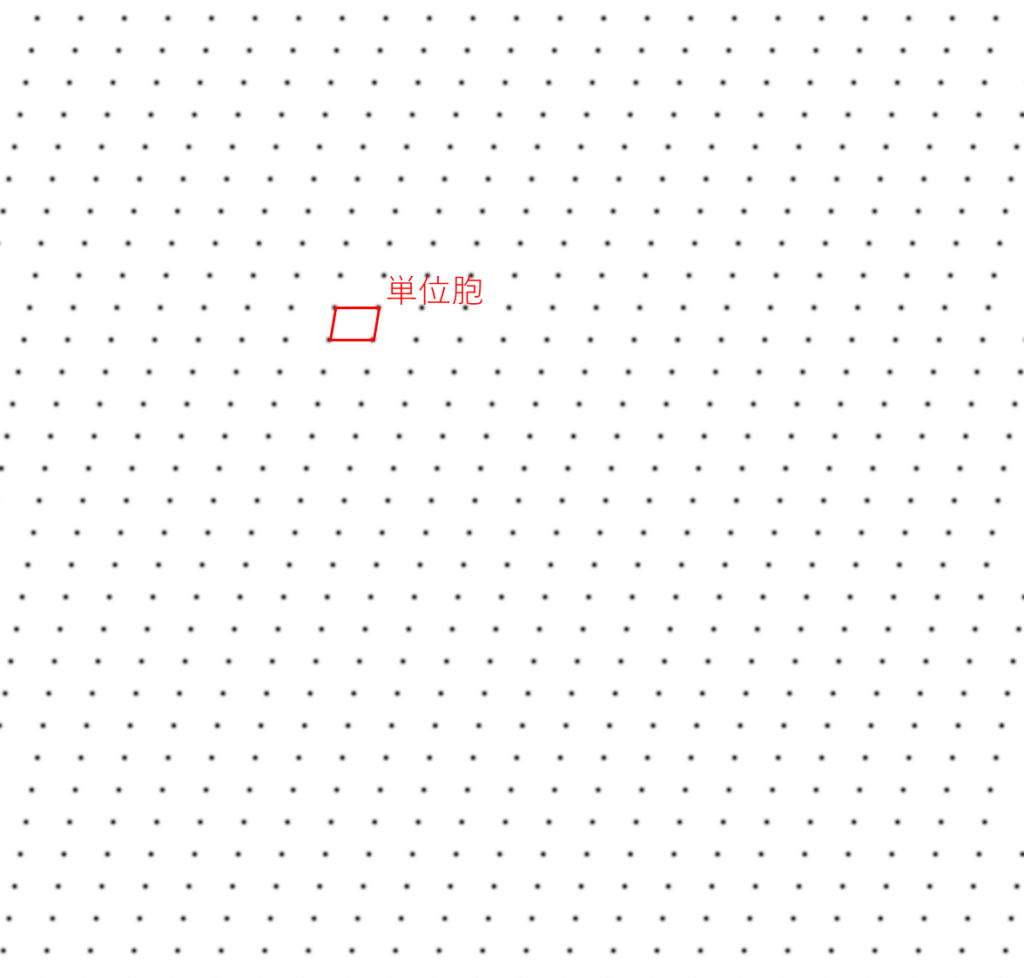
Lattice pattern (real space)
Diffraction pattern (reciprocal space)
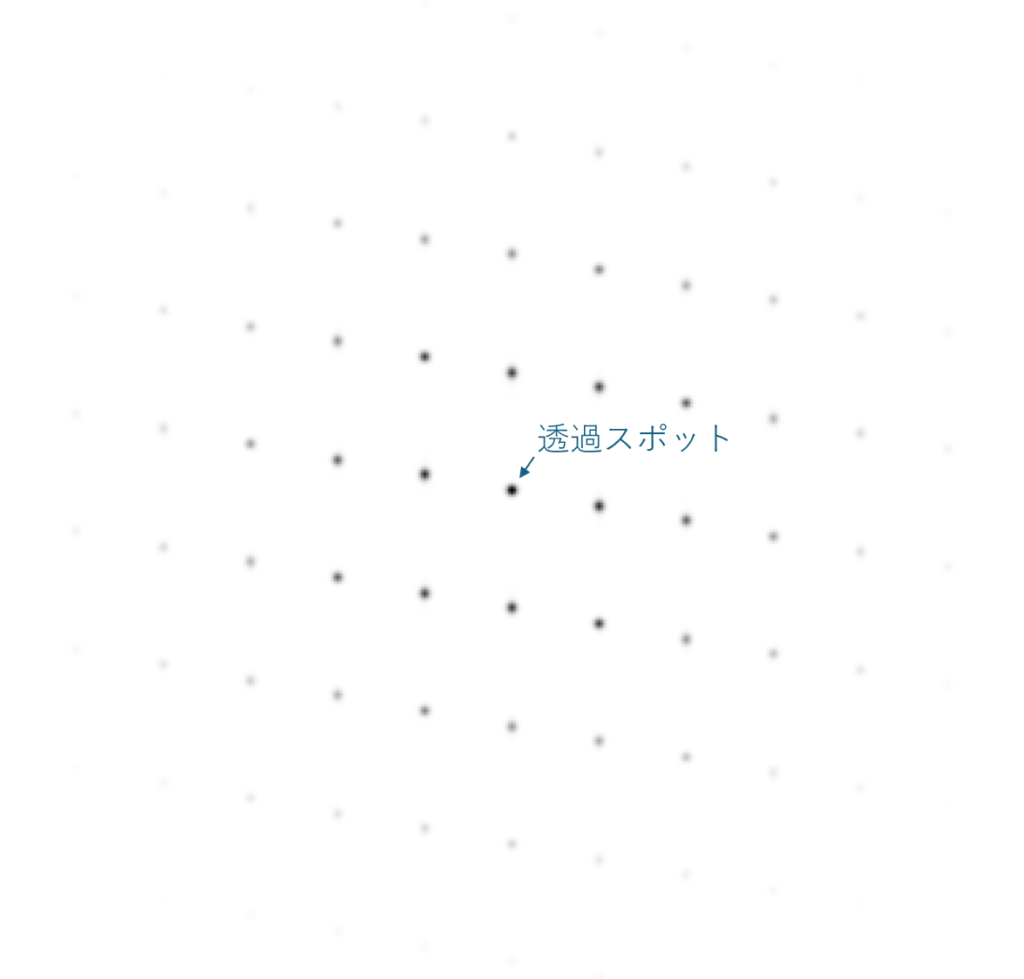
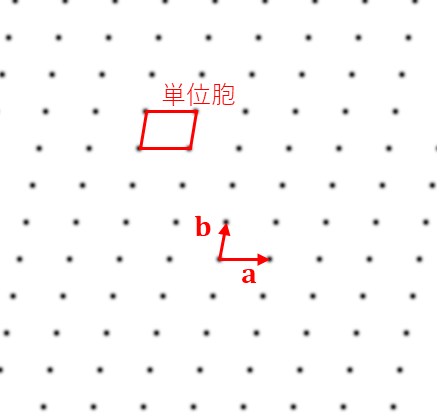
The first example is a two-dimensional crystal whose lattice pattern has perfectly undisturbed periodicity. Note that the black dots are the holes that transmit light. When light is shone on such a lattice pattern, the diffraction pattern shown on the right is obtained. The central spot is the transmitted spot where light travels straight through, corresponding to the origin in reciprocal space. The many dots seen around the transmitted spot are all diffraction spots. The diffraction spots are arranged periodically, and their intensity decreases with distance from the transmitted spot. The lattice pattern in real space and the lattice pattern in reciprocal space correspond to the relationship between real unit cell vectors and reciprocal unit cell vectors explained on the previous page. In two dimensions, the relationship between the real unit cell vectors \(\bf{a}, \bf{b}\) and the reciprocal unit cell vectors \(\bf{a^*}, \bf{b^*}\) is as follows.
Lattice pattern (real space)
Diffraction pattern (reciprocal space)
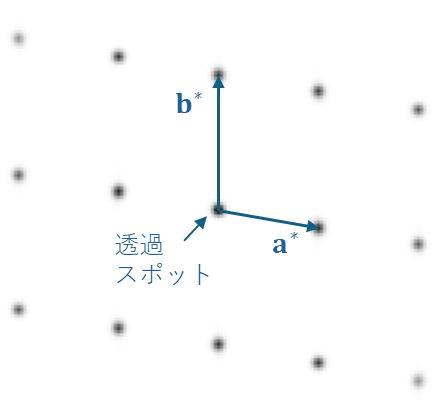
Relationship between real and reciprocal unit cell vectors
$$\bf{a} \bf{a^*}=1\\
\bf{a} \bf{b^*}=0\\
\bf{b} \bf{a^*}=0\\
\bf{b} \bf{b^*}=1$$
\(\bf{a^*}\) is a vector that is perpendicular to \(\bf{b}\) and whose dot product with \(\bf{a}\) is \(1\). Similarly, \(\bf{b^*}\) is a vector perpendicular to \(\bf{a}\) with a dot product of \(1\) with \(\bf{b}\). The diffraction pattern displays figures that correspond to this reciprocal lattice vector geometry.
Example 2: With Stacking Faults
The next example has the same unit cell as the one directly above, but with stacking faults present randomly.
Lattice pattern (real space) (\(\frac{1}{2}\bf{a}\) along \(\bf{b^*}\))

Diffraction pattern (reciprocal space)
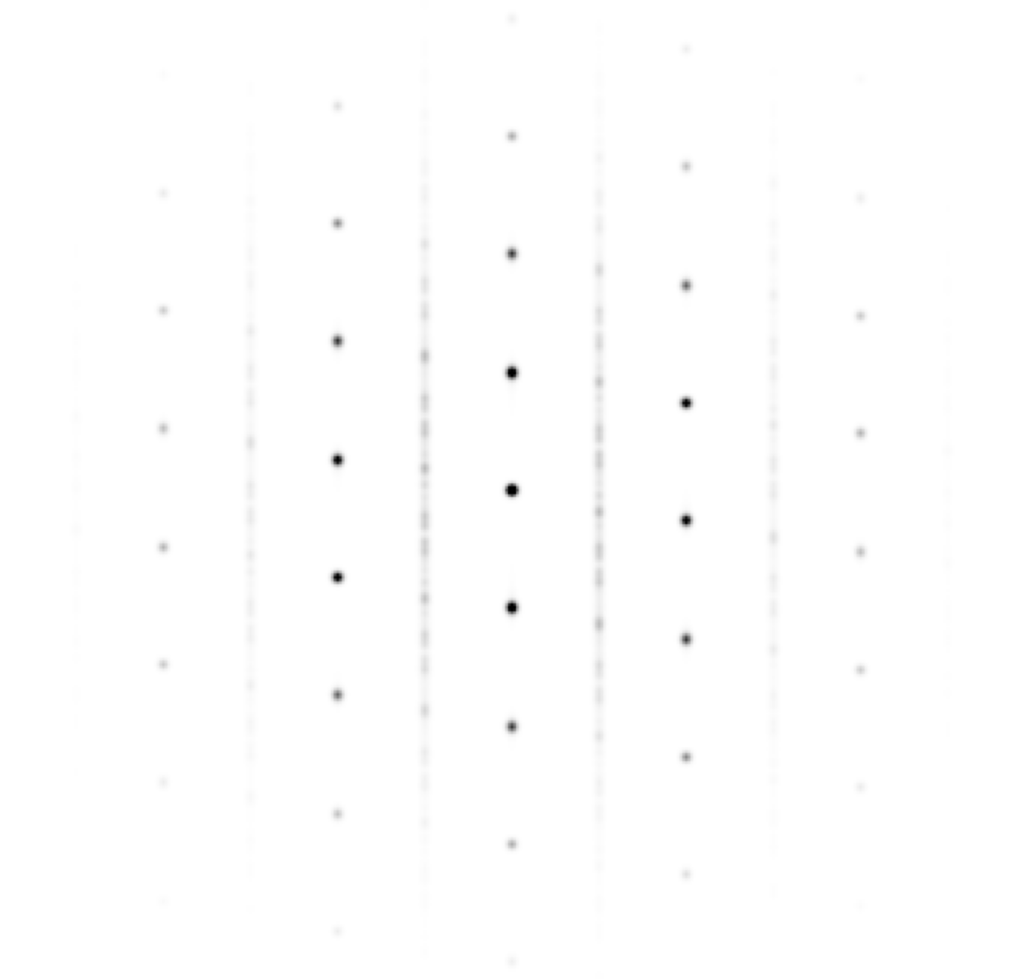
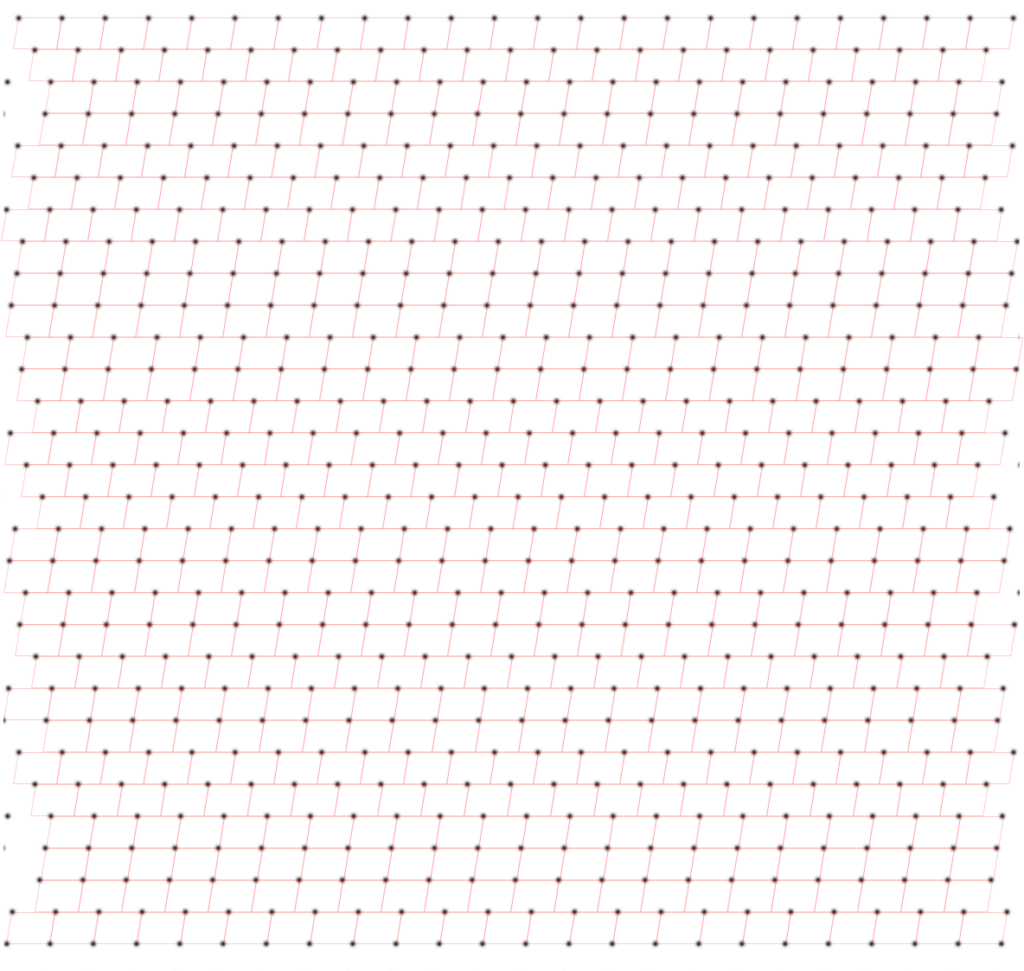
An unusual diffraction pattern has emerged. If you can immediately tell which planes are shifted in which direction by how much, you are very astute. Below is the lattice pattern with unit cell guide lines added. You can see that stacking faults exist randomly where the planes corresponding to \(\bf{b^*}\) are shifted by 1/2 in the \(\bf{a}\) axis direction. When such stacking faults occur, the diffraction spots also become disturbed, and spot-like and streak-like intensity distributions appear alternately.
Lattice pattern (real space) (\(\frac{1}{2}\bf{a}\) along \(\bf{b^*}\))
Diffraction pattern (reciprocal space)
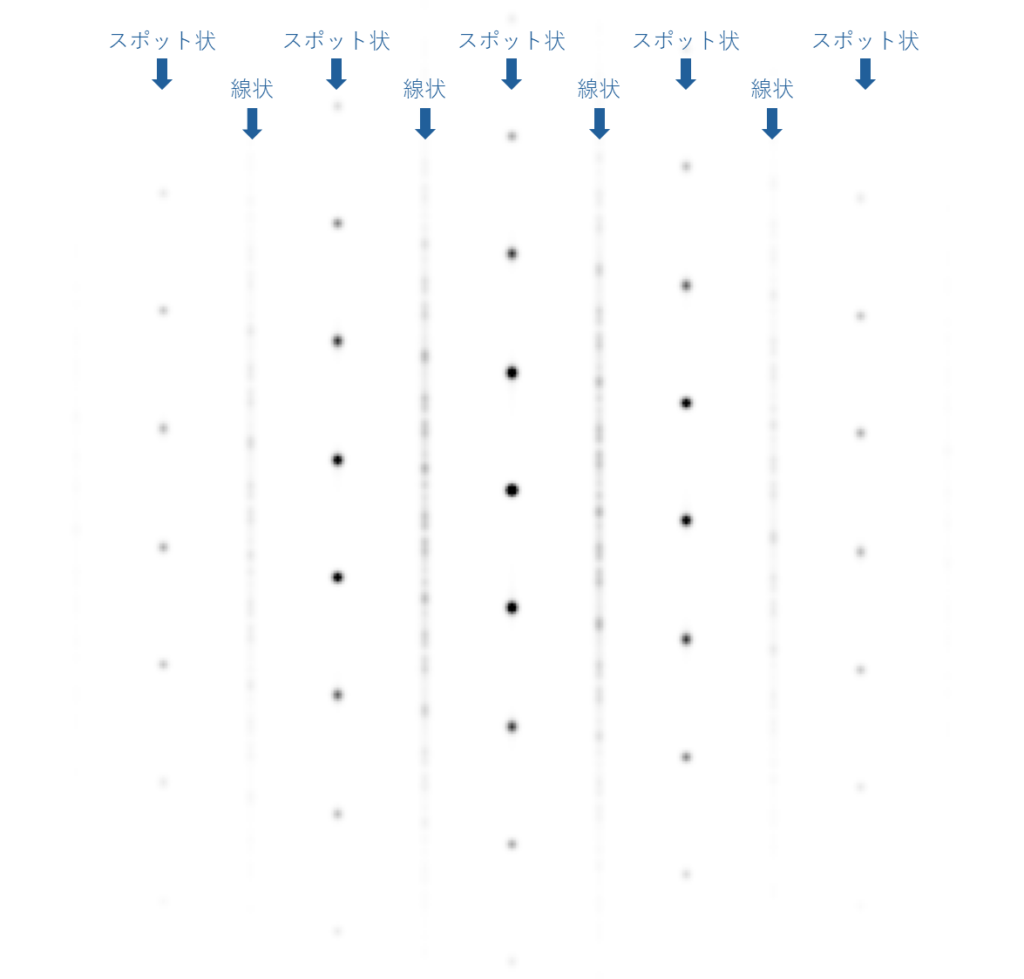
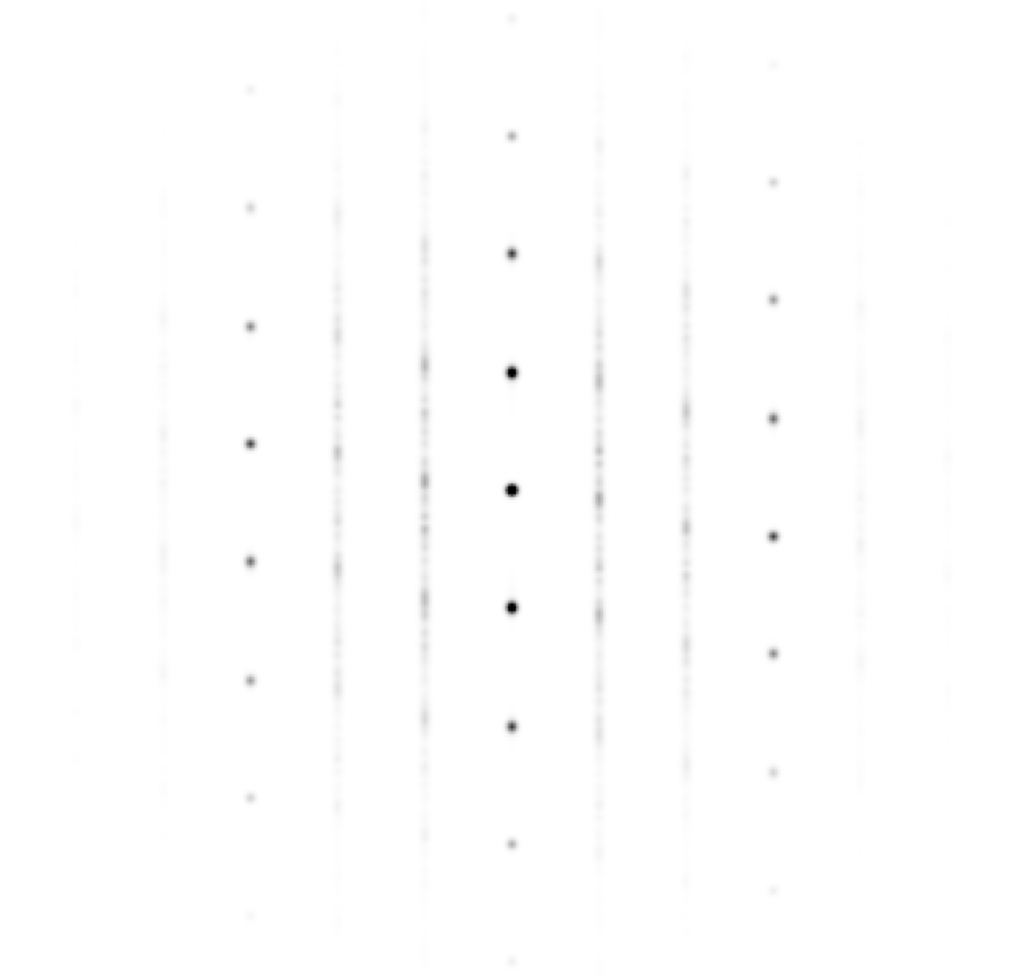
Below is the case where the shift amount is 1/3. Note that this time the intensity distribution in the diffraction pattern follows a cycle of spot → streak → streak → spot → …
Lattice pattern (real space) (\(\frac{1}{3}\bf{a}\) along \(\bf{b^*}\))

Diffraction pattern (reciprocal space)
Example 3: Superstructure and Modulated Structure
Now let us look at examples of superstructures and modulated structures.
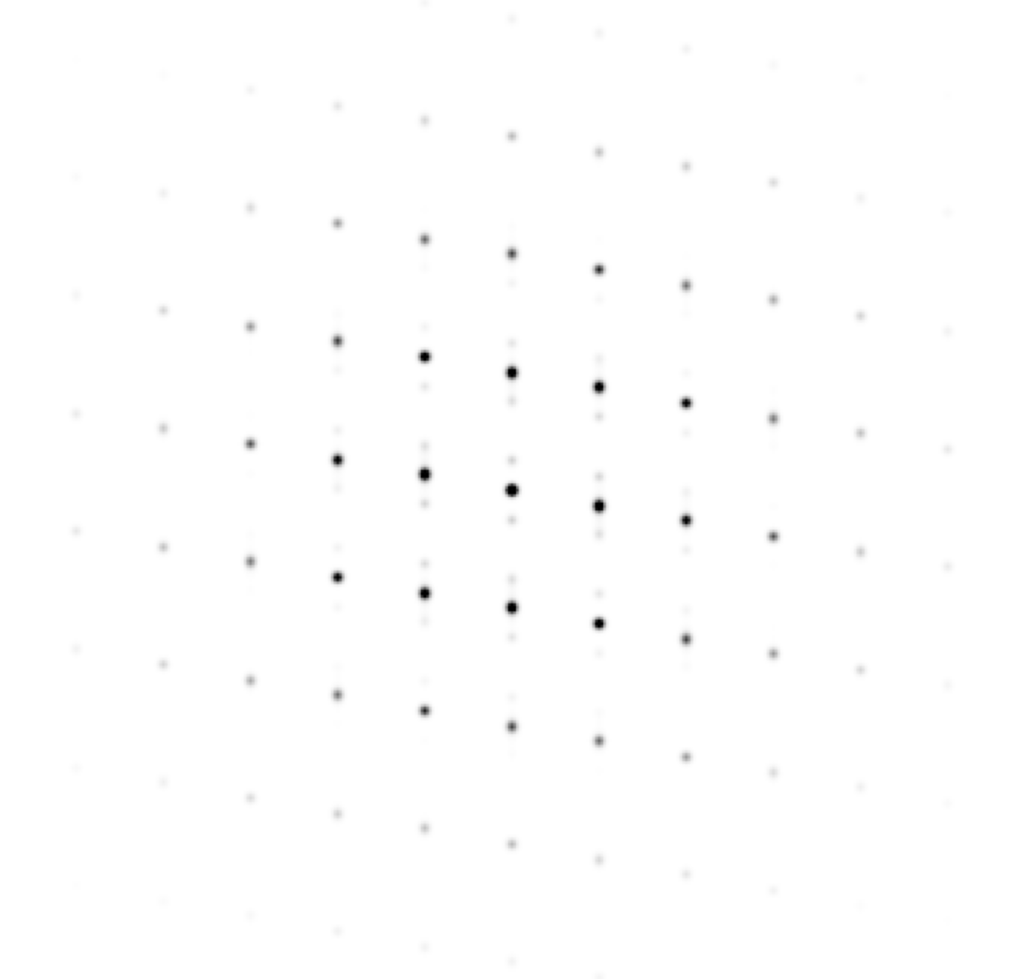
Below is an example where the hole positions are exactly the same as in the perfect crystal, but the sizes of the holes differ. Rows of large and small holes repeat with a period of 4 times in the vertical direction. In other words, this is a crystal with a unit cell whose \(\bf{b}\) axis is 4 times longer than the fundamental unit cell. Such a structure, where the axes of the fundamental unit cell are multiplied by integers, is called a “superstructure” (super structure)0. Since the \(\bf{b}\) axis is 4 times longer, \(\bf{b^*}\) becomes 1/4 the length, which gives the diffraction pattern shown on the right. Note also that since the basic hole arrangement is the same as the perfect crystal, the diffraction spots corresponding to the fundamental unit cell (called fundamental spots here) have stronger intensity.
Lattice pattern (real space) (amplitude modulation \(\bf{b’} = 4\bf{b}\))

Diffraction pattern (reciprocal space)
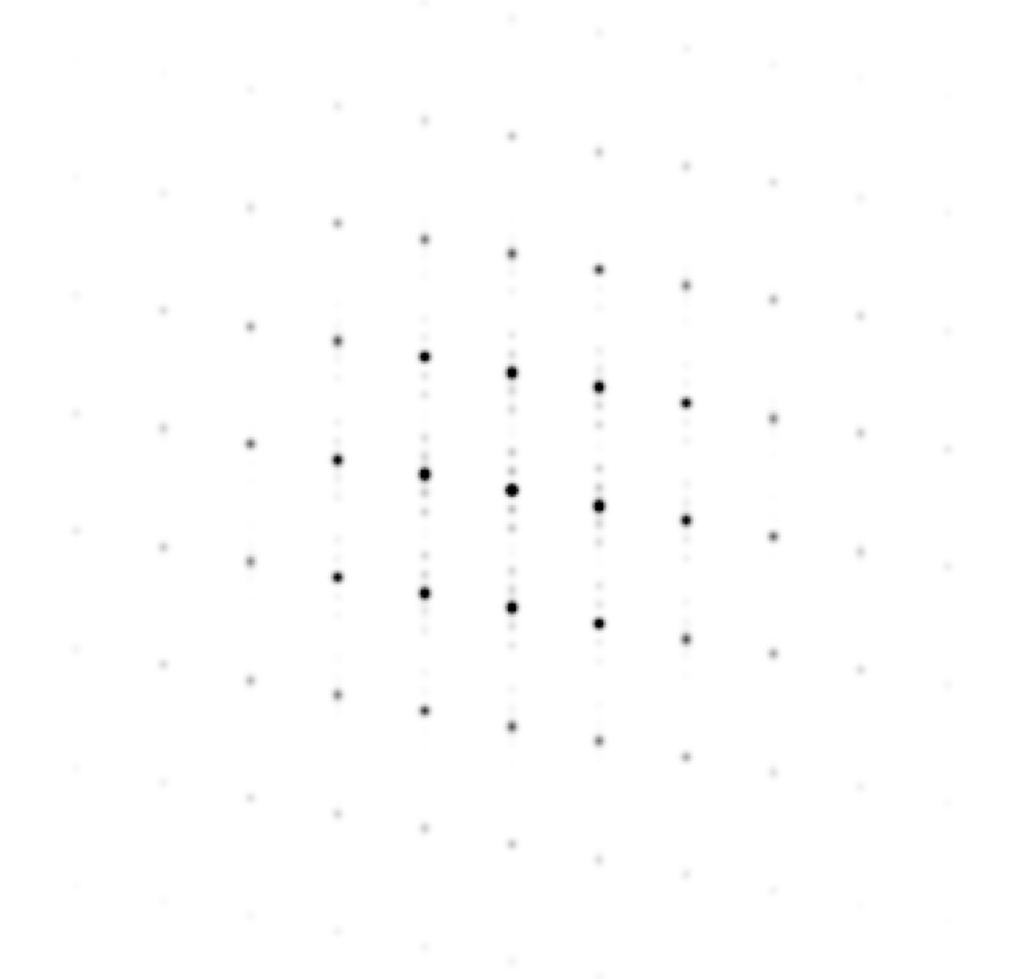
While the above example had an exact 4-fold period, this multiplier can also be non-integer. Such a structure is called a “modulated structure” (modulated structure). In a broad sense, superstructures are also a type of modulated structure. Below is an example with a modulation of 6.28 times along the \(\bf{b}\) axis. Weak spots can be seen around the fundamental spots, and they do not divide the fundamental spots into integer fractions.
Lattice pattern (real space) (amplitude modulation \(\bf{b’} = 6.28\bf{b}\))

Diffraction pattern (reciprocal space)
The two examples above were superstructures or modulated structures arising from differences in hole sizes. In a diffraction grating experiment, hole size corresponds to the amount of light transmitted, but extending to general diffraction experiments, it corresponds to the scattering factor (or scattering amplitude) of atoms or ions. Therefore, such modulated structures are sometimes called “amplitude modulation“.
While amplitude modulation involves changes in scattering power, another important factor is “phase.” Phase modulation means that the sizes (scattering power) of the holes remain unchanged, but the positions of the holes vary. Such modulation is called “phase modulation“. The following example has all holes of equal size, but the length of the \(\bf{b}\) axis (i.e., the phase) is modulated with a period of 6.28.
Lattice pattern (real space) (phase modulation \(\bf{b’} = 6.28\bf{b}\))

Diffraction pattern (reciprocal space)
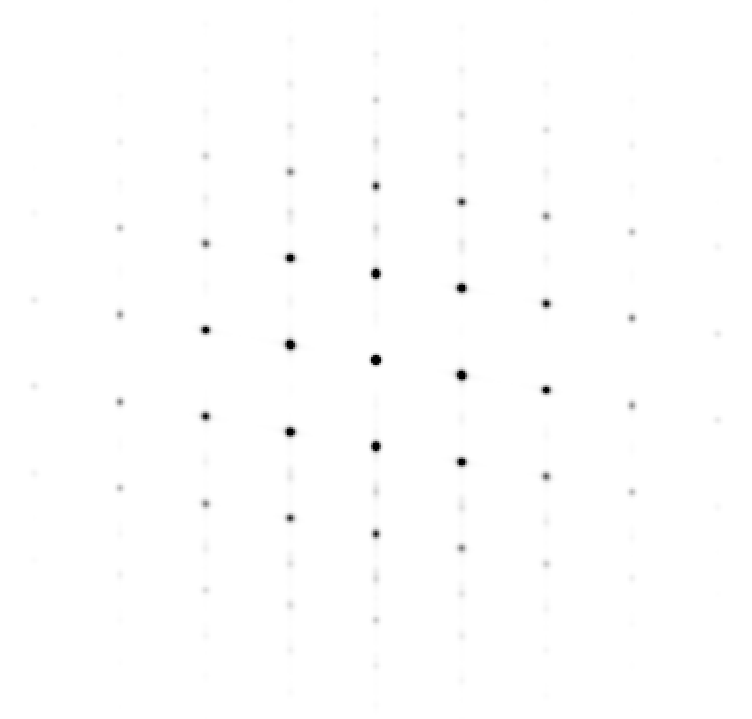
Similar to the amplitude modulation example, weak spots derived from the modulation appear around the fundamental spots, but we can see that the intensity distribution (particularly near the transmitted spot) is different.
Note that to rigorously treat structures with non-integer modulation, it is necessary to describe the crystal structure using higher-dimensional space groups, but explaining that is beyond my ability, so I will omit it here.
Example 4: Amorphous Specimens
- In real space, choosing a point and calling it the “origin” is arbitrary, and that point does not possess any different properties from others, so it is not a “singular point.” ↩︎
- For example, imagine a scalar quantity such as electron density. ↩︎
- Note that the diffraction pattern is not reciprocal space itself. Reciprocal space is a space with dimensions of inverse length, and the diffraction pattern is a projection of it into real space. ↩︎
- Strictly speaking, superstructures also include cases where multiple axes are multiplied by integers or combined to form new axes. ↩︎