What is a Crystal?
In a broad sense, a crystal refers to a state (and a substance in such a state) that possesses a certain translational symmetry. Translational symmetry is the property that when you move a certain distance in a certain direction, the resulting state is indistinguishable from the original. The unit of “a certain distance” does not matter1; however, readers of this page are likely interested in crystals as solid materials — substances in which atoms, molecules, or ions are periodically arranged at a small scale and possess a certain overall size (at a level where physical properties emerge). Hereafter, we use the term “crystal” in this sense.
Lattice Points, Crystal Lattices, and Unit Cells
Let us consider the properties of crystals. The figure below shows an infinitely extending park that possesses translational symmetry2. Suppose you stand at a certain location \(o\) in the park and observe the surrounding scenery, and then, without changing the direction you are facing, move in parallel to location \(a\), where the scenery looks exactly the same. You cannot tell from the scenery which position you are standing at. In other words, locations \(o\) and \(a\) have exactly the same surroundings. This means that at the position reached by advancing further from \(a\) by the vector \(\vec{oa}\) (i.e., position \(a’\)), the same scenery should naturally be visible. The locations where the same scenery is visible are not limited to the line \(oa\). For example, the same scenery appears to be visible at position \(b\) as well, and at position \(b’\), reached from \(b\) by the vector \(\vec{oa}\), the same scenery is also visible.
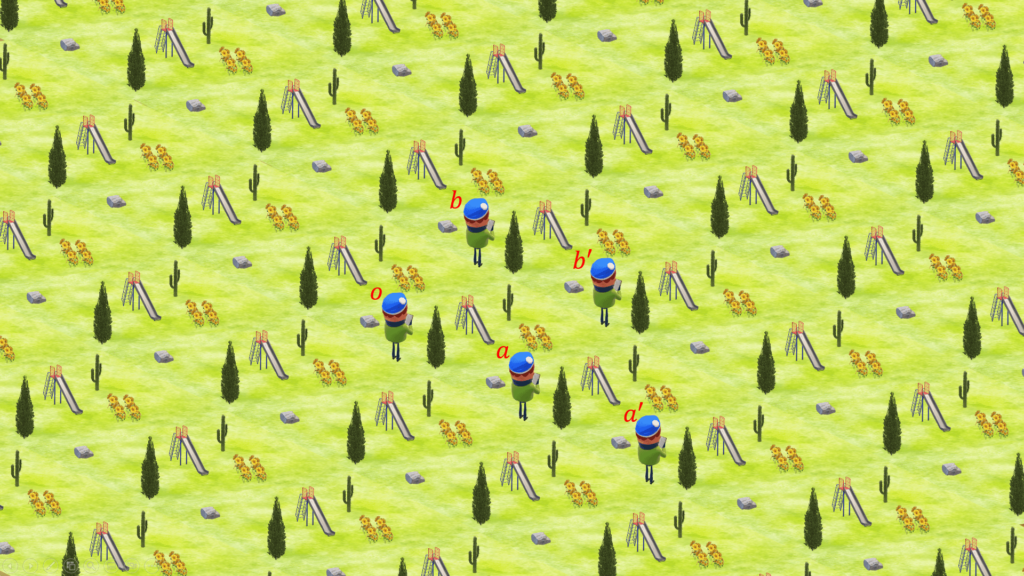
In this way, there are infinitely many locations within this park where exactly the same scenery is visible. Such locations are called lattice points. This is an extremely important concept. In the figure above, the lattice points (= observers) were placed on the lawn, but there would be no difference in the following discussion if we placed the lattice points at the stones or the slides. Where in the crystal you place the lattice points is up to you3. However, if you place one lattice point at a stone, all other lattice points must also be placed at stones. The essence of lattice points is the distance and direction (vector) from one lattice point to another. This is called a translation vector. Even if the entire park is shifted by a translation vector, the result is indistinguishable from the original state. This is one of the symmetry operations explained in the next section. If there are n independent translation vectors, the crystal is n-dimensional. In this park example, there are two independent translation vectors (for example, \(\vec{oa}\) and \(\vec{ob}\)), so it is a two-dimensional crystal.
An important concept to understand alongside lattice points and translation vectors is the crystal lattice and the unit cell. First, a crystal lattice is the periodic geometric arrangement of lattice points. It does not refer to a single lattice point, but rather describes how the lattice points are arranged as a whole. The following figure shows the lattice points connected by red lines. Red lines in two directions are evenly spaced, forming a lattice pattern. The smallest parallelogram that appears in this lattice pattern is called the unit cell.
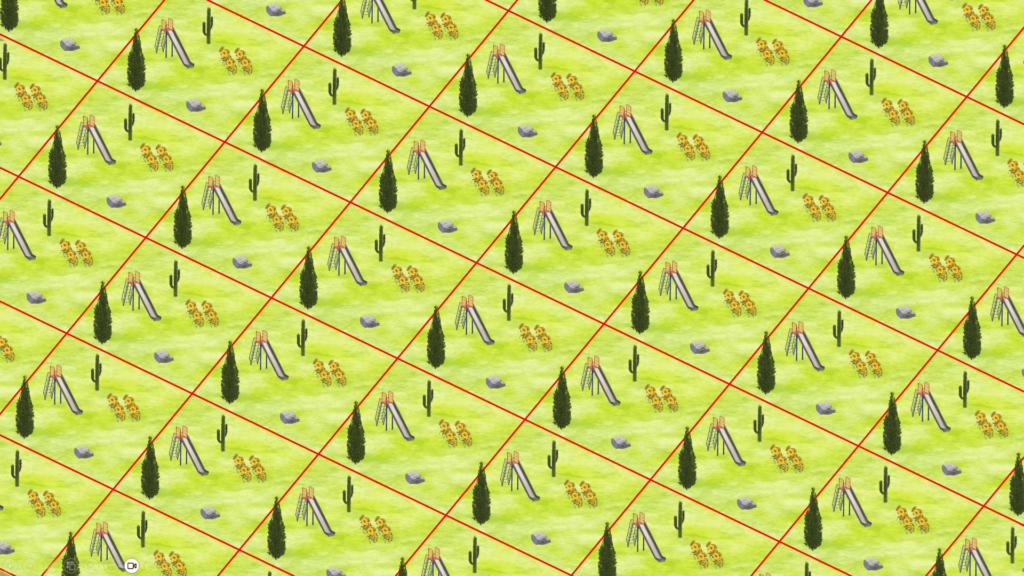
The unit cell is a parallelogram in the case of a two-dimensional crystal, and a parallelepiped in the case of a three-dimensional crystal. The crystal lattice is built by stacking unit cells. As with the discussion of lattice points, only the shape of the unit cell (the spacing and angles of the red lines) is important; what the vertices of the unit cell coincide with in the crystal is not essential.
Now, even for exactly the same crystal lattice (arrangement of lattice points), there can be variations in the patterns formed by connecting the lattice points. For example, if we draw the lines as shown below, the shape of the unit cell naturally changes as well. (Due to optical illusion, it may seem like you are viewing from a different angle, but only the way the red lines are drawn has changed.)
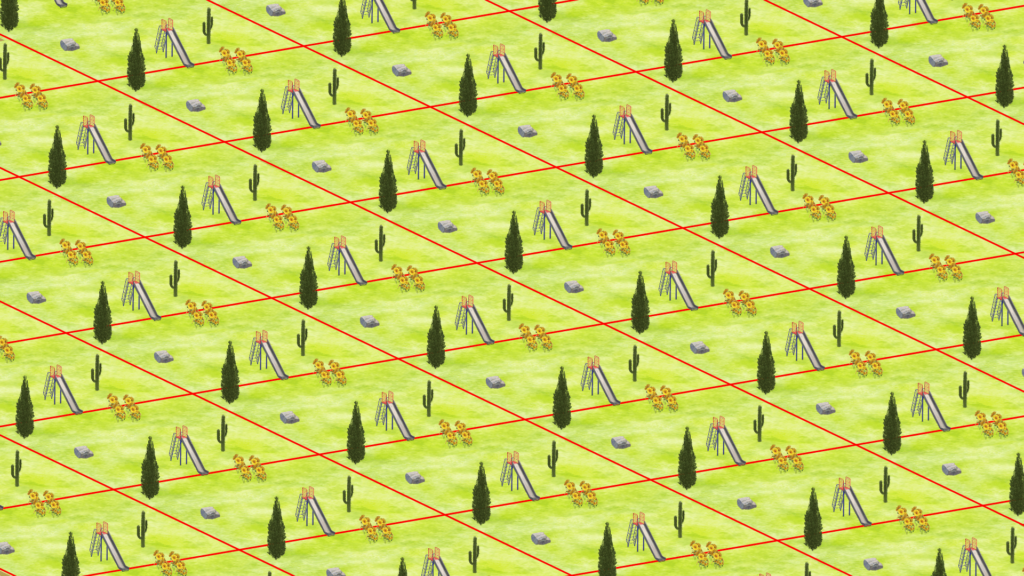
Which is the “correct” unit cell? The answer is “both are correct.” Then, is any unit cell that connects lattice points always “appropriate”? The answer is “it depends”4. The details of which unit cell should be chosen in which situation will be explained in more detail on subsequent pages, but the important fact to keep in mind is that even for exactly the same crystal lattice, there is freedom in how the unit cell is chosen.
Since various terms have appeared, let us summarize them as a list at the end.
- Lattice points: Positions (or the set of positions) in a crystal where the surrounding environment is exactly the same (including orientation and chirality). They do not need to coincide with special positions in the crystal (such as the positions of atoms or molecules).
- Crystal lattice: The periodic arrangement of lattice points. It describes how the lattice points are arranged as a whole.
- Unit cell: The repeating unit in a crystal lattice; it takes the form of a parallelogram in two dimensions and a parallelepiped in three dimensions. There is freedom in how the unit cell is chosen, and furthermore, its vertices do not need to coincide with the positions of atoms or molecules.
- Translation vector: A vector that represents the translational symmetry of a crystal, connecting one lattice point to another. Translating the entire crystal by this vector results in a state indistinguishable from the original.
Footnotes
- In a broad sense, for example, the sine function is in a crystalline state along the angle axis, and a frictionless pendulum motion is in a crystalline state along the time axis. ↩︎
- Imagine a situation where the park extends to the horizon as far as the eye can see. Of course, real crystals have a finite size and boundaries with the outside world, so a truly ideal crystal does not exist in this world. ↩︎
- However, if everyone chose completely freely, confusion would arise, so there are certain guidelines. For details, see the “6.3. Choice of Axes, Transformation of Axes” page, but beginners need not worry too much about this for now. ↩︎
- The park shown as an example contains neither rotation operations nor mirror operations, so any lattice pattern that passes through the lattice points constitutes a valid crystal lattice. If the crystal contains rotation or mirror operations, there is a crystallographic guideline to adopt a crystal lattice shape that reflects those operations as much as possible. ↩︎