Distinction between Trigonal and Hexagonal Crystal Systems
Both the “trigonal crystal system” and “hexagonal crystal system” are crystal systems that can be expressed with a hexagonal lattice setting (Hexagonal lattice setting) where \(a=b,\,\, \alpha=\beta=90°,\,\, \gamma=120°\). The criterion for distinguishing between the two is not whether the number \(3\) or \(6\) appears in the point group or space group symbol. For example, point group \(\bar{6}\) belongs to the hexagonal crystal system. The operation \(\bar{6}\) (6-fold rotoinversion) is equivalent to the operation \(3/m\) (3-fold rotation and mirror plane), but even if written as \(3/m\), it should not be classified as belonging to the trigonal crystal system.
The fundamental distinction between the trigonal and hexagonal crystal systems is whether a rhombohedral lattice setting (Rhombohedral lattice setting) can be adopted. If you can understand this alone, you are quite exceptional, so you may skip the following explanation. Note that the terms “hexagonal lattice setting” or “rhombohedral lattice setting” used in this page simply refer to the geometric shape of the lattice. These are slightly different from the concept of “lattice system” explained on the “5.1. Classification of Space Groups” page, so please be careful.
There are 12 point groups belonging to the trigonal and hexagonal crystal systems. For all of them, the symmetry can be expressed by dividing the surface of a “right prism with a regular hexagonal base” with different colors. The actual color-divided figures are shown below.
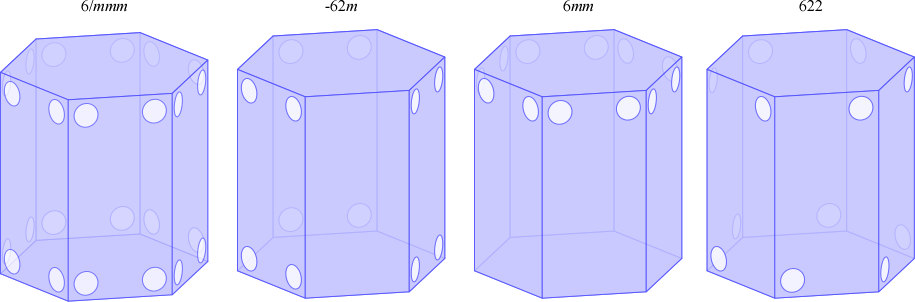
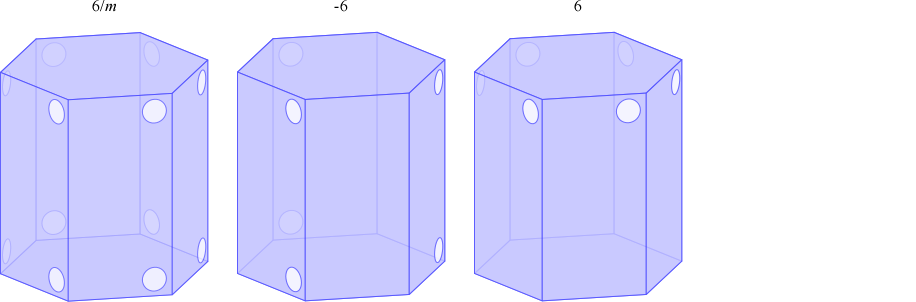
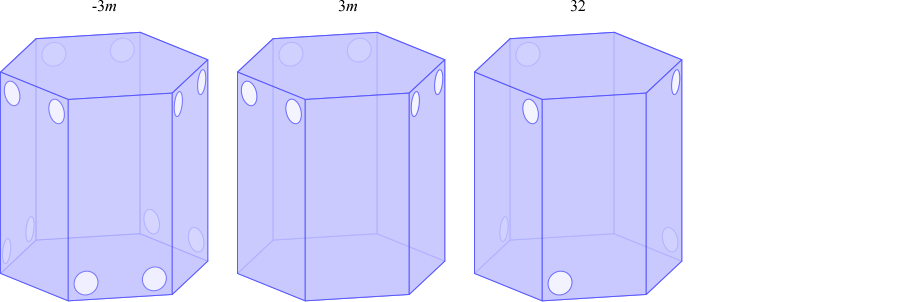
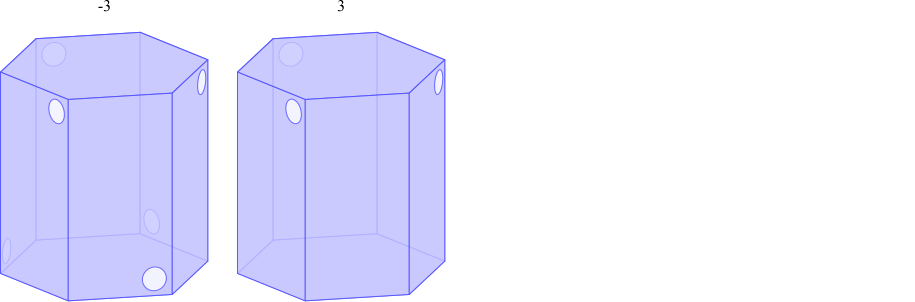
If a “right prism with a regular hexagonal base” is divided into three parts, a right prism with a rhombic base is obtained as shown below. In terms of crystal lattice expression, this has \(a=b, \alpha=\beta=90°, \gamma=120°\) (hexagonal lattice setting).
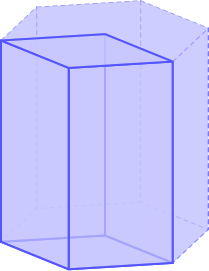
Since a space group is formed by adding translational operations to a point group, all crystals belonging to the trigonal and hexagonal crystal systems can have crystal lattices with a hexagonal lattice setting as described above.
In addition to the above polyhedron, the point groups belonging to the trigonal crystal system can also express their symmetry using a “rhombohedron” (a cube stretched or compressed along one body diagonal direction). The actual color-divided figures are shown below.
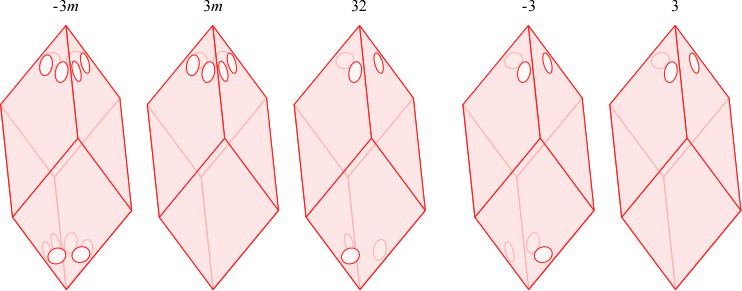
This rhombohedron has \(a=b=c,\,\, \alpha=\beta=\gamma\) (rhombohedral lattice setting) in terms of lattice expression. Trigonal crystals can have not only a hexagonal lattice setting but also a rhombohedral lattice setting. On the other hand, no matter how each face of the rhombohedron is colored, the symmetry of point groups belonging to the hexagonal crystal system cannot be expressed. Consequently, it is impossible for hexagonal crystals to have a rhombohedral lattice setting.
To summarize the above: For trigonal crystals, the meaningful crystal lattices are either a rhombohedral lattice setting or a hexagonal lattice setting. For hexagonal crystals, the meaningful lattice is only the hexagonal lattice setting. (Note: “meaningful” means that the lattice has a shape reflecting symmetry operations other than lattice translation.)
In group-theoretic terms, it can also be said that “the trigonal crystal system can be a subgroup of the cubic crystal system, while the hexagonal crystal system cannot.” For details, please refer to “2.5. Crystallographic Point Groups and Their Subgroups“. For the background of why such a complicated situation arises in the trigonal and hexagonal crystal systems, please refer to “3.7. Classification of Space Groups“.
By the way, “if it is a trigonal crystal system, a 3-fold rotation axis exists” is correct, but “if it is a hexagonal crystal system, a 6-fold rotation axis exists” is incorrect. For example, point groups \(\bar{6}\) or \(\bar{6}m2\) do not have a 6-fold rotation axis. Do not forget that \(\bar{6}\) (6-fold rotoinversion) is equivalent to \(3/m\).
Hexagonal Lattice Setting and Rhombohedral Lattice Setting
As stated above, trigonal crystals can have crystal lattices in one of two forms: either the hexagonal lattice setting (\(a=b,\,\, \alpha=\beta=90°,\,\, \gamma=120°\)) or the rhombohedral lattice setting (\(a=b=c,\,\, \alpha=\beta=\gamma\)). Let us consider the relationship between the two.
Consider a crystal with a 3-fold rotation axis. Since it is a crystal, there must be three independent translation vectors. Since it is our choice where to place the starting point (lattice point) of the translation vectors, we will start by placing a lattice point (gray circle) on the 3-fold rotation axis.

Now let’s make one assumption. We assume that “there is a short translation vector in a direction that is neither perpendicular nor parallel to the 3-fold rotation axis”1. This vector and lattice point are shown in light blue.
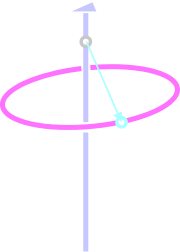
The light blue lattice points are transformed into cream-colored and yellow-green lattice points by the action of the 3-fold rotation. If the three vectors are considered as crystal lattice vectors \(a, b, c\), we can see that it becomes a “rhombohedral lattice setting with \(a=b=c,\,\, \alpha=\beta=\gamma\)”. We could consider this the completion of the crystal lattice, but let’s proceed a bit further.
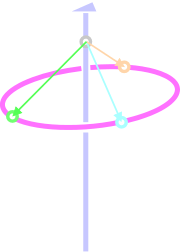
When these three vectors (light blue, cream-colored, and yellow-green) are combined, the endpoint of the resulting vector lies on the 3-fold rotation axis. That is, a lattice point also exists on the 3-fold rotation axis.
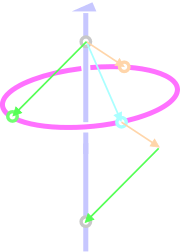
If we connect lattice point to lattice point, it is necessarily a translation vector. Vectors connecting lattice points on the 3-fold rotation axis are also translation vectors. Let us show this with a blue vector. We can also select two vectors (red and green) that are orthogonal to the 3-fold rotation axis. These are also translation vectors. If we consider the red, green, and blue translation vectors as \(a, b, c\) axes, we get a hexagonal lattice setting with \(a=b,\,\, \alpha=\beta=90°,\,\, \gamma=120°\).
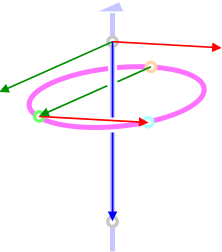
Now, the unit cell defined by this lattice vector does not have the minimum volume (it is not a Primitive crystal lattice). For example, at the \(c\)-axis cross-section advanced 1/3 along the \(c\) axis direction, the light blue lattice point is contained within the unit cell as shown in the figure below. The fractional coordinates of the light blue lattice point are (2/3, 1/3, 1/3). Similarly, at the \(c\)-axis cross-section advanced 2/3 along the \(c\) axis direction, a lattice point is found at the location (1/3, 2/3, 2/3).
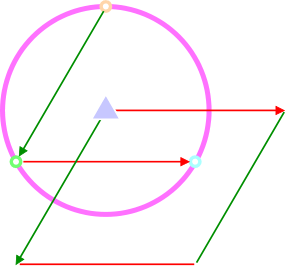
Summarizing the discussion so far: even if there is a “short translation vector in a direction that is neither perpendicular nor parallel to the 3-fold rotation axis,” we can ultimately adopt a crystal lattice with a hexagonal form (\(a=b,\,\, \alpha=\beta=90°,\,\, \gamma=120°\)), but it contains two extra lattice points within the unit cell. Now you understand. This is the hexagonal lattice setting in the space group of the \(R\) lattice type. For example, to express a crystal of space group \(R3\) in the hexagonal lattice setting, you need to specify the lengths of the \(a\) and \(c\) axes and consider the lattice translation of (2/3, 1/3, 1/3) and (1/3, 2/3, 2/3). On the other hand, the rhombohedral lattice (\(a=b=c,\,\, \alpha=\beta=\gamma\)) shape that appeared in the middle is the rhombohedral lattice setting in the space group of the \(R\) lattice type. For example, to express a \(R3\) crystal in the rhombohedral lattice setting, you need to specify the length of the \(a\) axis and the angle \(\alpha\). This rhombohedral lattice setting is a primitive lattice (primitive, minimum volume unit cell) representation, so it does not contain extra lattice points inside. It would be nice to use the symbol \(P\) (Primitive) in that case, but doing so would create other confusion. Let’s proceed a bit further.
Now let’s consider the case where “there is no short translation vector in a direction that is neither perpendicular nor parallel to the 3-fold rotation axis.” This is simple. It simply means “there is a short translation vector that is perpendicular or parallel to the 3-fold rotation axis,” so we can directly adopt those translation vectors as the \(a, b, c\) axes to get a hexagonal lattice. Naturally, this lattice is a primitive lattice (\(P\) lattice). Space groups such as \(P3, P32, P3m\) fall into this case. Since these groups already use the \(P\) symbol, we cannot use the \(P\) symbol for rhombohedral lattice setting space groups even if they are primitive lattices.
Now, even in space groups such as \(P3, P32, P3m\), if we appropriately combine the \(a, b, c\) axis vectors of the hexagonal lattice (for example, by taking the three vectors \(a+c, b+c, -a-b+c\) as crystal lattice vectors), we can also adopt a primitive lattice that satisfies the rhombohedral lattice setting, namely “\(a=b=c,\,\,\alpha=\beta=\gamma\)”. However, we normally do not do such a thing. The reason is that adopting the rhombohedral lattice setting makes the representation of crystal planes and crystal axes that are perpendicular or parallel to the 3-fold rotation axis less intuitive, and also because most people find the hexagonal lattice setting more understandable than the rhombohedral lattice setting. (There may be deeper reasons. We welcome the opinions of those with more expertise.)
Finally, let’s summarize everything. If a crystal has a 3-fold rotation axis, it can always adopt a hexagonal lattice setting2. It is determined by international rules that if the hexagonal lattice setting is a primitive lattice, the lattice type is \(P\); otherwise it is \(R\). For space groups of the \(R\) lattice type, a rhombohedral lattice setting, which is a primitive lattice, may be adopted.
Four-Index Notation for Crystal Planes/Axes in the Hexagonal Lattice Setting
Miller-Bravais Index
Crystal planes are normally expressed with three indices \(h, k, l\) as \((h\, k\, l)\). This is called the Miller index3. However, only when a hexagonal lattice setting (Hexagonal setting) is adopted for the trigonal or hexagonal crystal systems, it is convenient to express crystal planes with four indices as \((h\, k\, i\, l)\). This is called the Miller-Bravais index4.
In the hexagonal lattice setting of the trigonal or hexagonal crystal systems, the \(c\) axis coincides with the 3-fold rotation axis. Let’s consider the set of equivalent crystal planes related by this 3-fold rotation operation. In the three-index notation, for example, crystal planes equivalent to \((1\, 2\, 1)\) are \((\bar{3}\, 1\, 1)\) and \((2\, \bar{3}\, 1)\), but it’s a bit difficult to immediately judge that these three sets of plane indices are equivalent just by looking at them.
In the four-index notation \((h\, k\, i\, l)\) for crystal planes, \(i\) is defined such that \(i=-h-k\). For example, the three-index \((1\, 2\, 1)\) is expressed as \((1\, 2\, \bar{3}\, 1)\) in four indices. And by the 3-fold rotation operation, this plane is transformed into \((\bar{3}\, 1\, 2\, 1)\), \((2\, \bar{3}\, 1\, 1)\). Looking at these indices, we can see that \(h, k, i\) have the property of being cyclically permutable, that is, \((h\, k\, i\, l)\) ⇔ \((i\, h\, k\, l)\) ⇔ \((k\, i\, h\, l)\). In other words, by using the four-index notation \((h\, k\, i\, l)\), equivalent crystal planes related by 3-fold rotation become easier to distinguish. Yes, it’s convenient. Since the conversion method is simple and easy to remember, it has become widely adopted.
Weber Index
Well, if the four-index notation for crystal planes is convenient in the hexagonal lattice setting, wouldn’t a four-index notation for crystal axes also be convenient? You’re right; there is also a four-index notation for axes. This is called the Weber index5. The direction of an axis is normally expressed with three indices as \([u\, v\, w]\), but only in the hexagonal lattice setting of the trigonal/hexagonal systems, it can also be expressed with the Weber index \([\frac{2u-v}{3}\,\frac{2v-u}{3}\,\frac{-u-v}{3}\,w]\). Conversely, if written with four indices as \([u’\,\, v’\,\, i’\,\, w’]\), it should be converted to three indices as \([2u’+v’\,\, u’+2v’\,\, w’]\). For example, in three-index notation, \([1\, 2\, 1]\), \([\bar{2}\, \bar{1}\, 1]\), \([1\, \bar{1}\, 1]\) are equivalent, but it’s hard to see if they’re equivalent at first glance. Converting these to four-index notation gives \([0\, 1\, \bar{1}\, 1]\), \([\bar{1}\, 0\, 1\, 1]\), \([1\, \bar{1}\, 0\, 1]\). Indeed, they have a cyclically permutable relationship, making it easier to distinguish equivalent crystal axes. Also, only when \(w=0\), the \([u\, v\, i\, 0]\) axis coincides with the normal direction of the \((u\, v\, i\, 0)\) plane.
| Three-Index Notation | Four-Index Notation | |
|---|---|---|
| Crystal plane | \((h\, k\, l)\) | \((h\, k\, i\, l)\) where \(i=-h-k\) |
| Crystal axis | \([u\, v\, w]\) | \(\displaystyle\left[\frac{2u-v}{3}\,\frac{2v-u}{3}\,\frac{-u-v}{3}\,w\right]\) |
| \([2u’+v’\,\, u’+2v’\,\, w’]\) | \([u’\,\, v’\,\, i’\,\, w’]\) where \(i’=-u’-v’\) |
Now, while the four-index notation for crystal planes is widely used, the four-index notation for crystal axes is not widely adopted except in some specialized fields. Probably this is because the conversion formula is confusing, the Weiss zone law (\(hu+kv+lw=0\) means the normal to the \((h\, k\, l)\) plane is orthogonal to the \([u\, v\, w]\) axis) no longer applies, and there are few analytical situations where the crystal axis rather than the crystal plane plays the main role. Those interested in these matters should also read Professor Nespolo’s paper.
\(P321\) and \(P312\)
Among the space groups belonging to point group 32, there are \(P321\) and \(P312\). Have you ever wondered why it is necessary to distinguish between these two? Point groups 321 and 312 have exactly the same algebraic structure, so in discussions where only point groups are sufficient (cases where translation need not be considered), there is no need to distinguish between them. However, in the case of space groups that have translational operations, it is necessary to consider the relationship between the translational direction and the rotation axis direction, making \(P321\) and \(P312\) distinct. The following explains this in detail.
First, both \(P321\) and \(P312\) are space groups where “a 3-fold rotation axis and a 2-fold rotation axis orthogonal to it exist.” Since it is a 3-dimensional space group, it naturally includes translational operations (translation vectors) in 3 directions, but from the condition of “a 3-fold rotation axis exists” alone, one of the translation vectors can be chosen to be parallel to the 3-fold rotation axis, and the remaining two orthogonal to the 3-fold rotation axis (see “Hexagonal Lattice Setting and Rhombohedral Lattice Setting”). Let’s call these 2 translation vectors orthogonal to the 3-fold rotation axis \(a\) and \(b\).
Now, this space group has not only a 3-fold rotation axis but also a 2-fold rotation axis orthogonal to it. Naturally, due to the requirement of 3-fold rotation, 2-fold rotation axes exist in 3 directions (or 6 directions if we distinguish signs). What are the possible orientation relationships between these 2-fold rotation axes and translation vectors \(a, b\)? For them to form a valid space group, the possible relationships are limited. While I’ll omit the proof, the possibilities are narrowed down to the following two cases.
Case 1: 2-fold rotation axis aligns with the direction of \(a\) or \(b\)
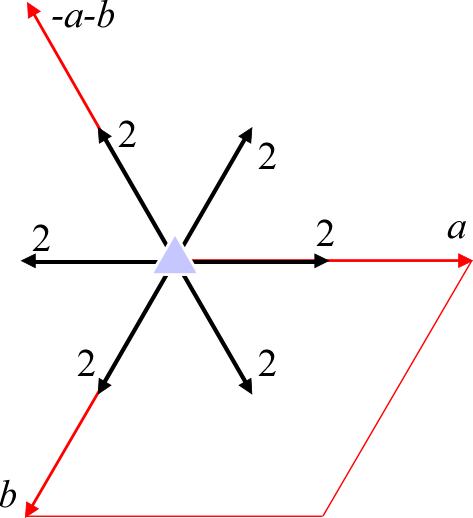
Case 2: 2-fold rotation axis aligns with the direction of \(a-b\) or \(a+2b\)
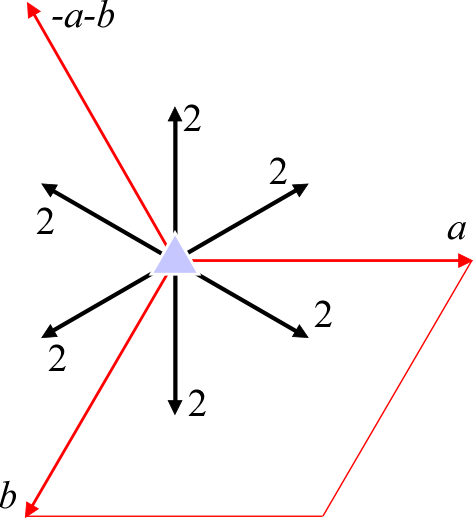
The above figures are projections viewed from the direction of the 3-fold rotation axis (\(c\) axis). Now you can see it; essentially, Case 1 corresponds to \(P321\), and Case 2 corresponds to \(P312\). The following shows the symmetry operations and the relationships of general points for these two space groups. You can see they are completely different space groups.
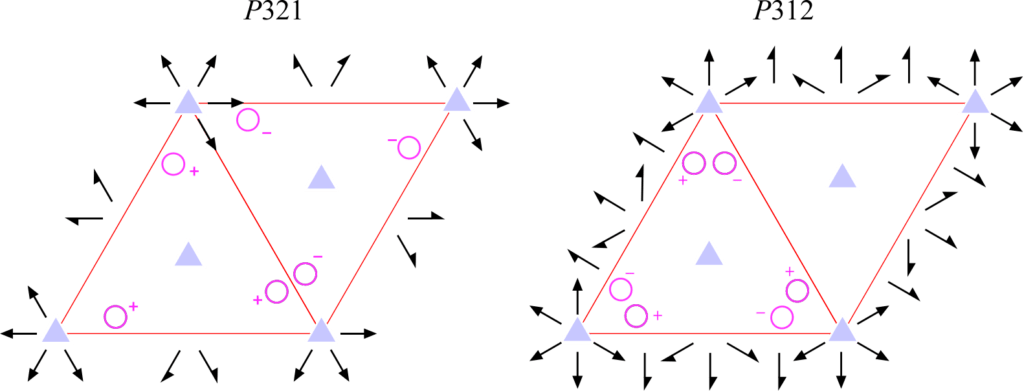
Here we explained using \(P321\) and \(P312\) as examples, but similar relationships apply to:
- \(P3_121\) and \(P3_112\)
- \(P3_221\) and \(P3_212\)
- \(P3m1\) and \(P31m\)
- \(P3c1\) and \(P31c\)
- \(P\bar{3}m1\) and \(P\bar{3}1m\)
- \(P\bar{3}c1\) and \(P\bar{3}1c\)
Be careful not to confuse them just because the notation looks similar.
By the way, such relationships are also seen in the tetragonal crystal system. For example, relationships such as \(P\bar{4} 2m\) and \(P\bar{4} m2\), \(P\bar{4} 2c\) and \(P\bar{4} c2\), \(I\bar{4} 2m\) and \(I\bar{4} m2\) in space groups belonging to point group \(\bar{4}2m\). These are distinguished by the orientation relationships with translation vectors as described above.
Now, when dealing with physical properties of materials in space groups like \(P312\) of Case 2, pay attention to the relationship with the point group and Laue class. For example, the shape of tensors such as elastic constants and dielectric constants is determined by the Laue class, but most literature treats only the Case 1 format. When applying elastic constants analyzed in Case 1 format to crystals of Case 2 type, it is necessary to perform axis transformations such as \(a-b → a’\), \(a+2b → b’\).
- In the expression “a short translation vector in a direction neither perpendicular nor parallel to the 3-fold rotation axis,” the meaning of “short” is, more precisely, whether the component perpendicular to the \(c\) axis is small. The vector with the smallest component perpendicular to the \(c\) axis is the vector parallel to the \(c\) axis. When we select the other independent vectors whose component perpendicular to the \(c\) axis is shortest, if the component parallel to the \(c\) axis of that vector is zero, it is a \(P\) lattice, and if it is non-zero, it is an \(R\) lattice. ↩︎
- If we develop a similar analysis for other orders of rotation and rotoinversion, we arrive at the conclusion that “when rotation or rotoinversion operations of order 2 or higher are present, a setting in which one translation vector is orthogonal to the other two (i.e., a right-angled prismatic unit cell) is possible.” ↩︎
- W. H. Miller (1839), A treatise on crystallography, Cambridge. https://commons.wikimedia.org/wiki/Category:A_Treatise_on_Crystallography_(1839)_by_MILLER ↩︎
- Depending on the reference, these may also be written as Bravais-Miller indices. ↩︎
- L. Weber (1922) Das viergliedrige Zonensymbol des hexagonalen Systems. Z. Kristallogr. 57, 200–203. ↩︎