What Are Lattice Planes?
In a crystal, atoms are arranged periodically in three dimensions. Because of this, when viewing a crystal from a certain direction, situations arise where atoms appear to be lined up approximately on the same plane. The following video shows an NaCl crystal (space group \(Fd\bar{3}m\) ) rotating. The yellow atoms are Cl and the green atoms are Na. If you observe the video carefully, you may notice that during the rotation there are moments when the constituent atoms align on the same plane, and furthermore, these planes are arranged parallel to each other at equal intervals. Moreover, the orientations and spacings of these planes appear to be of not just one but multiple types. What is essential for understanding diffraction is precisely such a “set of parallel, equally spaced planes,” which we call lattice planes.
Lattice Planes and Miller Indices
Lattice planes are defined as “an (infinite) set of parallel planes that are equally spaced and that collectively pass through all lattice points without exception.” To denote lattice planes, we use three mutually coprime1 integers \(h,k,l\) and write them as \((h\,k\,l)\). These are called Miller indices2. \((h\,k\,l)\) represents a set of planes that divide the lattice vectors \(\mathbf{a}, \mathbf{b}, \mathbf{c}\) into \(h,\,k,\,l\) equal parts, respectively. Beginners often mistakenly think that lattice plane \((h\,k\,l)\) represents a single specific plane, but that is not the case. We emphasize once again that lattice planes are a set of equally spaced parallel planes. On the other hand, Miller indices are also used to denote crystal faces (external surfaces), in which case they naturally refer to a single surface exposed on the exterior.
Specific Examples of Miller Indices
For example, the indices of a set of planes that divide the \(\mathbf{a}\) axis into 2 equal parts, the \(\mathbf{b}\) axis into 1 equal part, and are parallel to the \(\mathbf{c}\) axis (i.e., 0 divisions) are \((210)\). Note that when planes are parallel to an axis, the intercept along that axis direction becomes infinite, so the corresponding index becomes 0. \((100)\) represents a set of planes that divide the \(\mathbf{a}\) axis into 1 part and are parallel to the \(\mathbf{b}\) and \(\mathbf{c}\) axes, while \((001)\) represents a set of planes perpendicular to the \(\mathbf{c}\) axis. The video shown at the upper right shows the \((210)\) lattice planes for an NaCl crystal in translucent pink. Pay attention to the orientation of the lattice vectors and verify that it is indeed a set of planes that divides the \(\mathbf{a}\) axis into 2 parts, the \(\mathbf{b}\) axis into 1 part, and is parallel to the \(\mathbf{c}\) axis.
\(h,\,k,\,l\) can also be negative. In such cases, the negative sign is represented by a bar above the number, written for example as \((\bar{2}10)\). This does not mean “dividing the \(\mathbf{a}\) axis into -2 parts,” but rather “dividing the \(-\mathbf{a}\) axis into 2 parts.” The video shown at the lower right shows the \((\bar{2}10)\) lattice planes for an NaCl crystal. Note the difference from \((210)\).
↑\((210)\)↑ and ↓\((\bar{2}10)\)↓
Orientation of lattice vectors \(\mathbf{a}, \mathbf{b}, \mathbf{c}\)
(If the videos are not synchronized, please reload the page)
\((h\,k\,l)\) and \(\{h\,k\,l\}\)
When Miller indices are written not with round brackets \((\,)\) as \((hkl)\), but with curly brackets \(\{\,\}\) as \(\{h\,k\,l\}\), it represents the collection of sets of planes that are equivalent to each other by symmetry operations. This is particularly commonly used when describing crystal faces, but it is also used when one wants to collectively express equivalent lattice planes. For example, in the cubic crystal system, the six planes \( (1\,0\,0)\), \((0\,1\,0)\), \((0\,0\,1)\), \( (\bar{1}\,0\,0)\), \((0\,\bar{1}\,0)\), \((0\,0\,\bar{1})\) are collectively written as \(\{100\}\). Although \((100)\) and \(\{100\}\) look similar, they do not mean the same thing. The former is a set of planes in a specific orientation, while the latter is a collection of symmetrically equivalent sets of planes. Naturally, the notation \(\{hkl\}\) is only meaningful when the symmetry (point group or crystal system) has been specified. Note that this is a context-dependent usage.
The distinction between \((hkl)\) and \(\{hkl\}\) is very similar to the relationship between \([u\,v\,w]\) and \(\langle u\,v\,w\rangle\) in the expression of lattice directions discussed on the page “1.3. Lattice Constants, Crystal Systems, and Bravais Lattices.” For reference, \([u\,v\,w]\) refers to a single direction \(u\mathbf{a} +v\mathbf{b} +w\mathbf{c}\), while \(\langle u\,v\,w\rangle\) refers to the set of equivalent directions. There are many types of brackets, which can be confusing, but the following rules may help:
- Rounded brackets \((\,)\) and curly brackets \(\{\,\}\) represent planes
- Straight-lined square brackets \([\,]\) and angle brackets \(\langle\,\rangle\) represent directions
- Curly brackets \(\{\,\}\) and angle brackets \(\langle\,\rangle\), which have pointed middles, represent sets of equivalent planes/directions
Lattice Planes ≠ Atoms Arranged on a Plane
In the video at the top of the page, we happened to observe atoms lining up neatly on planes, but that does not mean that lattice planes are “planes formed by atoms arranged on a flat surface.” The crystal lattice is a geometric concept defined as a set of lattice points arranged periodically in space, and lattice planes are sets of planes determined by that periodicity. In actual crystal structures, many atoms may appear to be aligned along a certain lattice plane, but lattice planes do not always coincide with atomic positions. What is essential for diffraction is not that scatterers (atoms) are strictly arranged on a single ideal plane, but that the distribution of scatterers has spatial periodicity. The following explanation of the Bragg condition emphasizes lattice planes, but in reality this is merely a convenient way of intuitively understanding the periodic structure. It is more accurate to think of lattice planes not as imagining thin boards where atoms actually exist, but rather as “sets of planes where phases align.”
Crystal Faces
A term similar to lattice planes is “crystal faces.” Crystal faces refer to the actual flat surfaces that form the exterior shape of a crystal, sometimes also called crystal habit faces. Although they are originally a different concept from lattice planes, in everyday explanations the term crystal face is often used with the meaning of lattice planes. You can almost always determine which is meant from the context, so there is no need to worry.
From a historical perspective in crystallography, Miller index notation first developed from the need to describe the orientations of crystal external faces, and the same approach was later extended to lattice planes. Crystal faces and lattice planes are not unrelated. According to the Bravais law3, the external faces that develop prominently in a crystal are parallel to internal lattice planes with high lattice point density. In other words, the crystal faces visible on the exterior often reflect the periodicity of the internal lattice4.
Bragg Condition
The interplanar spacing of lattice plane \((hkl)\) is written as \(d_{hkl}\). The smaller the interplanar spacing, the more densely the planes in that set are arranged. As shown in the following figure, when an incident wave (X-rays, electron beams, neutron beams, etc.) is scattered by this set of planes, the reflected waves reinforce each other when the path difference between waves scattered by adjacent planes is an integer multiple of the wavelength. This phenomenon is called diffraction, and the condition for diffraction to occur $$
2d_{hkl}\sin\theta=n\lambda
$$ is called the Bragg condition (Bragg’s law)5. Here, \(\lambda\) is the wavelength of the incident radiation, \(\theta\) is the angle between the incident beam and the plane, and \(n\) is a positive integer representing the order of the reflection.
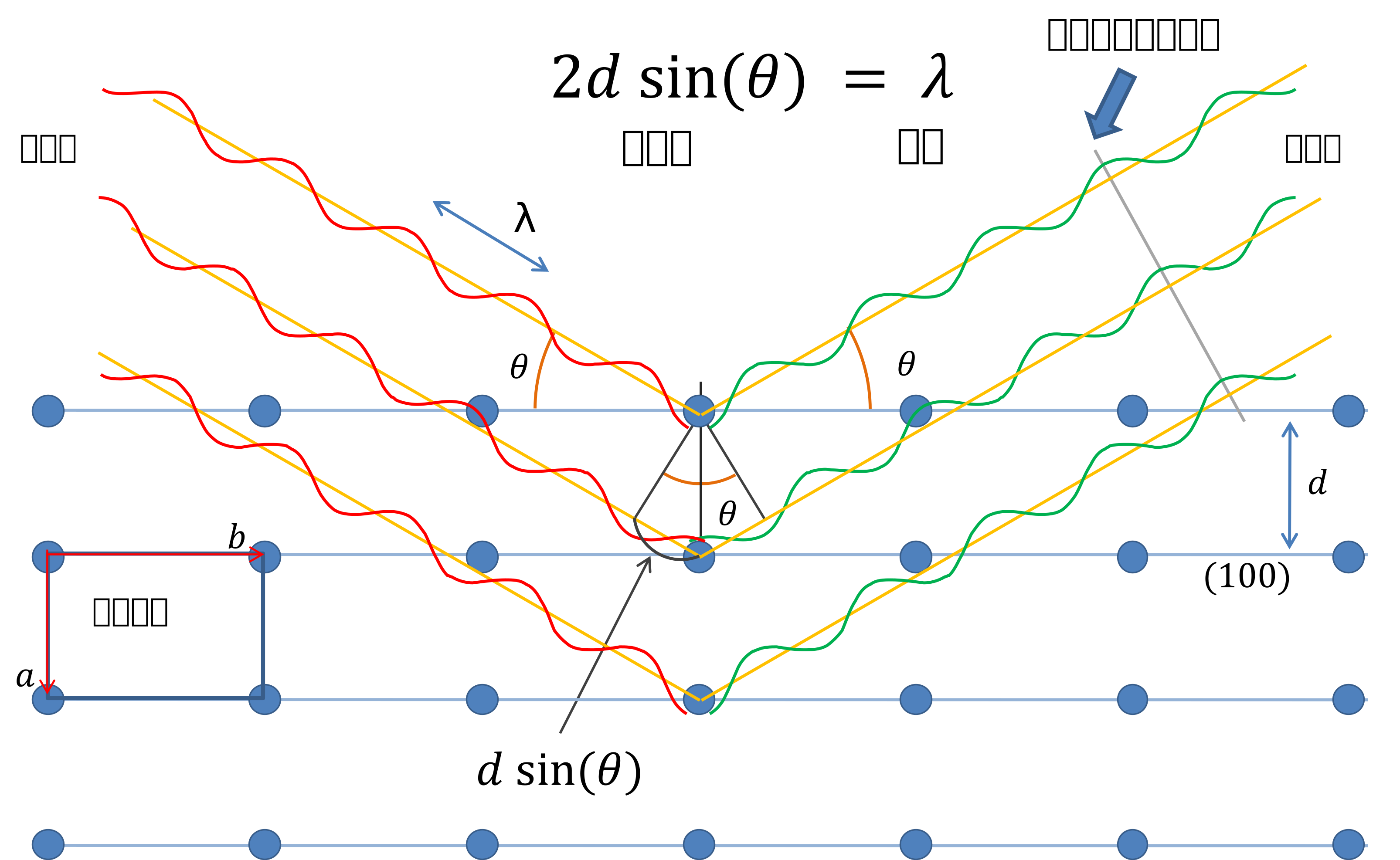
Schematic of the Bragg condition
(example of diffraction by \((100)\) lattice planes)
Note that the Bragg condition gives “at what angles constructive interference can occur,” but does not give the intensity of the reflection itself. The reflection intensity depends on what atoms are present at which positions within the unit cell, and this information is contained in the crystal structure factor. It is important to distinguish that the Bragg condition determines the reflection angle, not the intensity.
Order \(n\) and Reflection Indices
The relationship between the order \(n\) and Miller indices is a point that beginners tend to confuse considerably. For example, the \(n\)-th order Bragg condition can be rewritten as: $$
2d_{hkl}\sin\theta=n\lambda \quad \Rightarrow \quad 2\left(\frac{d_{hkl}}{n}\right)\sin\theta=\lambda
$$ That is, an \(n\)-th order reflection from a set of planes with spacing \(d_{hkl}\) is equivalent to a first-order reflection from a set of planes with spacing \(d_{hkl}/n\). And anyone will immediately realize that a set of planes in the same normal direction as \((h\,k\,l)\) but with spacing \(d_{hkl}/n\) is simply \((nh\,nk\,nl)\). In other words, the above equation can be further rewritten as: $$
2\left(\frac{d_{hkl}}{n}\right)\sin\theta=\lambda \quad \Rightarrow \quad 2d_{nh\,nk\,nl}\sin\theta=\lambda
$$ For example, a second-order reflection from \((111)\) can be thought of as a first-order reflection from \((222)\). This is a very useful way of thinking.
However, there is a caveat here. Index notation using non-coprime \(h,k,l\), such as \((222)\), is strictly speaking not Miller indices, and the plane periodicity represented by such indices is not lattice planes. Miller indices were originally developed to describe the orientations of crystal faces, so the definition does not distinguish between \((h\,k\,l)\) and \((nh\,nk\,nl)\). Nevertheless, as described above, the notation \((nh\,nk\,nl)\) is simple and hard to abandon. Therefore, in the context of describing diffraction phenomena, index notation using non-coprime \(h,k,l\) is permitted, and these are called reflection indices (also known as Laue indices). Having explained all this, it may seem counterproductive, but spending effort on these definitional and terminological distinctions is not very productive. On this website, we will not distinguish between Miller indices and reflection indices, and will simply express them as \((h\,k\,l)\), and will also call the periodicity represented by those indices lattice planes. Furthermore, the Bragg condition will be explained in the final form without the order \(n\) on the right-hand side.
To treat the relationship between lattice planes and diffraction more rigorously, it is convenient to introduce a vector perpendicular to the set of planes. For a set of planes \((hkl)\), a corresponding vector can be defined, and the interplanar spacing and diffraction conditions can be expressed in a unified manner. This approach leads to the introduction of the reciprocal lattice. On the next page, we will examine the meaning of this vector and how crystal planes, interplanar spacing, and diffraction conditions can be expressed in a unified way.
Footnotes
- Lattice planes are defined as a set of planes that pass through all lattice points without exception. There must be no lattice point that does not coincide with a plane, and no plane that does not pass through a lattice point. From this definition, we can show that \(h,\,k,\,l\) must be coprime. First, choose one lattice point as the origin and express spatial coordinates as \((u, v, w) = u\mathbf{a} +v\mathbf{b} +w\mathbf{c}\). Then the set of lattice planes can be expressed by the plane equation $$h u + k v + l w = m$$ where \(m\) is any integer. Since lattice point coordinates can be expressed as \((p,q,r)\) where \(p,q,r\) are any integers, it is obvious that one of the plane equations above is satisfied. That is, there are no lattice points that do not coincide with a plane. Now, suppose \(h,\,k,\,l\) are not mutually coprime and have a common factor \(n\). Letting \(h’=h/n,\, k’=k/n,\, l’=l/n\), the plane $$h’ u + k’ v + l’ w = m/n$$ would be included in the set of planes. \(m/n\) is not necessarily an integer. When it is not an integer, that plane does not pass through lattice points, which contradicts the definition. Therefore, \(h,\,k,\,l\) must be mutually coprime. ↩︎
- https://dictionary.iucr.org/Miller_indices ↩︎
- https://dictionary.iucr.org/Bravais_law ↩︎
- However, this does not mean that “all lattice planes appear as crystal faces.” Crystal faces are real surfaces, while lattice planes are geometric sets of planes based on the internal structure. ↩︎
- This equation is of particular historical importance in crystallography. In 1912, Max von Laue together with Friedrich and Knipping demonstrated that crystals produce diffraction patterns for X-rays. This was a groundbreaking achievement that clearly showed both that X-rays behave as waves and that crystals possess a regular periodic internal structure. Shortly after, in 1913, W. L. Bragg showed that by considering a crystal as a collection of many parallel lattice planes, the diffraction condition can be understood through very simple geometry. In this way, Laue’s diffraction experiment and Bragg’s geometric interpretation were linked, rapidly establishing the foundations of modern X-ray crystallography. https://dictionary.iucr.org/Bragg%27s_law ↩︎