In 3D space, the surface area of a sphere with radius \(r\) is \(4\pi r^2\), which everyone knows. But do you know how to calculate the area of a spherical triangle, a spherical cap1 (spherical cap), or the area of overlapping caps? Here we discuss some more advanced topics related to the area of a sphere.
Spherical Polygons and Spherical Triangles
When a sphere is cut by a plane passing through its center, the circle that appears on the cross-section is called a great circle. A region on the sphere’s surface enclosed by multiple great circles is called a spherical polygon, where the intersections of the great circles correspond to vertices and the arcs on the great circles correspond to edges.
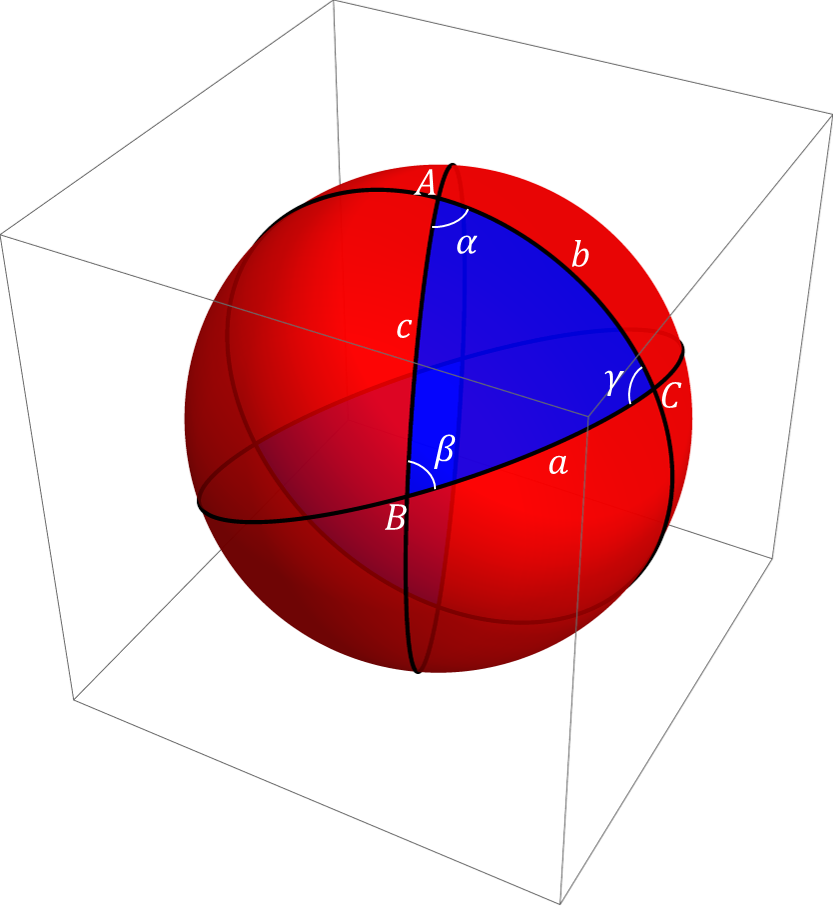
Consider the sphere shown in the figure2. The region shown in blue is a figure on the sphere’s surface enclosed by three great circles. Let the three vertices (intersections of great circles) be \(A, B, C\), the lengths of the edges be \(a, b, c\), and the interior angles be \(\alpha, \beta, \gamma\). Note that the edge lengths \(a, b, c\) are the lengths measured along the arcs on the sphere’s surface (not the straight-line distances between vertices). Therefore, \(a, b, c\) correspond to the angles between pairs of vertices (when the sphere has radius 1). Such a triangle is called a spherical triangle, and the various methods for working with such triangles are called spherical trigonometry. With the sphere’s radius set to 1, the following theorems hold. For comparison, we present them alongside their planar trigonometry counterparts.
| Theorem | Spherical (sphere of radius 1) | Planar |
|---|---|---|
| Law of cosines | \(\cos a = \cos b \cos c + \sin b \sin c \cos \alpha\) \(\cos b = \cos c \cos a + \sin c \sin a \cos \beta\) \(\cos c = \cos a \cos b + \sin a \sin b \cos \gamma\) | \(a^2=b^2+c^2-2bc\cos \alpha\) \(b^2=c^2+a^2-2ca\cos \beta\) \(c^2=a^2+b^2-2ab\cos \gamma\) |
| Law of sines | \(\displaystyle \frac{\sin a}{\sin \alpha} = \frac{\sin b}{\sin \beta}= \frac{\sin c}{\sin \gamma}\) | \(\displaystyle \frac{a}{\sin \alpha}=\frac{b}{\sin \beta}=\frac{c}{\sin \gamma}\) |
| Area | \(\displaystyle 2 \sin^{-1} \left[
\frac{\sqrt{ \sin s \sin (s-a)\sin (s-b)\sin (s-c)} }{2 \cos(a/2)\cos(b/2)\cos(c/2)}
\right]\) where \( \ 2s = a+b+c\) or \(\alpha+\beta+\gamma-\pi\) | \(\sqrt{s (s-a)(s-b)(s-c)}\) where \(2s = a+b+c \) For a triangle inscribed in a unit circle: \(2 \sin\alpha \sin\beta \sin\gamma\) |
Unlike planar triangles, since \(a,b,c\) have the nature of angles, the formulas look quite different at first glance. However, when \(a,b,c\) become small (i.e., when the spherical triangle becomes small), we have \( \sin a\rightarrow a,\ \cos a \rightarrow 1-a^2/2\)3, and one can see that the formulas approach those of planar trigonometry. Finally, the following relationships also hold among \(a,b,c,\alpha, \beta, \gamma\). Defining \(2s = a+b+c\) and \(2S = \alpha+\beta+\gamma\),
$$ \begin{array}{l} \sin^2 (\alpha/2) = [\sin(s-b)\sin(s-c)] / [\sin b \sin c] \\ \cos^2 (\alpha/2) = [\sin s \sin(s-a)] / [\sin b \sin c]\\ \sin^2 (a/2) = -[\cos S \cos(S-\alpha)] / [\sin \beta \sin \gamma]\\ \cos^2 (a/2) = [\cos(S-\beta)\cos(S-\gamma)]/[\sin \beta \sin \gamma]\end{array}$$
Spherical Excess and Area
The sum of the interior angles of a spherical triangle (\(\alpha+\beta+\gamma\)) is always greater than \(\pi\). The quantity indicating how much it exceeds \(\pi\) is called the spherical excess, defined as $$E= \alpha+\beta+\gamma-\pi$$ An interesting property is that for a unit sphere (a sphere of radius 1), \(E\) equals the area of the spherical triangle. This can be explained simply as follows.
First, a region enclosed by two great circles is a “spherical polygon with two vertices,” which we call a lune (digon)4. For a unit sphere, the area of a lune with vertex angle \(\theta\) is \(2\theta\).
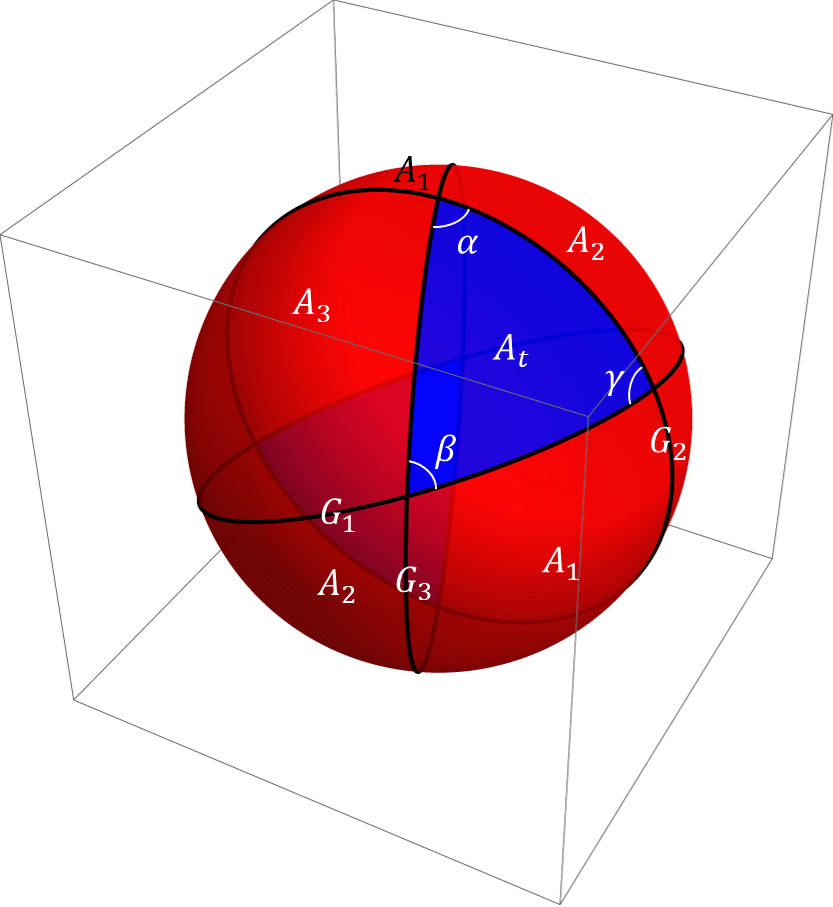
Now, let the three great circles defining the spherical triangle be \(G_1, G_2, G_3\) as shown in the following figure. Also, define the areas of each region separated by the great circles as \(A_t, A_1, A_2, A_3\). Of course, what we want to find is the area \(A_t\). The area of the lune \(L_1\) enclosed by \(G_2\) and \(G_3\) that contains \(A_t\) is $$2\alpha = A_t+A_1$$ Similarly, defining the other two lunes as \(L_2, L_3\), their areas are respectively $$2\beta = A_t+A_2,\quad 2\gamma=A_t+A_3$$ Combining these, we obtain $$3A_t+A_1+A_2+A_3=2 (\alpha+\beta+\gamma)$$ Finally, using the fact that \(A_t+A_1+A_2+A_3\) equals the hemisphere area \(2\pi\), we obtain $$A_t = \alpha+\beta+\gamma-\pi=E$$
Cap Area
A cap is a bowl-shaped solid formed when a sphere is cut by a plane. As shown in the following figure, suppose a sphere of radius \(r\) is cut by a plane at distance \(r-h\) from the center, creating a cap (shown in blue) with base radius \(a\), height \(h\), and opening angle \(\Theta\). We proceed with the assumption that the center of the cap coincides with the north pole \(N\).
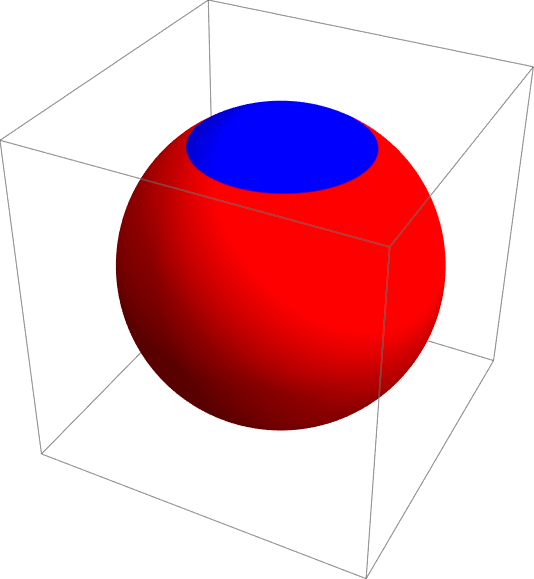
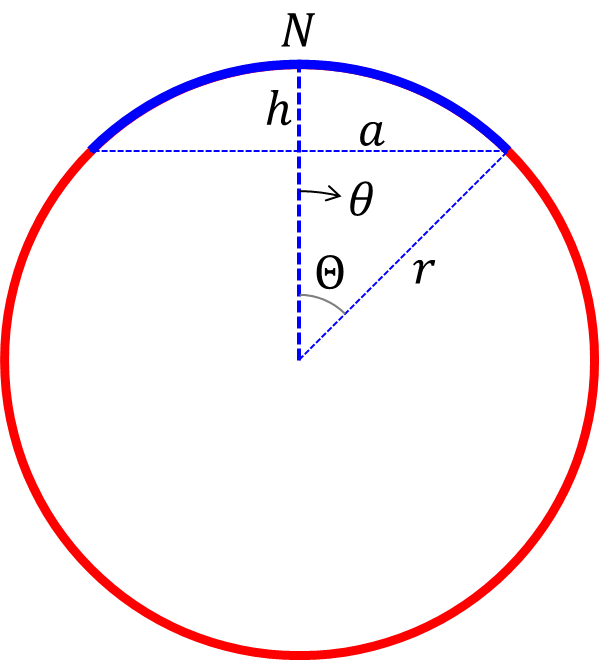
The surface area \(A\) of this cap can be found by integrating with respect to the angle \(\theta\) measured from the cap center: $$A=\int_0^\Theta {2 \pi r^2 \sin\theta\ d\theta} = 2\pi r^2 (1-\cos\Theta) $$5 Since \(r (1-\cos\Theta)=h\), this can also be written as \(A=2\pi r h\). Furthermore, since \(r^2=a^2+(r-h)^2 \leftrightarrow 2rh=a^2+h^2\), it can also be written as \(A=\pi (a^2+h^2)\).
Cap and Cap Overlap Area
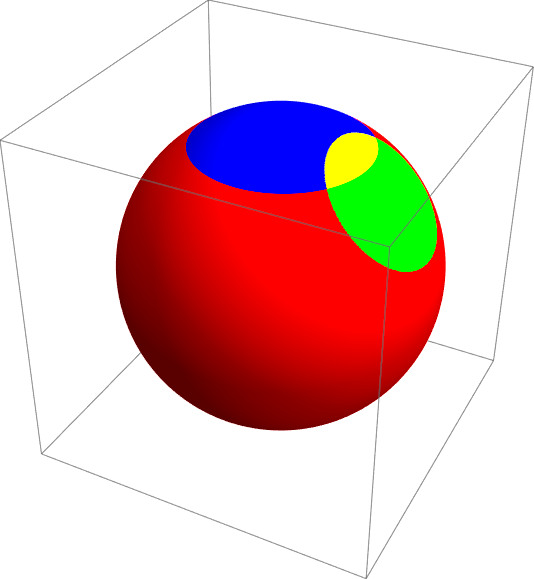
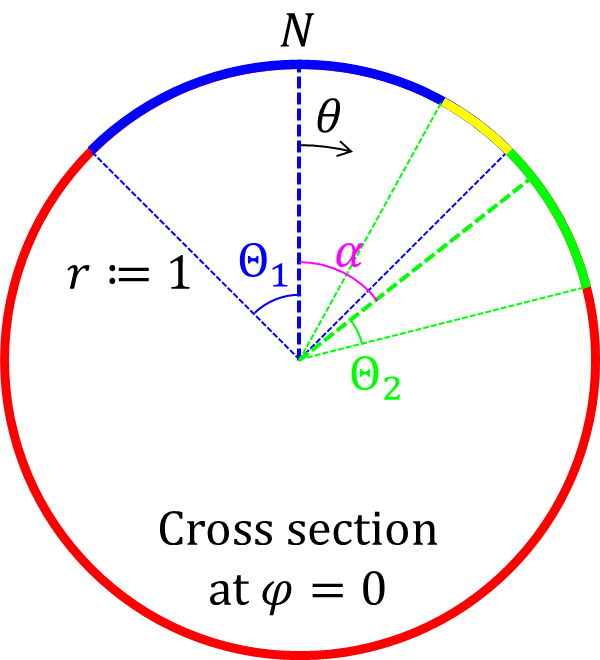
Now consider the situation shown in the following figure6. There is a blue cap and a green cap, and the problem is to find the area of the yellow overlap region. The opening angles of the blue and green caps are \(\Theta_1\) and \(\Theta_2\) respectively, and the angle between the cap centers is \(\alpha\). The center of the blue cap coincides with the north pole \(N\), and the center of the green cap lies on the zero-longitude circle. Note that hereafter the sphere radius \(r\) is assumed to be 1 (for other radii, simply multiply all results by \(r^2\)).
Method 1: As an Integration Problem
We show an enlarged view of the region of interest, with latitude lines (corresponding to \(\theta\)7) and longitude lines (corresponding to \(\varphi\)) drawn in. A point \(P\) on the sphere can be expressed as $$ P(\theta, \varphi)= (\sin\theta\cos\varphi, \sin\theta\sin\varphi, \cos\theta)$$ The center of the blue cap is \(C_1=(0,0,1)\), and the center of the green cap is \(C_2=(\sin\alpha,0,\cos\alpha)\). The condition for point \(P\) to be contained in the blue cap is \(\theta \le \Theta_1\), and the condition for being contained in the green cap is $$ P\cdot C_2 = \sin\theta\cos\varphi\sin\alpha + \cos\theta\cos\alpha \ge \cos\Theta_2 $$ Rearranging with respect to \(\varphi\): $$ \cos\varphi \ge \frac{\cos\Theta_2-\cos\theta \cos\alpha}{\sin\theta \sin\alpha}$$ Since the right-hand side expression appears repeatedly, we define $$k(\theta) = \frac{\cos\Theta_2-\cos\theta \cos\alpha}{\sin\theta \sin\alpha}$$
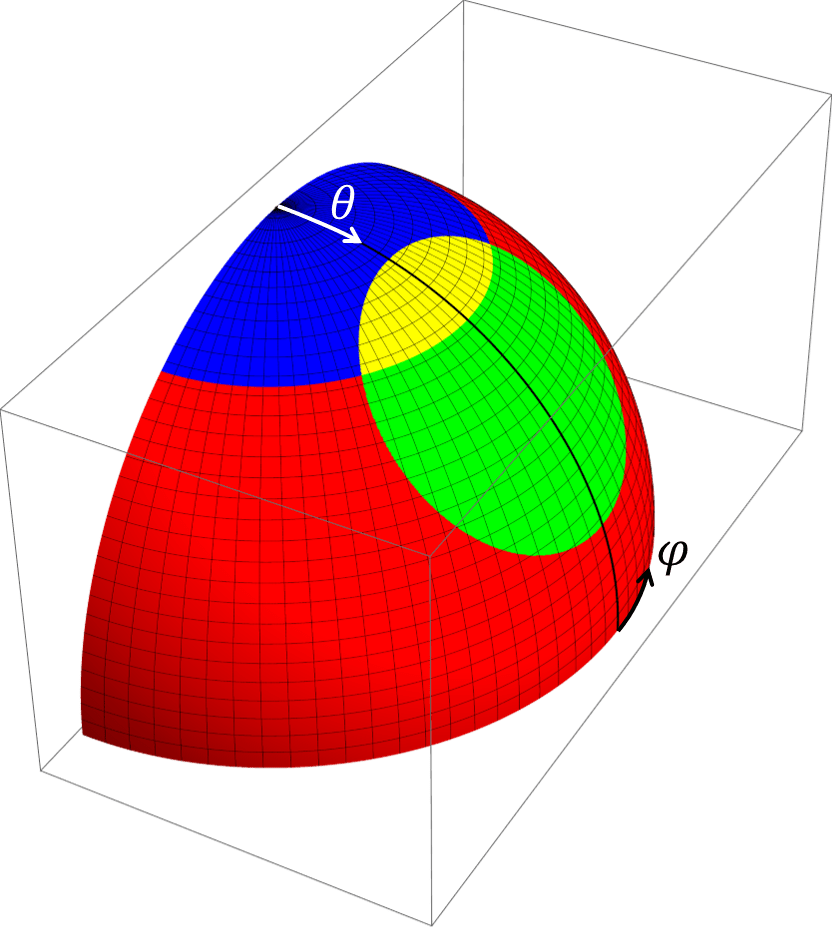
The range of \(\theta\) over which the yellow region appears is, as evident from the figure, \(\alpha-\Theta_2 \sim \Theta_1\)8. Within this range of \(\theta\), there exist values of \(\varphi\) satisfying \(\cos\varphi \ge k(\theta)\). For a fixed \(\theta\), the range of \(\varphi\) (the longitude range of the yellow region) can be expressed as $$ -\cos^{-1}\{k(\theta)\} \sim +\cos^{-1}\{k(\theta)\} $$ Now the problem is essentially solved. Finally, noting that the length along a latitude line is proportional to \(\sin\theta\), the area of the yellow region is obtained by evaluating the following integral: $$ \int_{\alpha-\Theta_2}^{\Theta_1} 2 \cos^{-1}\{k(\theta)\} \sin\theta\ d\theta = \int_{\alpha-\Theta_2}^{\Theta_1} 2 \cos^{-1}\left[\frac{\cos\Theta_2-\cos\theta \cos\alpha}{\sin\theta \sin\alpha}\right] \sin\theta\ d\theta $$ Unfortunately, \(\cos^{-1}\{k(\theta)\}\) has no simple antiderivative, so no further simplification is possible.
Method 2: As a Spherical Triangle Problem
Another approach is to reduce the problem to a spherical triangle problem. As shown in the figure, let the centers of the blue and green caps be \(C_1, C_2\), and their intersection points be \(P, P’\). Since the spherical triangles \(C_1 C_2 P\) and \(C_1 C_2 P’\) are congruent, we consider only the former. The arc lengths of the sides of \(C_1 C_2 P\) are \(\Theta_1, \Theta_2, \alpha\), and the interior angles are \(\beta_1, \beta_2, \beta_3\). Also, let the points where side \(C_1 C_2\) intersects the yellow boundary be \(Q_1, Q_2\). With this setup, you can see that the area of the yellow region is obtained by “taking the sum of the areas of the sector regions \(C_1 PQ_1\) and \(C_2 PQ_2\), subtracting the area of the spherical triangle \(C_1 C_2 P\), and finally doubling.”
The areas \(A_1, A_2\) of the sector regions \(C_1 PQ_1\) and \(C_2 PQ_2\), and the area \(A_t\) of the spherical triangle \(C_1 C_2 P\), can be simply expressed as $$ A_1=\beta_1(1-\cos\Theta_1)\\ A_2= \beta_2(1-\cos\Theta_2)\\ A_t=\beta_1+\beta_2+\beta_3-\pi$$
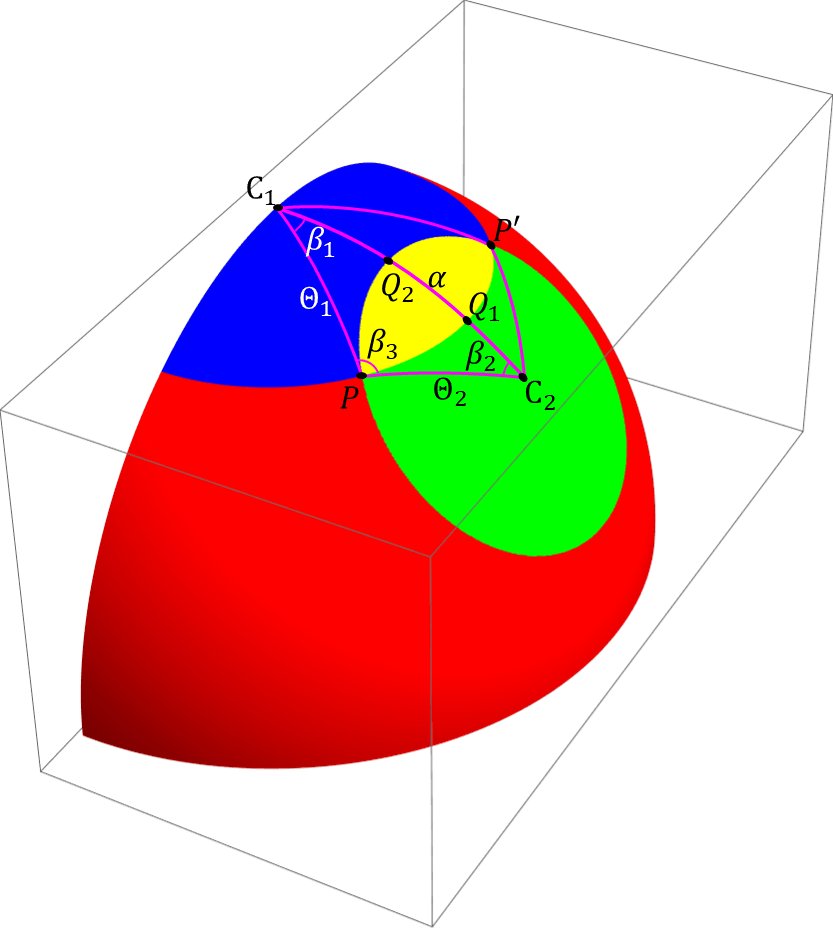
Also, as shown earlier on this page, \(\beta_1,\beta_2, \beta_3\) can be determined by the spherical law of cosines as $$ \cos\beta_1 = \frac{\cos\Theta_2 -\cos \Theta_1 \cos\alpha}{\sin\Theta_1 \sin\alpha} \quad \leftrightarrow \quad \beta_1 = \cos^{-1}\left[ \frac{\cos\Theta_2 -\cos \Theta_1 \cos\alpha}{\sin\Theta_1 \sin\alpha} \right]\\ \cos\beta_2 = \frac{\cos\Theta_1 -\cos \Theta_2 \cos\alpha}{\sin\Theta_2 \sin\alpha} \quad \leftrightarrow \quad \beta_2 = \cos^{-1} \left[ \frac{\cos\Theta_1 -\cos \Theta_2 \cos\alpha}{\sin\Theta_2 \sin\alpha} \right]\\ \cos\beta_3 = \frac{\cos\alpha -\cos \Theta_1 \cos\Theta_2}{\sin\Theta_1 \sin\Theta_2} \quad \leftrightarrow \quad \beta_3 =\cos^{-1} \left[ \frac{\cos\alpha -\cos \Theta_1 \cos\Theta_2}{\sin\Theta_1 \sin\Theta_2}\right]$$ Furthermore, using the relation \(\cos^{-1}(-\omega) = \pi-\cos^{-1}(\omega)\), we get $$ \pi-\beta_3 =\cos^{-1} \left[ \frac{\cos \Theta_1 \cos\Theta_2 -\cos\alpha}{\sin\Theta_1 \sin\Theta_2}\right] $$ which simplifies things slightly. That is, the area \(S\) of the yellow region is $$\begin{array}{l} {\Large{\frac{S}{2}}} = A_1+A_2-A_t = (\pi-\beta_3 ) -\cos\Theta_1 \beta_1 -\cos\Theta_2 \beta_2 \\ \quad = \cos^{-1}\left[\large{ \frac{\cos \Theta_1 \cos\Theta_2 -\cos\alpha}{\sin\Theta_1 \sin\Theta_2}}\right] -\cos\Theta_1 \cos^{-1}\left[\large{ \frac{\cos\Theta_2 -\cos \Theta_1 \cos\alpha}{\sin\Theta_1 \sin\alpha}} \right] -\cos\Theta_2 \cos^{-1} \left[\large{ \frac{\cos\Theta_1 -\cos\Theta_2 \cos\alpha}{\sin\Theta_2 \sin\alpha}} \right] \end{array}$$ This is extremely complex, but the integral form is eliminated, and it is now in a form that can be computed even in Excel.
Special Case 1: Equal Opening Angle
Let us see how much the formula derived above simplifies in special cases. First, when \(\Theta=\Theta_1=\Theta_2\): $$\beta_1=\beta_2 = \cos^{-1}\left[ \frac{1 -\cos\alpha}{\tan\Theta \sin\alpha} \right]\\ \pi-\beta_3 =\cos^{-1}\left[ \frac{\cos^2 \Theta -\cos\alpha}{\sin^2\Theta}\right]$$ In this case, the overlap area \(S\) of the two caps is $$ S= 2\cos^{-1} \left[ \frac{\cos^2 \Theta -\cos\alpha}{\sin^2\Theta}\right] -4\cos\Theta \cos^{-1}\left[ \frac{1 -\cos\alpha}{\tan\Theta \sin\alpha} \right] $$
Special Case 2: Two Orthogonal Caps
Substituting \(\pi/2\) for \(\alpha\): $$ \beta_1 = \cos^{-1}\left[ \frac{\cos\Theta_2 }{\sin\Theta_1} \right], \quad \beta_2 = \cos^{-1} \left[ \frac{\cos\Theta_1}{\sin\Theta_2} \right]\\ \pi-\beta_3 =\cos^{-1} \left[\frac{ 1}{\tan\Theta_1 \tan\Theta_2}\right]=\cos^{-1}(\cot \Theta_1 \cot \Theta_2) $$ In this case, the overlap area \(S\) of the two caps is $$ S=2 \cos^{-1} (\cot \Theta_1 \cot \Theta_2) -2 \cos\Theta_1 \cos^{-1}\left[ \frac{\cos\Theta_2 }{\sin\Theta_1} \right] -2 \cos\Theta_2 \cos^{-1} \left[ \frac{\cos\Theta_1}{\sin\Theta_2} \right] $$
Special Case 3: Two Orthogonal Caps with Equal Opening Angle
With this much restriction, the formulas become considerably simpler. Setting \(\Theta=\Theta_1=\Theta_2\) and \(\alpha=\pi/2\): $$ \beta_1 =\beta_2 =\cos^{-1}\left[ \frac{1}{\tan\Theta} \right] = \cos^{-1}(\cot \Theta) \\ \pi-\beta_3 =\cos^{-1} \left[\frac{1}{\tan^2\Theta}\right]= \cos^{-1} (\cot^2 \Theta) $$ In this case, the overlap area \(S\) of the two caps is $$ S=2\cos^{-1}( \cot^2 \Theta) -4\cos\Theta \cos^{-1}(\cot \Theta)$$
Special Case 4: Two Caps Intersecting at 120° with Equal Opening Angle
The overlap area \(S\) of the two caps is $$ S=2\cos^{-1} \left[ \frac{1 + 2 \cos^2 \Theta}{2\sin^2\Theta}\right] -4\cos\Theta \cos^{-1}(\sqrt{3}\cot\Theta) $$
Special Case 5: Two Caps Intersecting at 60° with Equal Opening Angle
The overlap area \(S\) of the two caps is $$ S= 2\cos^{-1}\left[ \frac{-1 + 2 \cos^2 \Theta}{2\sin^2\Theta}\right] -4\cos\Theta \cos^{-1}(\cot\Theta/\sqrt{3}) $$
Special Case 6: Two Caps Intersecting at 45° with Equal Opening Angle
The overlap area \(S\) of the two caps is $$ S=2\cos^{-1} \left[ \frac{-1 +\sqrt{2} \cos^2 \Theta}{\sqrt{2}\sin^2\Theta}\right] -4\cos\Theta \cos^{-1}( [\sqrt{2}-1] \cot\Theta) $$
- Also sometimes called a spherical crown. ↩︎
- The figures on this page were generated using the following Mathematica code. ↩︎
- Considering up to the second-order term in the Taylor expansion. ↩︎
- Derived from “luna,” the Latin word for moon. ↩︎
- Because the band on the ring from \(\phi\) to \(\phi+d\phi\) has length \(2\pi r \sin\phi\) and width \(r d\phi\). ↩︎
- The figures on this page were generated using the following Mathematica code. ↩︎
- Earth’s latitude is expressed as the angle from the equatorial plane, but in spherical polar coordinates it is usually expressed as the angle from the north pole (Z-axis direction). To avoid confusion with latitude, it is sometimes expressed as “colatitude.” ↩︎
- Here, we restrict to the situation where \(0 < \alpha – \Theta_2 < \Theta_1\). We do not consider cases where the green cap contains the center of the blue cap, or where the blue cap completely encloses the green cap. ↩︎